


 by Tom Gurney
Tom Gurney BSc (Hons) is an art history expert with over 20 years experience
Published on June 19, 2020 / Updated on November 18, 2026
Email: tomgurney1@gmail.com / Phone: +44 7429 011000
I am Beautiful
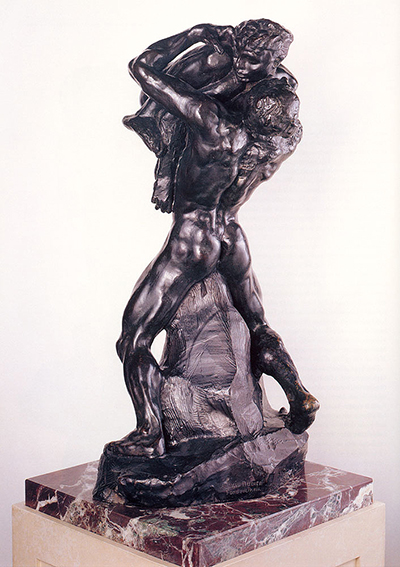
In Auguste Rodin’s I Am Beautiful, a man raises a woman above his shoulders. His legs open around a rough support while her limbs fold into the small space between his arms. The lift is visible from behind, where the slope of the back leads towards the cluster of heads, limbs and hands. Rodin made the pair in connection with The Gates of Hell, and it appears near the upper right of the doorway. The title comes from the opening of Charles Baudelaire’s poem Beauty. It gives the close physical encounter a voice that is absent from the gestures by themselves. [1] [2] [3]
The lift seen from behind
The man’s nearer foot takes up most of the ledge at the left. Follow the line up the calf and the knee turns outward before the thigh returns towards the centre. The leg on the right swings away on a diagonal. Its ankle is visible against the pale background, leaving an opening between the lower leg and the rock. From that point the body seems to gather itself inwards again. The wide stance leads to the narrow waist, which twists between the direction of the legs and the upward reach of the arms. This is easiest to see in the rear view, where the lifted figure covers relatively little of the lower back. [1] [2]
Above the waist, there are more overlaps. The man’s shoulder turns into the long diagonal of an arm, which crosses in front of forms that belong to the woman. Her head comes into view at the top of the group. The bend of her body is framed by the arms. The edges of individual limbs can be hard to distinguish amid the compact surfaces, but the outer silhouette makes the overall action clear. Below the man’s shoulders the body is stretched out and exposed. Above them the figure he supports is drawn into a small space. [1] [2]
The photographed bronze also shows why the rock matters. Its broad central surface rises between the legs, leaving the feet enough room to project on either side. Marks across it run in short ridges that are easy to see where the light falls obliquely. The shoulders and back, by comparison, carry longer reflections. This gives the eye a way to tell where the uneven support stops and the contours of the body take over. The stone slab beneath the bronze introduces a flat plane at the bottom of the image. It makes the backward angle of the body feel more pronounced by giving the viewer a clear horizontal reference. [1] [2]
Two figures brought together
The Musée Rodin describes the group as an assemblage associated with Crouching Woman and The Falling Man. The woman is turned so that her folded posture fills the space in the man’s arms. In her independent pose, the same compact movement can be understood through the relation of her hands and feet to the ground. Hoisted above the man, her weight appears to be borne entirely by another body. The man’s arched back, which can suggest recoil in an independent falling figure, acquires the appearance of strain as his arms reach around her. [1] [2]
The relationship of the models is clearer than their exact sequence. Philadelphia presents the work as the joining of two figures conceived for The Gates of Hell. The Musée Rodin’s dedicated doorway catalogue suggests that the independent falling figure may have emerged from the pair, since his hands still take a shape consistent with holding someone. Both readings can be tested against the sculpture. The arm seen bending away from the independent figure’s chest has a close visual relation to the arm that curves around the woman. How the viewer understands the gesture depends on whether the curve is filled by a body or opens onto empty space. [1] [2] [4]
In the full doorway the group’s shape has to register among several other bodies. The raised figure makes a concentrated mass at the top, and the relatively narrow waist below gives that mass a distinct outline. A separate bronze can be seen at a height that brings the shoulders and knees closer to the viewer. From there it is easier to examine the distribution of weight and to notice the opening between the man’s legs, where the rock takes up much of the interior. [1] [2]
Watch Rodin’s sculpture up close
Five films explore Rodin’s sculpture, from his use of classical models and the figures on his monumental doorway to the work of his studio.
Auguste Rodin – Challenging Beauty
Six sculptures show how Rodin adapted classical models.
Watch on YouTubeBaudelaire’s title and the independent versions
In Baudelaire’s Beauty, beauty speaks in the first person and compares herself to a dream of stone. The poem stresses stillness. The twist and lift of Rodin’s group give that language a different setting, in which physical effort is apparent. The National Museum of Western Art in Tokyo records an inscription from the poem on the front of its bronze, along with a Rodin signature and a foundry mark for Alexis Rudier. A viewer approaching the bronze from behind first sees the action. Coming round to the inscription provides another way to read the encounter. The Musée Rodin also lists titles such as The Abduction, which direct attention towards the nature of the lift and the relation between the two figures. [1] [3] [5]
The different titles also change where a viewer might look first. The title drawn from the poem encourages close attention to the woman, whose head inclines over the man’s shoulder. The name The Abduction gives greater weight to his movement and to the question of how the bodies came together. The rear view puts much of that action into the visible line of his back and supporting legs. [1] [3]
The Musée Rodin dates its plaster S.01292 to 1882 and gives its height as 69.8 centimetres. Philadelphia’s example was cast in 1925–26 from a model the museum dates to 1885. The Tokyo bronze is about 70 centimetres high. These records document specific objects and show why dates attached to one version need to stay with the museum record that supplies them. The rear view shows the group on a reddish veined slab, with few details of the front of the base. That angle limits the evidence for identifying the exact cast, but it shows clearly where the shoulders turn and how far the raised figure projects above them. [1] [2] [5]
The plaster that preserves the joins
In January 2021 the Musée Rodin acquired a plaster that it identifies as the original assemblage. Its examination found fresh-plaster joins between the figures’ chests and where the woman’s right arm meets the man’s left side. The joins on the man’s arms show that the sections were cut and repositioned to fit the figure he carries. The museum also found that the woman had been cut from an earlier base and that the surfaces that had attached her to it were reshaped in plaster. These observations give physical evidence for the changes between the separate figures and the group. Rodin could adjust the contact between two bodies by changing the limbs and the surfaces that met, while preserving much of the bend already present in each. [6]
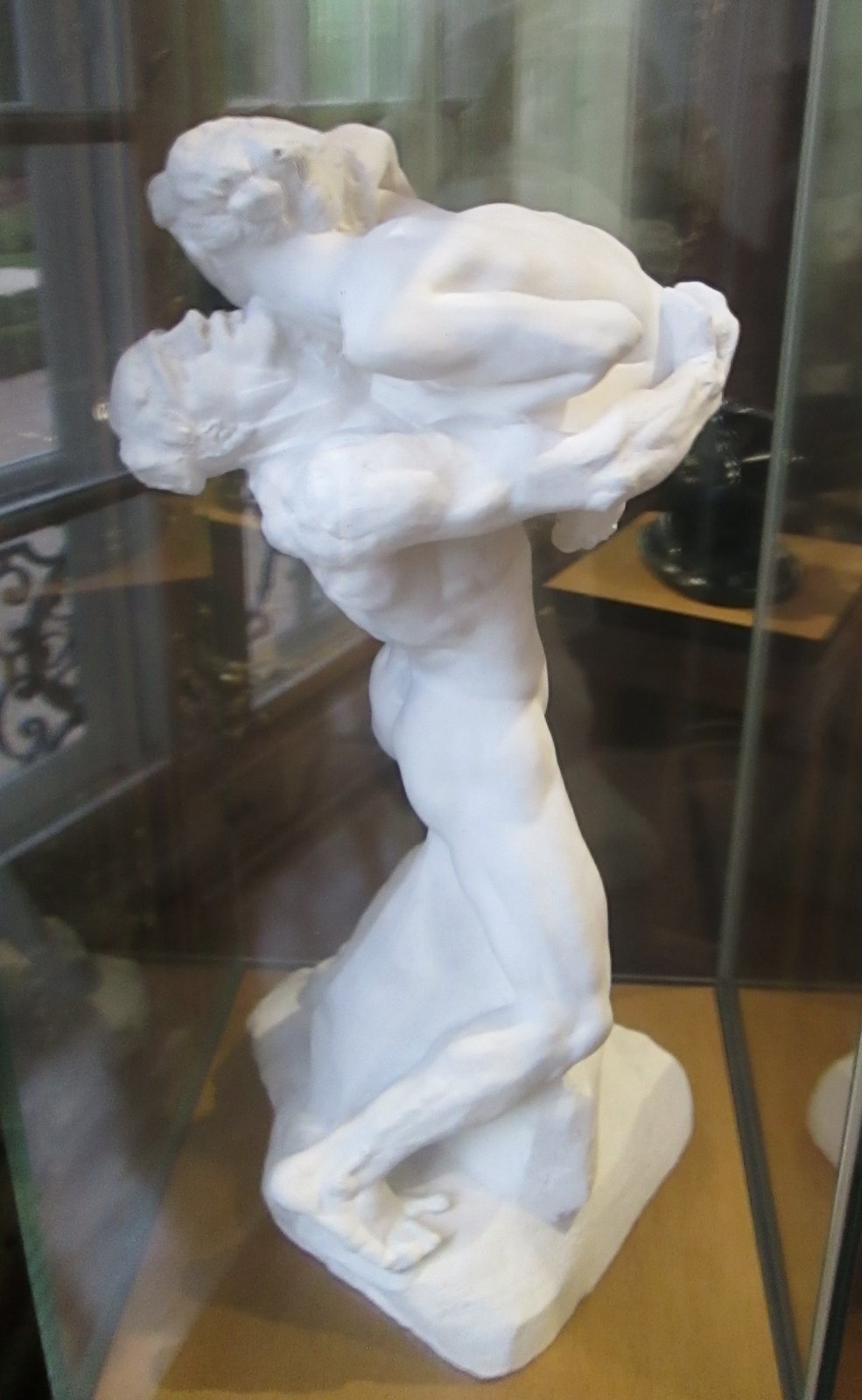
The Musée Rodin plaster shows how the curled figure sits against the supporting body. Photograph by Beyond My Ken, Wikimedia Commons. Image source. CC BY-SA 4.0. Resized for the web.
The acquired plaster also lacks the Baudelaire quatrain that the museum records on other examples. The first exhibition at the Galerie Georges Petit in 1886 gave the group no explicit title, but contemporary press accounts noted the lines on its base. A separate foundry plaster preserves the inscription and Rodin’s signature beneath the right knee. The two plasters therefore document both the assembly of the pose and the attachment of the literary text to the base in versions prepared for display or reproduction. [6] [7]
Rodin artworks directory
Discussion
Look again at the images and ideas explored in I am Beautiful. These editorial prompts invite your observations.
Reader Insights
After reading “The lift seen from behind”, what detail would you look for in the object or image?
What extra evidence would help you distinguish the artist’s choices from the effects of material, viewpoint or later display?
Join the Conversation
Share a detail, comparison or question about I am Beautiful below.
References
- Musée Rodin. I am Beautiful, S.01292. View source.
- Philadelphia Museum of Art. I Am Beautiful. View source.
- Brown University Library. Baudelaire and the Arts, La Beauté and Rodin. View source.
- Musée Rodin. L’Homme qui tombe, La Porte de l’Enfer. View source.
- National Museum of Western Art, Tokyo. I am Beautiful, S.1959-0028. View source.
- Musée Rodin. Je suis belle, original assemblage acquired in 2021. View source.
- Musée Rodin. Je suis belle, inscribed foundry model. View source.

 Auguste Rodin.jpg)





