


 by Tom Gurney
Tom Gurney BSc (Hons) is an art history expert with over 20 years experience
Published on June 19, 2020 / Updated on November 18, 2026
Email: tomgurney1@gmail.com / Phone: +44 7429 011000
Suzon
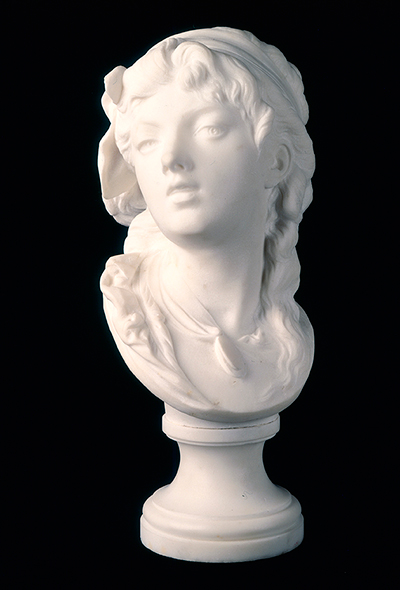
In Auguste Rodin’s Suzon, a young woman turns her head and looks slightly upwards. Her lips are parted. A ribbon gathers at one temple, while a long curl runs down the other side of her neck. The bust comes from Rodin’s years in Brussels, when he was working on architectural sculpture and modelling smaller decorative pieces. The Musée Rodin dates its plaster to 1872. The Compagnie des Bronzes in Brussels later obtained the rights to reproduce the bust in different materials and sizes. The pale example pictured here shows how much of the figure’s character depends on small changes in depth across the face and hair. [1] [2] [3]
The turn of the head
The face in the photograph is lit most strongly across the forehead and the raised plane of the cheek. The pupils are hard to distinguish at first because the surrounding surface is so pale. The shadows around the eyelids make the direction of the gaze clearer. Below them, the lips separate along a short dark line. The chin curves gently under the mouth, and the illuminated side of the jaw merges gradually into the neck. The scale of these transitions gives the face its animation. A slight turn towards the light is enough to change which eyelid and which corner of the mouth can be seen. [1] [3] [4]
The head also turns against the direction of the shoulders. The shallow bust extends to the left in the photograph, where folds close over the cut edge. On the other side the line of the shoulder is partly taken up by the hair. Together these forms pull the eye across the chest before bringing it back to the face. From a more lateral view, the distance that the curls project away from the neck becomes clearer. The Los Angeles County Museum of Art’s photographs of its bronze include rear and profile views, which show how the modelling continues past the contours visible in a frontal photograph. [1] [4]
Ribbon, hair and pedestal
The ribbon forms two raised shapes beside the face and then continues across the top of the head. Its flatter surface breaks the sequence of short curls above the forehead. At the other side the hair narrows near the ear before descending in a longer lock. The comparison between those two edges helps explain why the face seems to change as the bust is turned. On one side the forward ribbon stands clear of the brow. On the other the exposed ear and the long curl make it easier to follow the shape of the neck. The small fold visible at the front of the neckline gives the eye another point to pause before it reaches the support. [1] [4]
The pale bust in the photograph stands on a short circular pedestal with a narrow waist. Its bottom rings project and give the small sculpture a broad footing. The upper lip of the pedestal receives the rounded bottom of the chest. There, the continuous curve of the bust gives way to the straight horizontal edges of the support. The regular base keeps the sequence of asymmetric details above it legible. It also gives the viewer a point of reference for the angle at which the head lifts. The difference is especially apparent in a three-quarter view, where the rings are visible as nested curves below the turn of the neck. [1] [4]
Watch Rodin’s sculpture up close
Five films explore Rodin’s sculpture, from his use of classical models and the figures on his monumental doorway to the work of his studio.
Auguste Rodin – Challenging Beauty
Six sculptures show how Rodin adapted classical models.
Watch on YouTubeA decorative bust from Brussels
Rodin went to Brussels in 1871 to work with Albert-Ernest Carrier-Belleuse on the city’s stock exchange and remained in Belgium until 1877. The Metropolitan Museum of Art dates the modelling of Suzon and Dosia to 1872. Its account describes decorative figures and busts as part of Rodin’s output alongside sculpture intended for public buildings. A bust such as Suzon could be viewed at close quarters, making subtle changes in the surface of the eye or lip as important as an outline that would be visible from farther away. The Brooklyn Museum places it in the Neo-Rococo style Rodin practised at that time. The loops of the ribbon, the lightly worked clothing and the sideward turn of the face give that description concrete details to look for. [2] [3] [5]
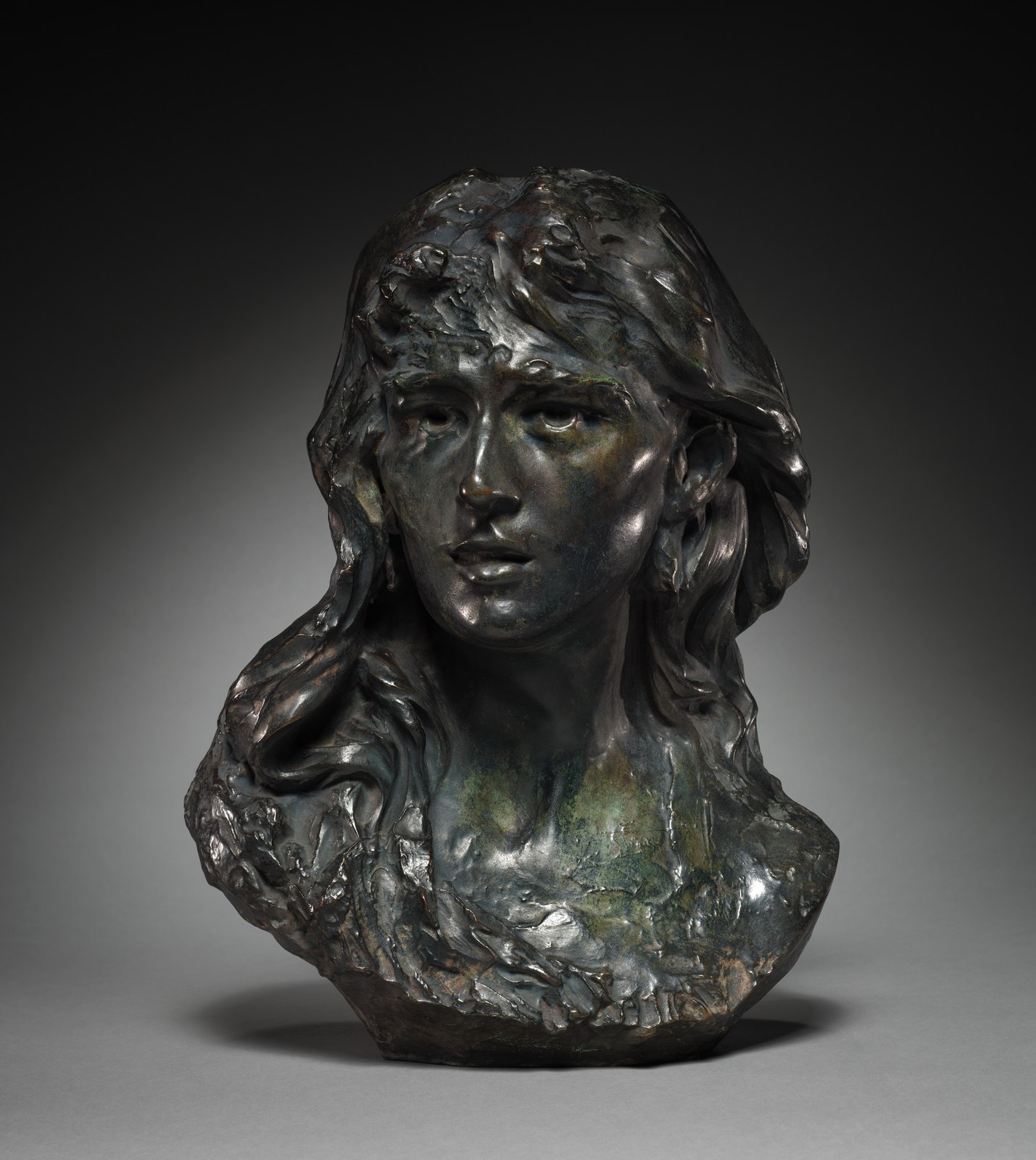
Rodin’s early bust of Rose Beuret, known as Mignon, gives a comparison for the smaller decorative portrait format. The Cleveland Museum of Art, In memory of Ralph King, gift of Mrs. Ralph King; Ralph T. Woods, Charles G. King; and Frances King Schafer, 1946.351. Image source. CC0 / Public domain. Resized for the web.
The Musée d’Ixelles dates Rodin’s reproduction contract with the Compagnie des Bronzes to 1875. The agreement permitted production in several materials and sizes, and the Brooklyn Museum records that the company continued reproducing the model until at least 1939. For a collector, the pose could therefore be familiar even if the finish and size of the bust differed from another example. The rounded chin and the raised ribbon still locate the turn of the head in a smaller version. A change of material affects the way that movement registers, particularly where a finish makes the ridges of the hair more reflective than the area around the eyes. [3] [6]
Distinguishing the versions
The Musée Rodin catalogues S.01845 as a plaster moulded from marble, mounted on a pedestal and measuring 43.5 centimetres in height. It records a signature beneath the right shoulder. The Brooklyn Museum’s bronze stands 40.6 centimetres high and carries a signature on the left shoulder, along with the number 7347 at the lower edge of the back. The dates attached to that bronze distinguish the early design from the period in which the company cast the example. The bronze at the Los Angeles County Museum of Art provides a further comparison, with its warm metallic finish making the deeper creases around the ribbon and shoulders conspicuous. [1] [3] [4]
The pale surface and dark backdrop in the legacy photograph put most of the emphasis on the modelling. Light spreads across the forehead and is interrupted where the ribbon projects, and it falls more sharply across the ring at the bottom of the chest. The visible shape agrees with the documented Suzon design. The photograph leaves the exact object and its material open, since pale examples can share a similar profile and the identifying marks are outside this view. The lifted eyes, short shadows at the mouth and fall of the hair can still be read clearly enough to follow how Rodin gave the bust its movement. At the temple, a narrow shadow separates the ribbon from the forehead. [1] [3] [4]
A Brussels bronze with its own pedestal
The Musée Rodin’s bronze S.00961 was sand-cast by the Compagnie des Bronzes de Bruxelles before 1939. Its bust is 32.5 centimetres high, the same height that the museum records for a separate plaster, S.01621. The bronze also has a gilded bronze pedestal 11.5 centimetres high, which the museum measures and weighs separately. The pedestal lifts the figure into view and gives the lower part of the object a brighter finish than the bust. The plaster record helps put the overall proportions in perspective. The vertical distance from the pedestal to the face belongs to the presentation of this bronze as well as to the model of the sitter. [7] [8]
The bronze carries the foundry mark at the cut of the left shoulder and the number 3999 on the back. On the plaster S.01621 the museum records Rodin’s signature at the lower left. Moving around the two objects can therefore answer a different question from looking at the familiar ribbon and turn of the face. The sculpture’s contour helps recognise Suzon. The underside of a shoulder, the rear of the cast and the pedestal give evidence for identifying the individual object. [7] [8]
Rodin artworks directory
Discussion
Look again at the images and ideas explored in Suzon. These editorial prompts invite your observations.
Reader Insights
After reading “The turn of the head”, what detail would you look for in the object or image?
What extra evidence would help you distinguish the artist’s choices from the effects of material, viewpoint or later display?
Join the Conversation
Share a detail, comparison or question about Suzon below.
References
- Musée Rodin. Suzon, S.01845. View source.
- Metropolitan Museum of Art. Auguste Rodin, 1840–1917. View source.
- Brooklyn Museum. Suzon, 84.75.11. View source.
- Los Angeles County Museum of Art. Suzon. View source.
- Metropolitan Museum of Art. Rodin: The B. Gerald Cantor Collection, chronology. View source.
- Musée d’Ixelles. Suzon. View source.
- Musée Rodin. Suzon, Brussels bronze S.00961. View source.
- Musée Rodin. Suzon, plaster S.01621. View source.

 Auguste Rodin.jpg)





