


 by Tom Gurney
Tom Gurney BSc (Hons) is an art history expert with over 20 years experience
Published on June 19, 2020 / Updated on November 18, 2026
Email: tomgurney1@gmail.com / Phone: +44 7429 011000
Danaid
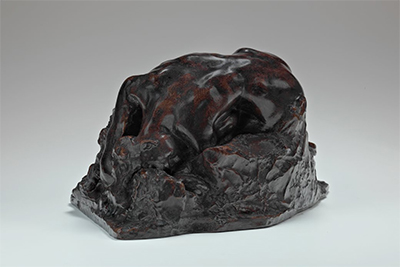
A woman curls over a rocky surface in Auguste Rodin’s Danaïd. The back rises high above the head and then drops towards the hair, which spreads across the support. In some views the face is difficult to locate. The easiest line to follow is the one that rises over the shoulders and continues down past the head. The Musée Rodin dates the conception to around 1885, when Rodin was working on The Gates of Hell. The figure was left out of the final doorway and acquired an independent life. The museum’s marble was carved by Jean Escoula and shown at the Salon in 1890. [1] [2]
A body close to the ground
In the dark bronze view, the upper part of the back catches a long, uneven band of light. It is possible to follow that band for some distance before the shoulder and the rock begin to look almost continuous. A deep shadow below the raised part of the figure helps separate the body from the support. The nearer edge of the base has a different rhythm. It takes several short turns before it reaches the ground. These two lines give an impression of how far the body has folded over itself, even when the limbs are partly covered by the surrounding mass. [1] [3]
The lowering of the head changes the way the whole figure reads. A standing or seated figure can give its direction through a gaze. Here the curve through the neck and the spread of the hair supply much of that information. Near the support, individual strands become hard to distinguish from the modelling alongside them. Look at the small intervals between the main locks, then at how the surfaces change beyond them. The body reaches the ground by degrees. From another angle the point at which the head meets the base may become easier to find, while the broad sweep of the back becomes shorter in perspective. [1] [2] [3]
The vessel associated with the myth is low within the composition. The Metropolitan Museum’s catalogue describes it under the woman’s arm. Its position matters when looking at the figure. A prominently displayed jar could make the story immediately recognisable. Here the back and shoulders first give an impression of someone folded into the rock. The vessel helps account for the posture after that impression has registered. Viewers may notice it at different times, depending on how far around the sculpture they can move and what the light makes visible close to the base. [1] [2]
The punishment of the Danaids
In the account preserved by Hyginus, Danaus’s daughters kill their husbands at their father’s command. Hypermnestra alone spares her husband, Lynceus. The other daughters must pour water into a pierced vessel in the underworld. The punishment depends on repetition, since their work never brings them closer to filling it. Rodin’s composition concentrates on one woman, with her weight close to the ground and the vessel beside her. The spectator can imagine the task from the title and attribute, while the curve of the body allows space for fatigue and for a pause within a story of ceaseless labour. [1] [2] [4]
The Musée Rodin records The Spring as another title. It shifts attention towards water and the appearance of the figure within the rock. The way the hair spreads gives a visible starting point for that reading, especially in the marble, where the smooth body and the broken support have distinct surfaces even though they share a colour. The two titles place different emphasis on the same parts. Danaïd gives the vessel and the folded figure a place in a story. The Spring encourages the eye to follow the hair and its movement across the material. [1] [5]
Watch Rodin’s sculpture up close
Five films explore Rodin’s sculpture, from his use of classical models and the figures on his monumental doorway to the work of his studio.
Auguste Rodin – Challenging Beauty
Six sculptures show how Rodin adapted classical models.
Watch on YouTubeEscoula’s marble and the later bronzes
The Musée d’Orsay’s record names Escoula as the practitioner and dates work on the marble to 1889–90. The Musée Rodin draws attention to the finish he achieved, with polished flesh against a block that retains traces of the tools. From the back, that change is visible along a large part of the figure. Follow the broad surface of the body until it reaches the smaller ridges of the block. The reflected light stays fairly continuous across the polished passage and breaks into short marks over the base. The distinction makes the body appear to emerge from the stone even where the two are closely joined. [1] [5] [6]
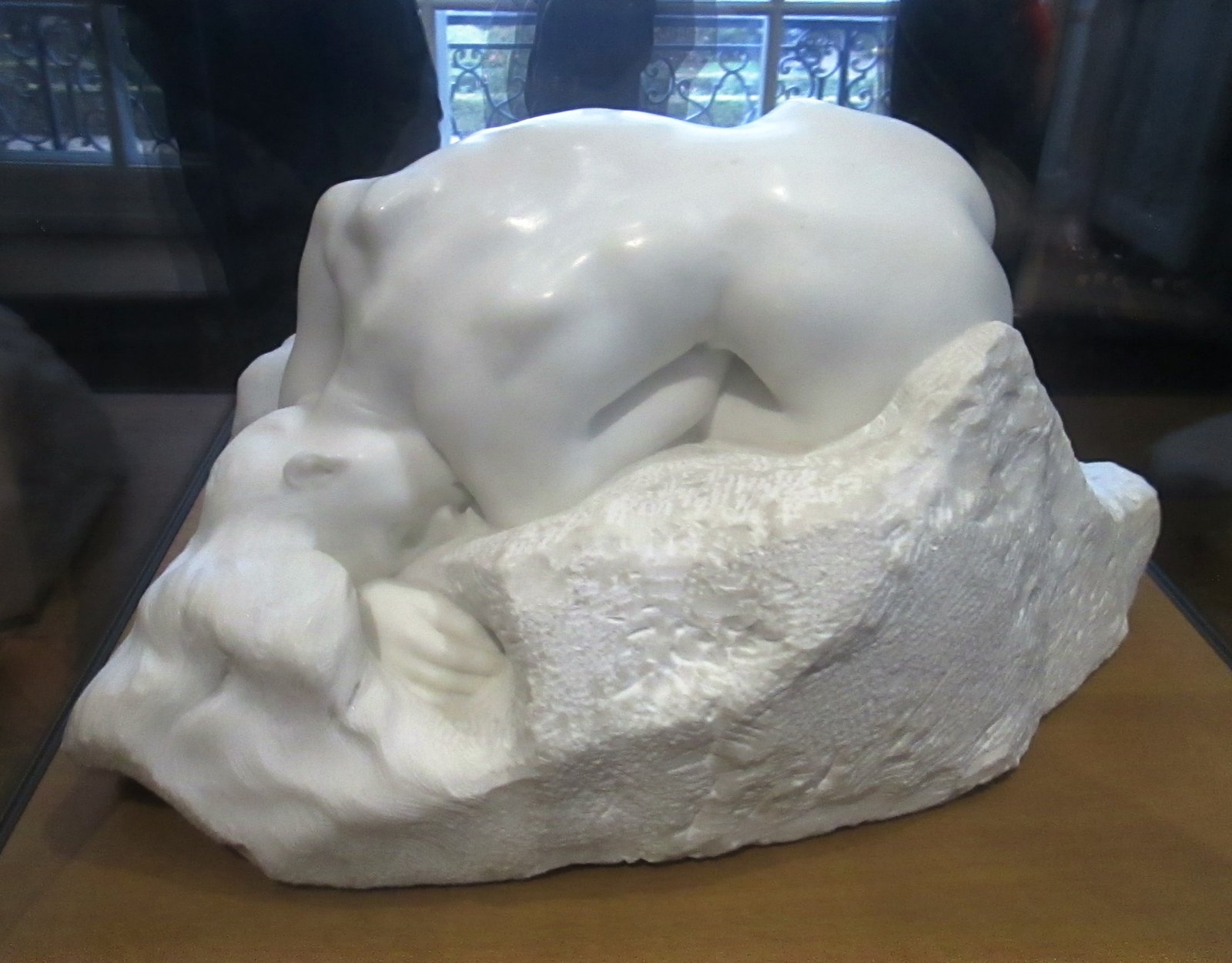
The Musée Rodin marble shows how the figure’s back and hair run into the surrounding stone. Photograph by Beyond My Ken, Wikimedia Commons. Image source. CC BY-SA 4.0. Resized for the web.
The Musée du Luxembourg acquired the marble after its appearance at the Salon of the Société Nationale des Beaux-Arts in 1890. Other institutions have examples with their own histories of manufacture and acquisition. Princeton records a marble carved in 1903–04 from a design it places in the 1880s. LACMA identifies its bronze as a cast made in 1967, numbered four of twelve. The French national collections database records a small bronze as well as the large Paris marble. A date for a stone carving or bronze cast belongs to that object, while the model dates refer to the development of the shared composition. [1] [3] [6] [7] [8]
The title also appears in the history of a different reclining figure. The Museo Nacional de Bellas Artes in Buenos Aires catalogues its marble as Andromède and gives La Danaide as a former title. Compare the turn of the head in the two designs. The Philadelphia Andromeda brings the face up, with a gap between the upper body and the rock. Here the head drops towards the support. Both figures curl over stone, and that difference in the neck gives a way to tell the poses apart. [1] [9] [10]
In comparing a bronze and a marble, start with the long curve through the shoulders, then move down to the edges of the base. The darker bronze may leave the lower parts of the face in heavy shadow, especially if the light is high. A lighter marble can make the boundary between the head and the rock easier to see, while its polished back supplies a different quality of reflection. The material and the position of the light affect how quickly the observer recognises what is happening. In a view that puts the back at the centre, the way the figure lowers towards the base becomes clear well before the face or the vessel does. [1] [3] [7]
The jug in the Princeton marble
The Princeton marble is 23 centimetres high on a base measuring 40 by 26 centimetres. Its catalogue locates Rodin’s signature on the side of the base below the falling water. That description offers a route through the sculpture from the figure to its setting. Start at the upper curve of the back, and then follow the body down towards the jug and the place where the water reaches the lower edge. Princeton’s account reads the water as spilling away from the exhausted figure. The sequence ties the pose to the repeated task that gives the work its subject. [4] [7]
The museum traces this marble to Adolph Lewisohn in New York by at least 1928. It passed to his son Sam and entered Princeton’s collection through his bequest in 1954. That history belongs to a version carved in 1903–04. The earlier Paris marble entered a French public collection after the 1890 Salon. Following the two marbles separately makes it possible to trace the design’s public reception through both exhibition and private collecting. [6] [7]
Rodin artworks directory
Discussion
Look again at the images and ideas explored in Danaid. These editorial prompts invite your observations.
Reader Insights
After reading “A body close to the ground”, what detail would you look for in the object or image?
What extra evidence would help you distinguish the artist’s choices from the effects of material, viewpoint or later display?
Join the Conversation
Share a detail, comparison or question about Danaid below.
References
- Musée Rodin. Danaïd. View source.
- Metropolitan Museum of Art. Rodin: The B. Gerald Cantor Collection, Danaïd entry. View source.
- Los Angeles County Museum of Art. Danaïd, M.73.108.15. View source.
- Hyginus. Fabulae, 168, translated at Brigham Young University. View source.
- Musée Rodin. La Danaïde. View source.
- Musée d’Orsay. Danaïde. View source.
- Princeton University Art Museum. Danaid. View source.
- French Ministry of Culture. Danaïde, bronze S 606. Joconde. View source.
- Museo Nacional de Bellas Artes. Andromède, inventory 7764. View source.
- Philadelphia Museum of Art. Andromeda. View source.

 Auguste Rodin.jpg)





