


 by Tom Gurney
Tom Gurney BSc (Hons) is an art history expert with over 20 years experience
Published on June 19, 2020 / Updated on November 18, 2026
Email: tomgurney1@gmail.com / Phone: +44 7429 011000
Photographs
In Eugène Druet’s photograph of The Clenched Hand, a bronze emerges from folds of white cloth. The fingers and wrist seem to belong to something much larger, and a second image intrudes at the edge. The Metropolitan Museum of Art identifies that second image as a view of Rodin’s monument to Victor Hugo. Neither sculpture would look quite this way on a pedestal under ordinary gallery light. Druet’s print makes it possible to see the imagination of a photographer at work on forms Rodin had made. The two men’s signatures appear on the negative. It is a particularly vivid example of the overlapping responsibilities that make a photograph of a sculpture worth studying in its own right. [1]
What a photograph could do in the studio
Rodin used photographs to look again at works he was still making. An image holds a particular view steady. A sculptor can see whether a head appears to have enough room around it, or decide where a shadow separates one limb from another. Once it is printed, he can work on that view with a pencil, pen or brush. The Musée Rodin records many such interventions. Sometimes they were instructions for a photographer or an engraver, such as a suggestion that a shadow should be strengthened. In other cases, the marks record a line of thought about the sculpture itself. [2]
These uses could overlap. A print selected for publication might be changed partly to help the image read more clearly, and a print marked up in the studio might help the sculptor imagine a revised arrangement. The altered photograph of Young Girl Embraced by a Marble Ghost is one of the Musée Rodin’s examples. The photographer, Druet, had already chosen how the figures would register on paper. Rodin could look at the resulting image as a surface to work on. The photograph records a state of a sculpture and a moment in the effort to decide what should happen next. [2]
Photographs of Rodin and his work
 1898.jpg)
 taken by Pierre Choumoff.jpg)
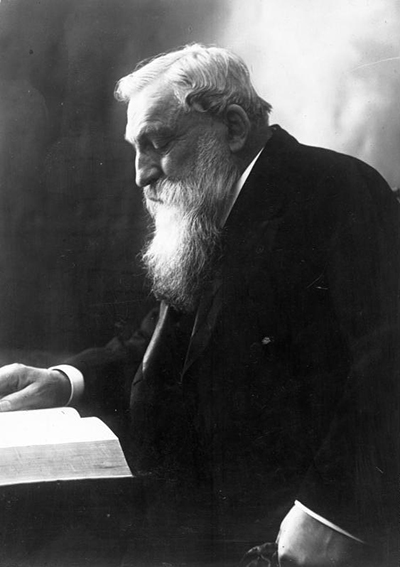
 taken by Alphonse Eugene Druet.jpg)
Pictures of people at work
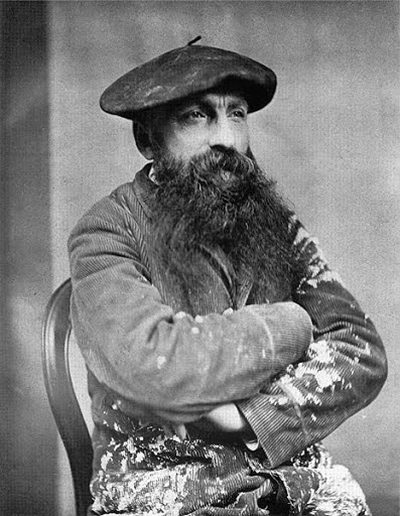
In Dornac’s photograph of Rodin seated at the Dépôt des marbres, the sitter shares his surroundings with a plaster for the monument to Victor Hugo. The Musée Rodin dates its albumen print Ph.00179 to around July 1898. The photograph gives some sense of how much space the sculpture occupied in the workshop. A cropped image changes the relationship between the seated man and the objects around him. The Buenos Aires exhibition catalogue notes that a wider view reveals an assistant as well as the plaster. A photograph used to advertise an individual artistic personality can at the same time offer evidence of the space and labour around him. [3] [4]
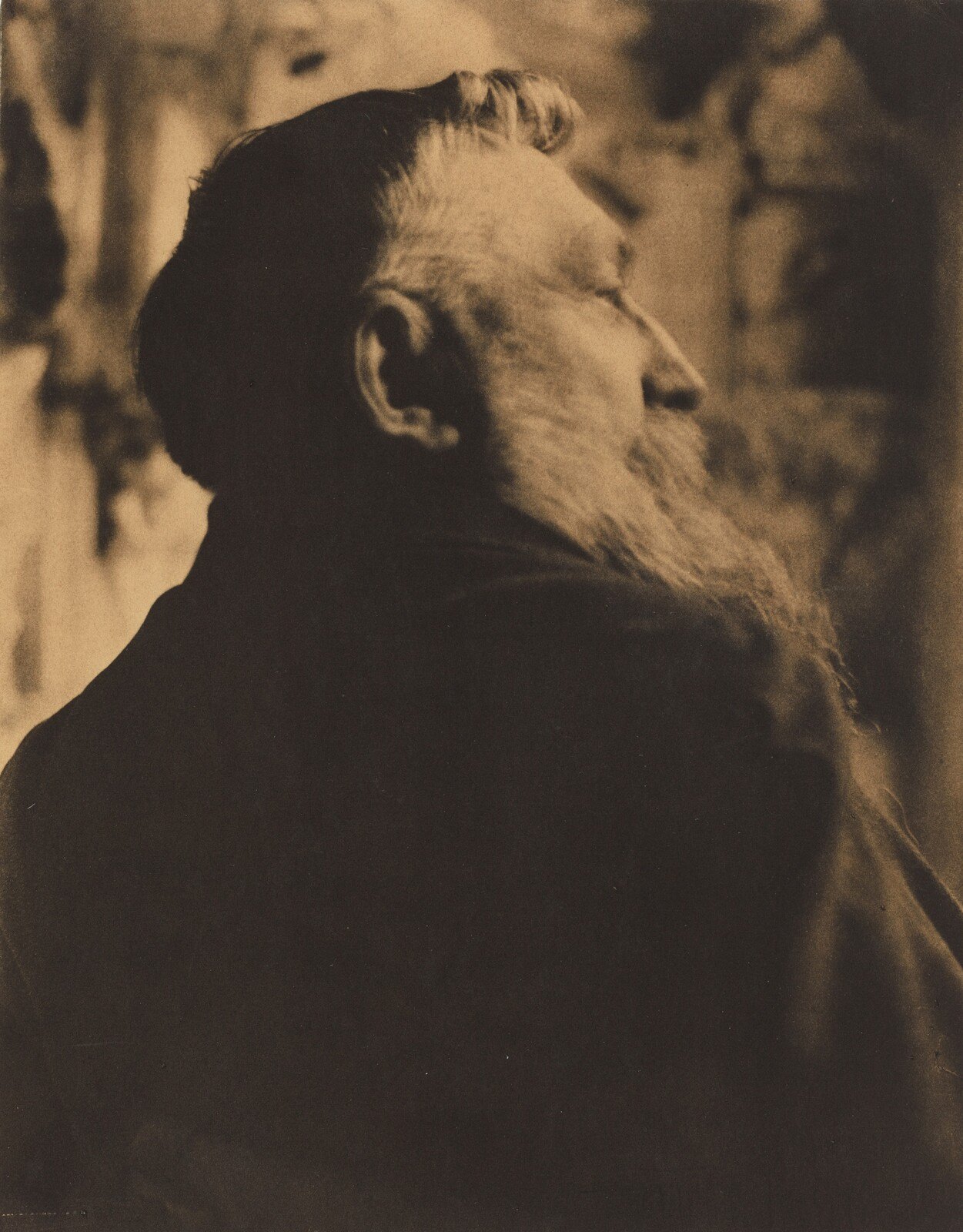
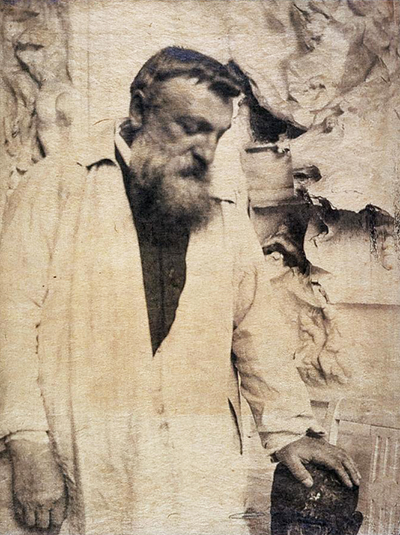
Gertrude Käsebier’s portrait adds another photographer’s interpretation of Rodin to the cluster. National Gallery of Art, Washington, Patrons’ Permanent Fund, 2008.65.13. Image source. CC0 / Public domain.
The documents that preserve a portrait can be as revealing as the image. A date can refer to the sitting, to a negative, or to the making of the particular print in a collection. A portrait of Rodin by Gertrude Käsebier in the Princeton University Art Museum is associated with her visit to Paris in September 1905. At first glance it belongs with many other images of the bearded sculptor. The museum record connects it to an introduction through the photographer Adolf de Meyer and to Käsebier’s effort to catch Rodin absorbed in looking at a sculpture. Those circumstances give us something more specific to ask of the portrait than whether it resembles its sitter. [5]
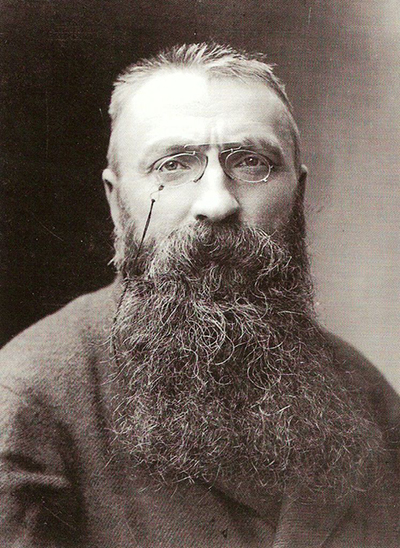
Pierre Choumoff’s photographs belong in part to the final years at Meudon. The Musée Rodin identifies a portrait taken there on 29 January 1917, the day Rodin married Rose Beuret. The dated record gives the image a context that an uncaptioned portrait of the elderly sculptor would lose. It also provides a point of comparison when assessing other photographs attributed to Choumoff or loosely dated to Rodin’s last years. [8]
Watch Rodin’s sculpture up close
Five films explore Rodin’s sculpture, from his use of classical models and the figures on his monumental doorway to the work of his studio.
Auguste Rodin – Challenging Beauty
Six sculptures show how Rodin adapted classical models.
Watch on YouTubeFrom the studio to an exhibition
Druet’s collaboration with Rodin was particularly visible in the sculptor’s 1900 retrospective at the Pavillon de l’Alma. The Met records that the show included seventy-one of his photographs. Their presence meant that someone could encounter a sculpture as a physical object and see it from a position a photographer had chosen. That position might draw attention to a passage of modelling that was hard to see in the exhibition. Photographs could also make forms available that were elsewhere, or preserve a view of a work at a stage that had already passed. [1] [2]
The channels by which those images reached people mattered. In 1903 Jacques-Ernest Bulloz published a portfolio of reproductions of Rodin’s sculpture. A portfolio gives a reader the possibility of moving through a set of works at their own pace and placing different views beside one another. It adds a publishing history to the object’s history. A reader tracing a photograph of The Burghers of Calais or another public sculpture can begin by checking the photographer and the print, then ask whether it shows a plaster in the studio or a bronze in one of several installations. A title that identifies the group still leaves those questions open. [2] [6]
A plaster in the moonlight
Edward Steichen photographed the Balzac plaster outside at Meudon in 1908. His use of moonlight gave the figure an atmosphere very different from its display at the Salon a decade earlier. The robe could become a paler mass against a dark field, with the head and body partly gathered into shadow. Alfred Stieglitz showed the photographs in New York in 1909 and published them in Camera Work in 1911. The plaster had found a new audience long before some of the bronze casts familiar to museum visitors today. A print of one of Steichen’s night views bears its own date and history of circulation. It also records the state and material of the work available to him at Meudon. [7]
Rodin’s photographs repay a comparison at the level of the individual print. A studio portrait can tell us how a sculpture stood among other people and objects. A close view of a hand can make the surface unfamiliar. Another photograph can show how a monument changes when seen outside against the night. When you encounter a reproductive image, ask who put the camera there, what was in front of it, and what may have been taken out of view. Those questions can uncover a story about the sculpture as well as one about the photograph. [1] [3] [6] [7]
The model and the plaster as evidence
When critics accused Rodin of taking a cast directly from the living model for The Age of Bronze, he commissioned Gaudenzio Marconi to photograph both the plaster and the sitter, Auguste Neyt. The Musée Rodin identifies Ph.00270 as one of Marconi’s photographs of Neyt from 1877. A picture of Neyt alone could document a pose. In the dispute its purpose was to be read beside photographs of the plaster, where viewers could compare the way the sculpted figure carried its weight and how the limbs related to the torso. The museum notes that Rodin made his case through photographs rather than by producing a life cast to set alongside the sculpture. [2] [9]
Marconi also supplied photographs for art students, and the museum illustrates the range of Rodin’s holdings with another Marconi print, Ph.09109, a study of a nude male model seen from behind around 1870. The two photographs have different roles in the archive. The image of Neyt belongs to the record of a particular work and a public dispute. The rear-view study belongs to the stock of reference images a sculptor could consult when thinking about a pose. Subject and medium alone would leave that difference hard to see. [9]
Rodin artworks directory
Discussion
Look again at the images and ideas explored in Photographs. These editorial prompts invite your observations.
Reader Insights
After reading “What a photograph could do in the studio”, what detail would you look for in the object or image?
What extra evidence would help you distinguish the artist’s choices from the effects of material, viewpoint or later display?
Join the Conversation
Share a detail, comparison or question about Photographs below.
References
- The Metropolitan Museum of Art. Eugène Druet, Auguste Rodin’s The Clenched Hand. View source.
- Musée Rodin. Rodin et la photographie. View source.
- Musée Rodin. Rodin assis dans son atelier devant le Monument à Victor Hugo, Ph.00179. View source.
- Museo Nacional de Bellas Artes. Rodin: centenario en Bellas Artes. View source.
- Princeton University Art Museum. Gertrude Käsebier, Auguste Rodin. View source.
- Musée Rodin. Photographies. View source.
- Musée Rodin. Rodin and Steichen. View source.
- Musée Rodin. Portrait de Rodin le jour de son mariage. View source.
- Musée Rodin. Rodin and photography, Marconi and the photographic archive. View source.

 Auguste Rodin.jpg)





