



 by Tom Gurney
Tom Gurney BSc (Hons) is an art history expert with over 20 years experience
Published on June 19, 2020 / Updated on November 18, 2026
Email: tomgurney1@gmail.com / Phone: +44 7429 011000
The Walking Man
The front foot in Auguste Rodin’s The Walking Man has already found the ground. The back foot is still there too. Look from the side and you can follow the distance between them, then see the torso swing forward over that opening. The figure has no arms to balance it and no head to look in the direction of travel. Its movement depends on the angle at which the body is set on the legs, the reach of the stride and the way the feet bear against the base. There is enough in those relationships to make a heavy bronze seem about to go on walking. [1] [2]
From Saint John to a new figure
The torso and legs came out of studies associated with Saint John the Baptist. The Musée Rodin traces them to work begun in the late 1870s, then distinguishes that early modelling from the assembly of the figure around the turn of the century. A torso that had acquired cracks while stored in the studio could be put back to work. Rodin brought it together with legs from another study. That history matters to what you see at the waist, where one part appears to sit unevenly on the other. The shift between them gives the chest a slight turn and makes its forward weight more noticeable. [1] [3]
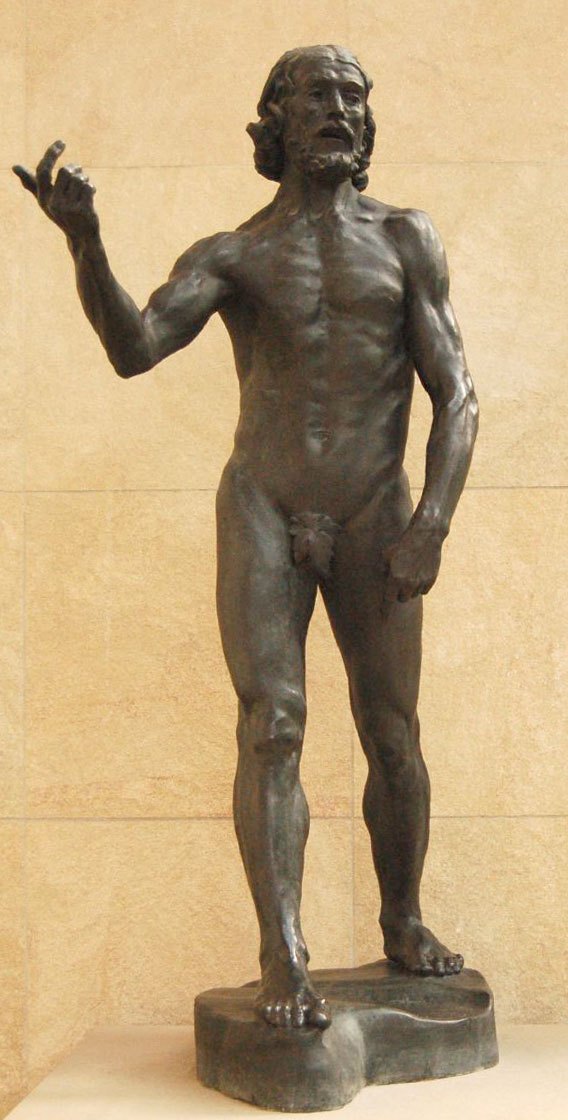
Compare the placement of the feet in Saint John with the later headless figure. Photograph by Maarten, Wikimedia Commons. Image source. CC BY 2.0. Resized for the web.
The full figure of Saint John offers a useful comparison. His arms participate in a public address. The relation of the head to the limbs helps establish that he is speaking or making himself heard somewhere beyond the figure’s immediate space. Take away the head and arms, as in the later work, and the main evidence for what is happening lies in how the figure stands and how it might move. Any association with Saint John depends on knowing its workshop history. What a visitor can see without that knowledge is a body in the course of a long step. [1] [2] [3]
The life of the torso on its own
The Petit Palais keeps a bronze called Male Torso, catalogued under PPS1256. Its account puts Rodin’s rediscovery of the damaged clay around 1887. A mould could preserve the cracks and uneven boundaries along with the shape of the chest. That made it possible to keep an object whose original material was vulnerable, while using the shape again in other materials. The bronze at the Petit Palais gives the torso a surface that can be followed right up to the place where the figure breaks off. The torso joined to the legs sets up a different expectation. The eye follows the modelling downwards and has to make sense of the interruption at the waist before it can continue towards the knee. The visual force of that irregularity depended partly on Rodin keeping evidence of what had happened to an earlier study. [1] [11] [12]
The object records describe the same history at different levels of certainty. The Meudon account identifies the torso and legs as studies for Saint John. The detailed catalogue of the Musée Rodin bronze qualifies the original purpose of the torso as probable. That distinction matters because we know how Rodin used the fragment later, even if its earliest role is harder to establish. The Petit Palais bronze is evidence that the form had a life of its own. Its existence allows a comparison of motifs without requiring the Paris bronze to have supplied the physical torso that went into the assembly. Plaster and bronze are separate ways of preserving the form, and the early clay can be discussed as the source of relationships visible in both. [6] [11] [13]
Both feet on the ground
The connection to Saint John was something the first audiences could follow through public exhibitions. The complete bronze now at the Musée d’Orsay was entered in the 1881 Salon and reached the Musée du Luxembourg in 1884. In 1900 the Alma catalogue identified the new plaster as a study for the Luxembourg statue. For anyone who knew the earlier bronze, the reference made it possible to compare a figure that seemed to address someone with one that had no means of speaking. The two works could also be read through their feet. In each, the wide distance between the points of support shows the body already engaged in moving forward. The later figure asks how much action remains legible when features that ordinarily carry expression are taken away. [4] [7]
The torso also had a public history before it appeared on these legs. The curators of the 2017 Rodin centenary trace a study of the torso for Saint John to the 1889 joint exhibition with Claude Monet. They identify it as the model subsequently known as Torso of The Walking Man. The study invited its first audience to pay attention to a part of a body on its own. Joining a torso to legs changes the terms of that attention. The upper body now has a direction relative to the forward knee and to the rectangle of the base. The twist visible at the waist is a relation between forms. The same turn in an isolated torso can be read against its own shoulders and lower edge. The catalogue history connects those two encounters without requiring the object displayed in 1889 and the assembled plaster displayed in 1900 to have been the same physical exhibit. [1] [3] [8]
One way to look at the bronze is to begin with the feet rather than the fractured upper edge. An actual step moves weight forward through a sequence of positions. In the bronze you can examine the beginning and end of a stride at the same time. The Met’s collection history draws attention to Rodin’s use of both feet in contact with the ground to convey movement. As the eye travels from the extended back leg to the forward foot, there is movement in the act of looking. The stable footprint lets the torso lean well forward, and the strain in the hips links a fixed base to a shape that seems to be changing. [2] [4]
Different views make that action more or less apparent. Directly in front of the figure, one leg can partially hide the other. A view from the side opens the gap and makes the stride easier to measure by eye. From the back, the contour of the waist and the uneven top of the fragment can command more attention than either foot. The bronze allows the spectator to switch between those views. The sculpture’s subject may be a single step, but the time it takes to see that step depends on how you move around the object. [1] [2] [5]
The plaster at the Alma
Rodin showed a plaster at the Pavillon de l’Alma in 1900, during the year of the Paris Exposition Universelle. The catalogue described it in connection with Saint John. According to the Musée Rodin, the figure stood on a tall plaster column. Height could make the broad separation of the legs stand out against the space around it, but it also meant that visitors saw the broken edge of the torso from below. The way the sculpture was exhibited is part of what those first viewers encountered. An indoor bronze displayed near the floor gives the eye a much clearer route from the figure’s stance to the join between its parts. [3] [4]
Rodin later had Henri Lebossé enlarge the work in 1905–06. The Musée Rodin links that large form to the exhibition of L’Homme qui marche at the Salon of the Société nationale des beaux-arts in 1907. The new title draws attention to an ordinary action, and the larger size gives it an extraordinary presence. A big figure appears to have an even longer distance to carry its weight, while the lean of the torso can be read across a room. The enlargement makes the join and the fragmentary upper outline part of a public sculpture. Features that could still connect the earlier plaster with a studio study now help give the independent work its shape. [3] [6]
Working out what enlargement would change
The Musée Rodin dates Rodin’s collaboration with Henri Lebossé to 1894 and explains the use of a sculptor’s pantograph. The operator traced a contour on the model with a point. An articulated arm transmitted the movement at a different scale to another point working against a softer material. That gave the enlargement proportions taken from the earlier object. It also gave Rodin a new surface on which to judge whether the proportions did what he wanted. At monumental scale the shoulder, hips and legs can be spread across a viewer’s field of vision. A bend small enough to pass quickly at the size of a statuette may now need to hold together across a much broader area. The museum describes the possibility of adjusting volumes after mechanical enlargement, without specifying adjustments for every passage of this figure. [3] [14]
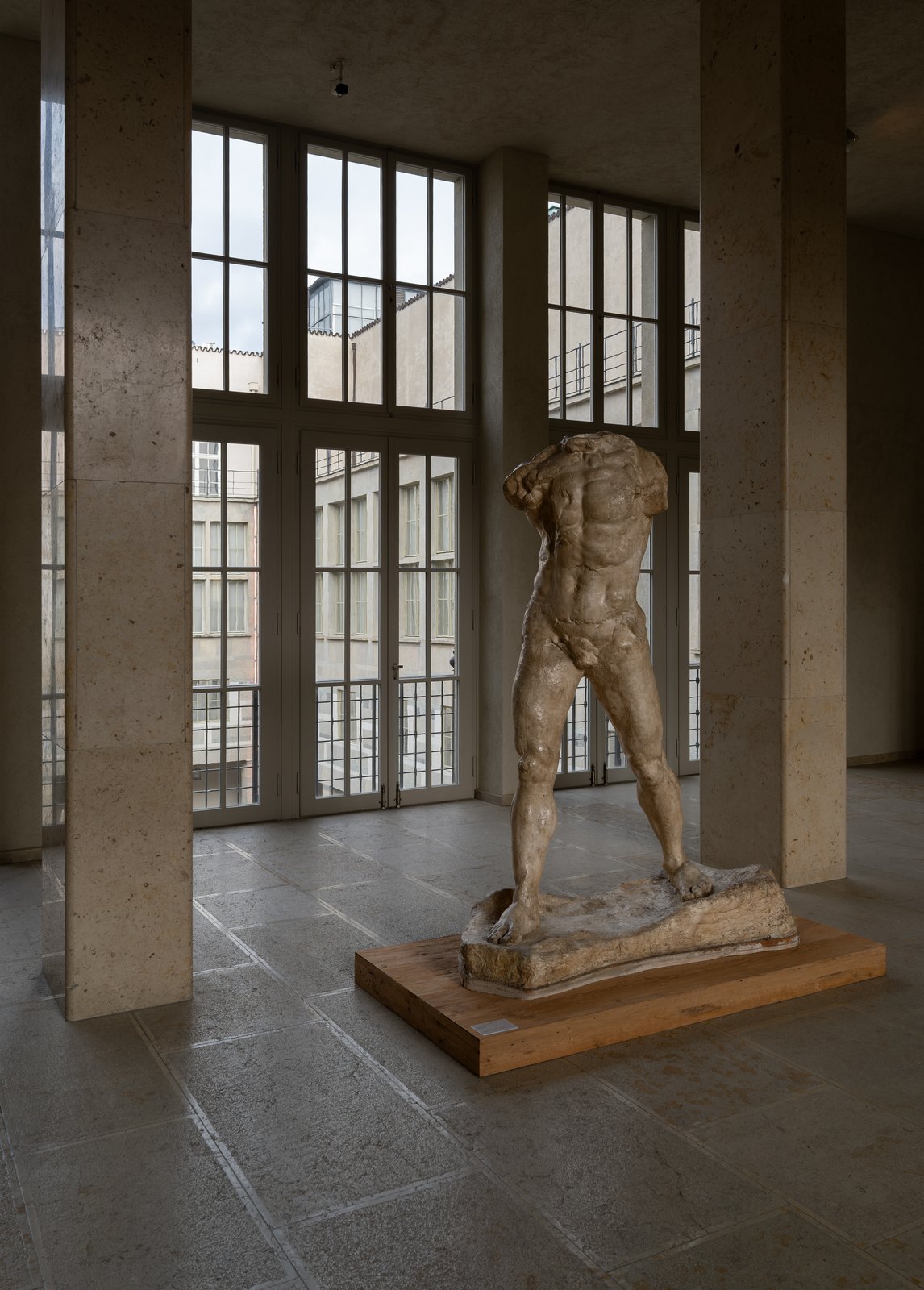
The plaster shown at Basel lets the viewer follow the stance in a material that gives the contours a different emphasis from the bronzes. Photograph by Jules Verne Times Two, Wikimedia Commons. Image source. CC BY-SA 4.0. Resized for the web.
One photograph fixes a moment before that enlargement. The Musée Rodin dates a carbon print by Haweis and Coles to 1903–04 and locates the plaster it depicts in the garden of the Villa des Brillants. Its date makes it evidence for the earlier scale. Its setting shows that before the large Salon plaster appeared, the sculpture could already be taken out of an interior and photographed at Meudon. The print has dimensions of its own and sits on a larger mount. These are measurements of the photographic object. The plaster’s scale and the garden’s scale have to be read from the identification and circumstances of the sitting. [6] [15]
The large plasters also have distinct catalogue histories. Meudon lists S.00164, dated 1907, at 214 centimetres high. The collection database records S.05715 as a patinated plaster foundry model at 218.3 centimetres. A third plaster, S.05716, is recorded as taken from its mould in 1987. The same title and very similar heights could therefore describe plasters produced for different purposes or far apart in time. An accession number gives a firmer starting point for comparing views and surfaces. In particular, a plaster recorded as a foundry model had a practical role in transferring a form to another material. Its patinated surface is part of the history of that plaster, alongside the finish of whatever bronze someone wants to compare with it. [6] [16] [17]
The column that supported the small figure at the Alma also made a difference to the movement Rodin wanted viewers to see. In its study of Rodin and antiquity the Musée Rodin notes how the figure’s feet overhang the narrow space available at the top. A column gives the figure enough height to stand out in a crowded exhibition, yet affords it very little apparent ground on which to go on walking. The support can make the legs look more exposed and the step more precarious. By contrast, the monumental bronze’s base is itself a visible part of the work, large enough to register against the flooring of a gallery or the paving in a courtyard. An enlargement changes how the figure occupies space, and the choice of support changes how much space it appears to have left in which to move. [6] [12] [13]
Bronzes at different scales
The Musée Rodin’s monumental bronze, S.998, is over two metres high and was cast by Alexis Rudier in 1913. The Met’s 85.1-centimetre bronze, 40.12.4, was cast before 1914, also by Rudier. Elizabeth Robinson commissioned the smaller cast. Its base carries Rodin’s dedication to her, which names the domestic setting where he expected it to be seen. The foundry name links the two examples. Their sizes and uses give each of them a different relation to the body of the viewer. The Met bronze can be taken in from close range. The Paris example makes the width of the stride something the visitor can judge against their own step. [1] [2]
The green patina of the Met bronze also belongs to that particular object. Its catalogue photographs show where the bronze surface gathers light on the shoulder and thigh, while the hollow at the upper edge reads quite differently from the surrounding planes. A viewer looking at the column-mounted plaster at the Alma would have had a different view of that edge as well as a different surface to read. [2] [3]
The National Gallery of Art gives a probable date of 1903 for its cast, with a much wider date range for the model. The casting estimate places that object before the monumental version appeared at the Salon. A museum label therefore may refer to the date of an early study, the assembly of a torso and legs, an enlargement or the casting of a particular bronze. The years belong to different parts of the work’s history. From an early small bronze to the large example in Paris, the same open span between the feet gives the figure its subject. At each scale there is something slightly different to see in the moment that the weight shifts. [1] [3] [5] [6]
The bronze that went to Rome
The large bronze now at Orsay has a different history from the 1913 example at the Musée Rodin. The Orsay files tie their cast to the public celebrations for the fiftieth anniversary of Italian unification. Four donors, Maurice Fenaille, Victor de Goloubeff, Joanny Peytel and Léon Grunbaum, gave the monument to the French state. It was placed in the courtyard of the Palazzo Farnese in Rome, the seat of the French embassy, in 1911. In that setting a visitor could see the sculpture from across an architectural space. The figure had no staff, scroll or other object to give an account of itself. Its claim on a ceremonial site came through its scale and the directional force of its stance. [9] [10]
The catalogue identifies where signatures are placed on the Orsay bronze. Rodin’s appears on the base near the left foot and the Alexis Rudier foundry mark on the edge beneath the right heel. Those positions give a way to check an identification when a photograph shows enough of the base. They also register separate contributions in the making of a bronze. The name tied to the modelling appears beside the name of the foundry that made the cast. A photograph taken from farther back, with the whole sculpture in view, can show the arrangement of the figure within the courtyard or garden while leaving those marks invisible. The history of the object depends on evidence at both distances. [9] [10]
The sculpture’s occupation of the courtyard eventually raised a practical difficulty. Orsay’s monument archive records that the bronze obstructed vehicles. In 1923 it was assigned to the Musée des Beaux-Arts de Lyon, where it stood in the garden of the Palais Saint-Pierre. It was assigned to Orsay in 1986. The move from Rome to a museum garden changed the kind of space in which people could see it. The same base that could interrupt a route in a working embassy could give someone visiting the garden a chance to approach from the front or walk around the back. The history of that cast is part of the history of the size Rodin and Lebossé had given the figure. [9] [10]
Two small bronzes in American collections
The Washington cast and Elizabeth Robinson’s bronze at the Met are both catalogued at 85.1 centimetres high. Each can be connected to a different household. The National Gallery of Art identifies Mr. and Mrs. John W. Simpson as having bought their bronze from Rodin in 1903. Their bronze was lent to the Copley Society’s joint exhibition of Monet and Rodin in Boston in 1905, where its title still identified it as a Saint John without arms or a head. That name directs attention to the incomplete saint and recalls the link made in the 1900 catalogue. The dedication on the Robinson bronze uses L’Homme qui marche, a name that starts with the action of the figure. The two records show how names shaped what collectors and exhibition visitors were invited to look for. They also give a way to identify which bronze belonged to which collection even when the height on a label is the same. [2] [4] [5]
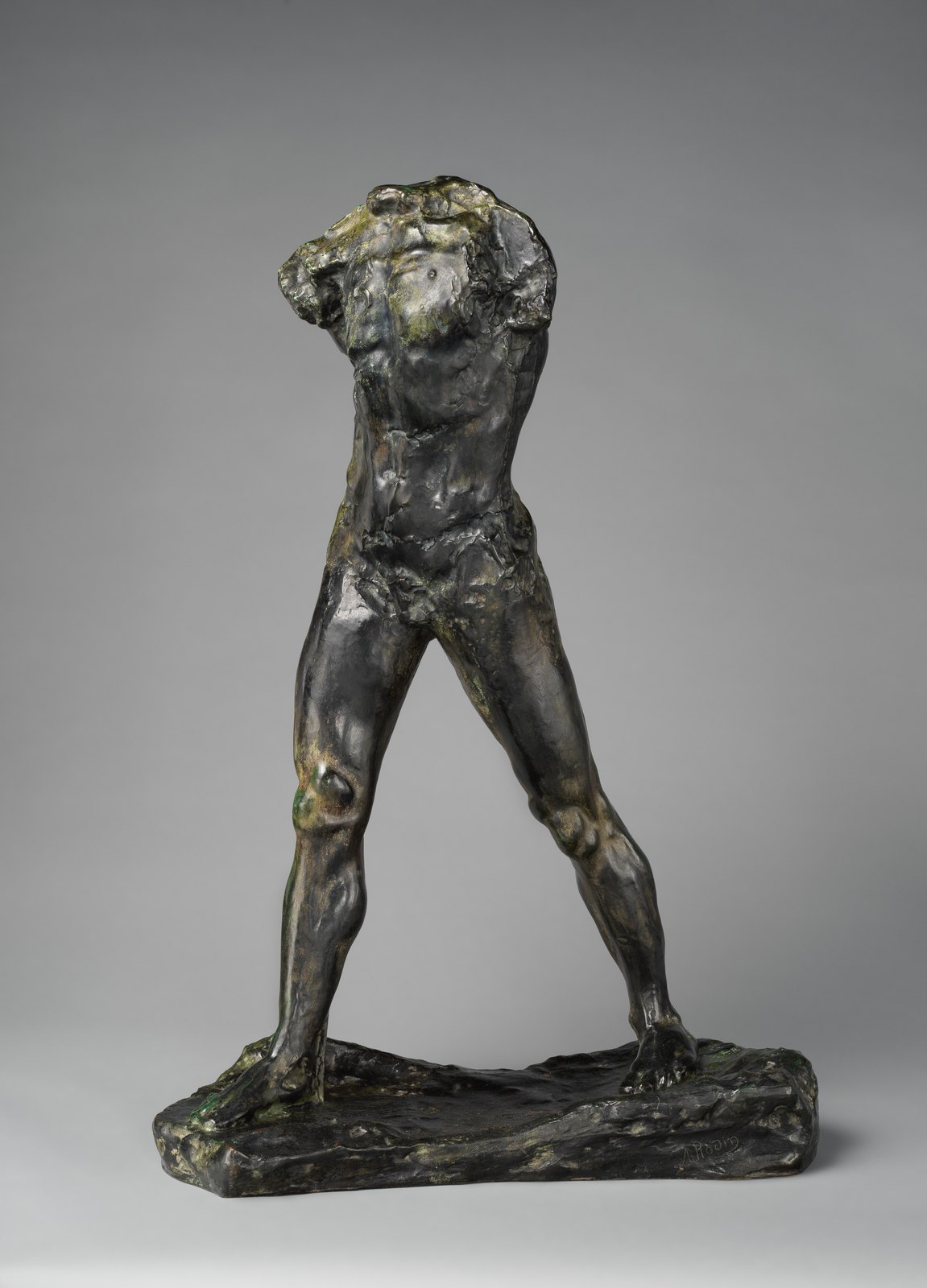
The Metropolitan Museum of Art’s small bronze makes it possible to compare the placement of both feet with the later enlargement. The Metropolitan Museum of Art, Gift of Miss G. Louise Robinson, in memory of Mrs. Nelson Robinson, 1940, 40.12.4. Image source. CC0 / Public domain.
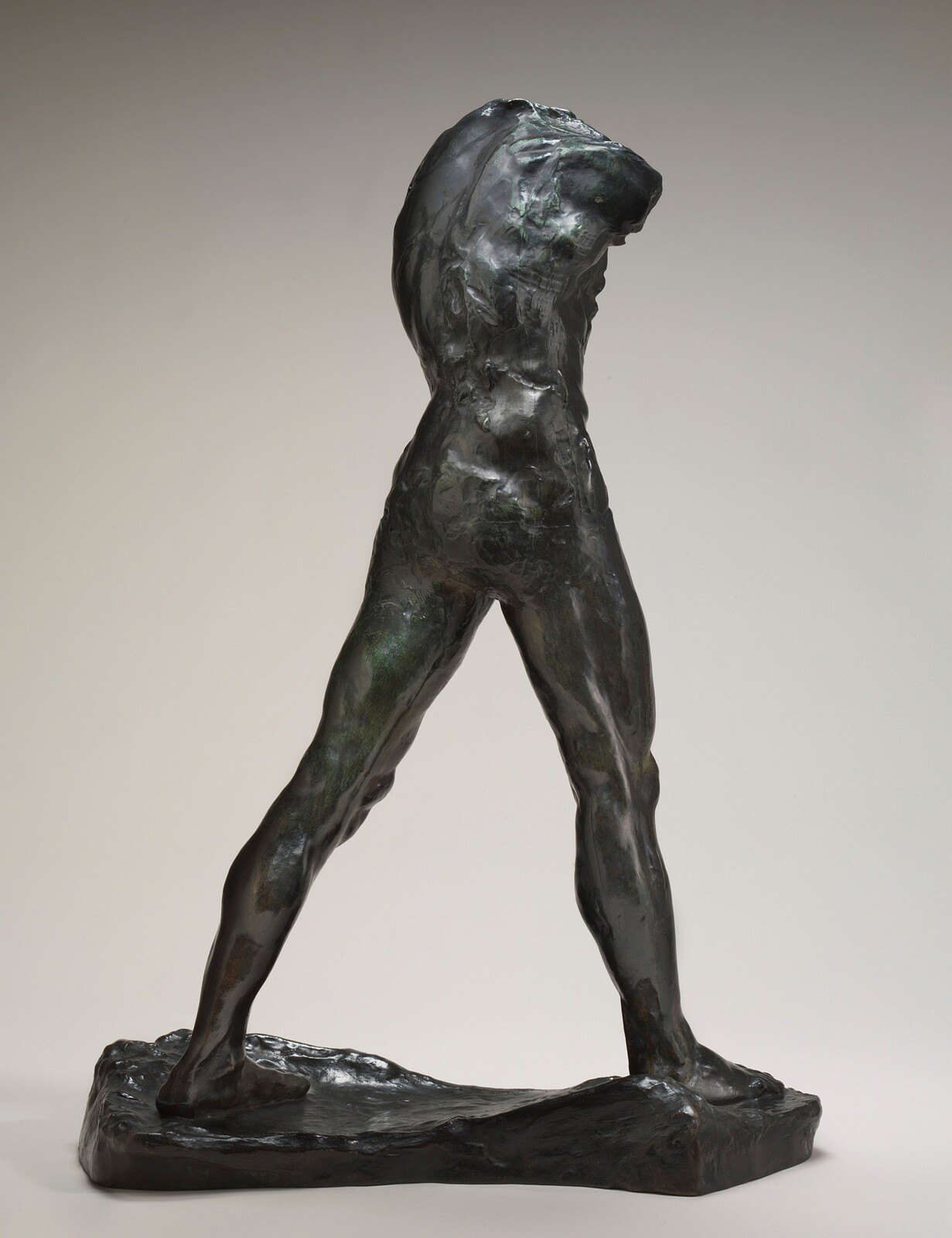
The Simpson bronze in Washington gives a second museum example at small scale. National Gallery of Art, Washington, Gift of Mrs. John W. Simpson, 1942.5.11. Image source. CC0 / Public domain. Resized for the web.
Watch Rodin’s sculpture up close
Five films explore Rodin’s sculpture, from his use of classical models and the figures on his monumental doorway to the work of his studio.
Auguste Rodin – Challenging Beauty
Six sculptures show how Rodin adapted classical models.
Watch on YouTubeReading the foundry marks and edition numbers
The Museum of Modern Art’s bronze 183.1994 gives another example of how a label’s dates do different jobs. MoMA dates the model to about 1890–95 and the bronze to about 1904, while the Musée Rodin’s object account puts the assembly in 1899–1900. The earlier model date should be read alongside the other institution’s account of the assembly, with each estimate kept visible. The estimated casting date places MoMA’s bronze much closer to the Simpson purchase than to the 1907 exhibition of the large plaster. At 85.7 centimetres high, it also belongs with the examples that can be seen more easily from above than the monumental figure. Those points of comparison hold even while the museum accounts differ on when the model took shape. [1] [5] [18]
A bronze at the National Gallery of Victoria provides evidence of later casting at approximately that size. The gallery calls its 84-centimetre example the moyen modèle, or middle model, and records it as number 11 in an edition of 12. Its maker’s mark names Georges Rudier. The date 1964 appears on the side of the base with the Musée Rodin’s copyright inscription. The Met’s Robinson bronze is only a little taller, but its base records a dedication to a particular collector and the museum credits the cast to Alexis Rudier. The same surname on two objects can therefore conceal a difference in both foundry attribution and the circumstances of production. An edition number, an inscription and a museum’s acquisition record together establish more about an object than the model’s title and year. [2] [19]
The monumental casts require the same care. The Hirshhorn records its example as cast in 1962, following an enlargement dated 1905. A 1962 cast appears in MoMA’s historical Rodin exhibition catalogue as number 6 of 12, marked Georges Rudier and lent by the Musée Rodin. The Norton Simon Museum identifies its large bronze as number 7 of 12 and gives 1905 in its date field. That field alone does not establish when the metal was poured. The old exhibition catalogue records a bronze under its lender’s name at a particular moment. The current records give separate evidence about casts in Washington and Pasadena. In a photograph that shows only a headless figure striding, these differences may be hard to detect. The accession and edition numbers let the reader connect the image to the appropriate object history. [20] [21] [22]
What a fixed image can show about walking
In the conversations published by Paul Gsell, Rodin argued that the instantaneous photograph and the sculpture could answer different questions about movement. A short exposure records the positions of the parts of the body at one instant. A sculptor can bring together positions that suggest the progress of an action over several moments. In The Walking Man, the forward foot and the rear leg give the viewer more than one place to begin following the step. A pause at the back foot calls attention to the stretch through the leg. A pause at the forward knee makes it easier to see how the weight could come over it. The experience of looking at the object has a duration even though the bronze itself keeps its position. [4] [23]
Rodin’s use of photographs shows how much he could still ask of a fixed image. The Musée Rodin records that he sometimes marked prints to indicate changes to lighting or to work through possible changes to the sculpture. Edward Steichen’s photographs of the Balzac plaster in 1908 offered another possibility. By photographing the figure at night and varying the exposure, Steichen could make the silhouette and surrounding darkness carry much of the description. Rodin gave him a bronze of The Walking Man in thanks. This particular gift establishes a connection between the works through a photographer. It does not identify the gift with one of the museum casts described here. It does show that Rodin could value a photograph for the way it concentrated attention on a sculpture even when, in conversation with Gsell, he questioned whether a photograph of a moving person could convey the experience of seeing movement. [23] [24]
A later sculptor looks at the figure
Henry Moore singled out The Walking Man for the attention it gives to the human figure. The Musée Rodin’s exhibition with the Henry Moore Foundation used the work to bring two sculptors’ interests into proximity. That framing adds a later episode to its exhibition history. At the Alma, the catalogue offered the complete Saint John as the point of reference. A comparison with another sculptor opens a different question about the dimensions a fragment needs in order to hold its own in a room. The unusually wide spread of the feet makes two points on the floor part of the design. The broken edge above narrows the area that can make the figure seem to turn. Seen through those relations, what a later sculptor could learn from it was also a matter of how it occupied space at its enlarged scale. [4] [6] [25]
What audiences made of the large figure
The museum accounts give different impressions of the response at the 1907 Salon. Meudon describes resistance from the public and some critics. The Rodin–Giacometti exhibition texts published by Fundación MAPFRE describe enthusiasm and preserve a comparison with the Winged Victory of Samothrace. The texts give grounds for talking about both admiration and resistance, while leaving the balance between them uncertain. The comparison with the ancient sculpture is especially interesting because a viewer already accustomed to reading movement in a headless figure could find a precedent for concentrating on the action. The ancient figure’s wings and drapery give its movement much of its force. Rodin’s figure has no equivalent extension above the waist. The comparison directs attention to the long stride and the way the torso continues its momentum. [6] [26]
The large plaster exhibited in the twenty-first-century comparison has a date of its own. The Madrid label gives 1907 beside the accession number S.05716. The Musée Rodin inventory records that this actual plaster was taken from a mould in 1987. The date on the exhibition label situates the design within Rodin’s working life. The inventory entry establishes the much later production of the museum object that visitors encountered. Both facts matter when following the work through exhibitions. A photograph of that installation can give evidence about how the large figure was presented in Madrid, while its accession number and moulding record supply a separate history from the plaster at the 1907 Salon. [6] [17] [26]
Walking into a square
In the late 1950s Giacometti returned to the walking figure while developing a proposal for Chase Manhattan Plaza in New York. The scheme did not go ahead, but the individual figures survived as works. The Fondation Giacometti catalogues both Walking Man I and Walking Man II, and their separate exhibition records show how often particular examples have been brought into conversation with other works. In Giacometti’s striding figure the head and arms remain. The arms hang close and help establish the distance between the thin upper body and the surrounding space. The disproportionately long legs carry the reach of the step. Rodin works with the mass of the thighs and chest, cutting the figure off where an arm might ordinarily complicate its outline. The Madrid exhibition gave visitors a way to compare how much of each body was needed to establish its pace. [26] [27] [28] [29]
Their public settings also began with different decisions. Rodin’s enlarged figure had already appeared at the Salon before the cast associated with the anniversary of Italian unification was installed in Rome. The courtyard was a setting found for an existing figure. The New York proposal gave Giacometti a specific site in which to test a motif he had been making since the 1940s, even though the group he planned was never installed there. The open base in Rodin’s work contains the whole distance of the step. Giacometti’s close grouping of the upper limbs and the thinness of the legs make it easier to take in the space immediately around the figure. Both compositions can suggest travel within a gallery. Their project histories explain why that effect has also been discussed in relation to the spaces people cross outside museums. [9] [10] [26] [28] [29]
A cast in Bourdelle’s museum
The Musée Bourdelle presented a bronze cast by Alexis Rudier in 1927 in its exhibition on Rodin and Antoine Bourdelle. The date follows Rodin’s death and sits alongside an attribution to the same foundry that had made examples during his lifetime. The museum’s exhibition placed the cast in a group about the legacy of the walking figure. Among the comparisons was Henri Matisse’s The Serf. The organisers explain that Matisse worked in proximity to Bourdelle and removed the arms from his figure when it was cast in 1908. In The Serf, the rough torso and the placement of the legs give the truncated body its presence, while its head still directs the viewer’s attention. Seeing the works together gives two particular uses for a reduced silhouette. Rodin’s step reaches out along the base. Matisse’s figure invites attention to the weight of the standing body and the way its surface holds the light. [2] [30]
In 1969 the Baltimore Museum of Art placed the Simpson bronze in an exhibition devoted to the partial figure in modern sculpture. The same object had appeared in Boston in 1905 under a title describing a Saint John without arms or head. The later catalogue title put the object in the company of work by other artists for whom partial figures had become an artistic choice. Its route from a private collection to these exhibitions makes it possible to distinguish two changes that often get compressed into one. Rodin made a new composition by assembling fragments from his studio. The people who subsequently exhibited it gave those fragments different meanings by changing the title, the works nearby and the history in which the bronze was placed. [5] [26] [30]
Reading the studies across materials
The Musée Rodin keeps an original plaster of the torso study under the number S.00529. The catalogue dates it between 1878 and 1887, gives its height as 53 centimetres and records its arrival through the 1916 donation. It also transcribes two numbers on the object, one beneath the flattened end of the right leg. These particulars help identify the plaster as a workshop object with a history of its own. The record links it to The Walking Man under the subject heading for the torso study. In physical terms it preserves the form of a torso down to an abbreviated section of a thigh. On the walking figure, the corresponding area has to carry the turn of the body into a fully extended leg. The join makes that transition part of the sculptural problem. An isolated torso can stop where the workshop study stops. Once there is a long stride below, the viewer can test the alignment of the chest against the direction in which the legs seem to be carrying it. [1] [6] [31]
The Cantor collection catalogue illustrates another version of the torso in bronze. It dates the cast to 1979 and identifies it as number three of an edition made by the Coubertin foundry from a model in the Rodin collection at Meudon. The illustration shows the fragment mounted with a narrow support above a rectangular base. That arrangement allows the short extension below the hip to remain visible. In the complete walking figure the support can be read through the feet and the base beneath them. The isolated torso’s mount gives it an orientation while leaving much of its lower edge exposed. Those different conditions make the comparison worth doing even at the level of the silhouettes. The torso appears to turn within its own small compass, while in the assembled figure the spread of the feet supplies a larger framework against which to judge the same kind of turn. [2] [31] [32]
Rodin also made a frontal drawing for Saint John, now catalogued by Orsay under RF 16079 and kept in the Louvre’s department of graphic arts. The museum records graphite and black ink and gives no date. The sheet bears a dedication to Monsieur Arago, evidence that a study connected with a sculpture could have a life outside the process of making the figure. The designation of the view is itself useful. On a sheet the spectator receives a single orientation chosen by the artist. In front of a sculpture, a frontal view can be followed by a step to either side, revealing how far the hips and shoulders turn away from each other. The undated sheet can help readers think about those conditions of looking without imposing a new date on the sequence of clay, plaster and bronze. [7] [33]
The complete Saint John the Baptist Preaching in MoMA’s collection offers a second comparison. The museum dates the modelling to 1878–80 and the casting of its own bronze to 1921. At about two metres high, the saint commands a space of roughly human scale before the viewer takes account of his arm and hand. MoMA’s installation photographs show that the bronze has also been presented in a sculpture garden, where the outstretched hand can appear against foliage, architecture or open space as the viewer changes position. The walking figure places the corresponding visual demand lower down. Its reach begins at the hip and is carried into the space between the feet. The standing saint has a second line of action in the lifted arm. Taking in those two lines together makes clear how much Rodin could change simply by choosing which forms to carry forward from his studies. [1] [7] [34]
The plaster among portraits in 1907
The Met’s Cantor catalogue chronology records that Rodin sent portrait busts to the 1907 Salon alongside the large plaster of The Walking Man. It lists portraits of Mrs Goloubeff, Mrs Hunter and Miss Fairfax. The records establish that visitors could encounter the same artist’s work in both forms during a single exhibition, although the catalogue chronology does not fix the objects’ relative positions in the room. In one kind of work a recognisable person could be conveyed through the face and the turn of the head, even when there was little body to see. The large plaster left the conference of shoulder, hip and feet to do almost everything. What counted as a complete work depended on what Rodin asked it to show. The Salon selection put the two demands before its public at the same time. [6] [26] [32]
The names in the Salon record also provide a link to the later history of the monumental bronze. Victor de Goloubeff appears among the donors of the bronze installed in Rome four years later. The Salon list and the monument record thus give a place to begin tracing the social connections around the work, even though the surviving entries describe different objects and transactions. [10] [32]
Rodin artworks directory
Discussion
Look again at the images and ideas explored in The Walking Man. These editorial prompts invite your observations.
Reader Insights
After reading “From Saint John to a new figure”, what detail would you look for in the object or image?
What extra evidence would help you distinguish the artist’s choices from the effects of material, viewpoint or later display?
Join the Conversation
Share a detail, comparison or question about The Walking Man below.
References
- Musée Rodin. The Walking Man, S.998. View source.
- The Metropolitan Museum of Art. The Walking Man, 40.12.4. View source.
- Musée Rodin. Multiples, fragments, assemblages. View source.
- The Metropolitan Museum of Art. Rodin at The Metropolitan Museum of Art: A History of the Collection. 1981. View source.
- National Gallery of Art. The Walking Man. View source.
- Musée Rodin, Meudon. L’homme qui marche, grand modèle. View source.
- Musée d’Orsay. Saint Jean-Baptiste, RF 670. View source.
- Grand Palais and Musée Rodin. Rodin, l’exposition du centenaire, exhibition guide. View source.
- Musée d’Orsay. L’homme qui marche, RF 4094. View source.
- Musée d’Orsay. L’Homme qui marche, monument archive and postcards. View source.
- Petit Palais, Paris Musées. Torse d’homme, PPS1256. View source.
- Musée Rodin. Rodin et l’Antique, exhibition dossier. View source.
- Musée Rodin. L’Homme qui marche, grand modèle, S.00998, detailed record. View source.
- Musée Rodin. Museum documentary dossier, p. 17. View source.
- Musée Rodin. Haweis and Coles, L’Homme qui marche (plâtre), Ph.04454. View source.
- Musée Rodin. L’Homme qui marche, grand modèle, S.05715. View source.
- Musée Rodin. L’Homme qui marche, grand modèle, S.05716. View source.
- Museum of Modern Art. The Walking Man, 183.1994. View source.
- National Gallery of Victoria. Walking man, 2022.1298. View source.
- Smithsonian Institution, Hirshhorn Museum and Sculpture Garden. Walking Man, 66.4343. View source.
- Museum of Modern Art. Rodin exhibition catalogue, entry 3. View source.
- Norton Simon Museum. The Walking Man, M.1966.05.S. View source.
- Musée Rodin. Rodin and photography. View source.
- Musée Rodin. Rodin and Steichen. View source.
- Musée Rodin. Moore Rodin. View source.
- Fundación MAPFRE. Rodin–Giacometti exhibition texts. View source.
- Fondation Giacometti. Walking Man I. View source.
- Fondation Giacometti. Walking Man II. View source.
- Fondation Beyeler. Bacon–Giacometti gallery texts. View source.
- Musée Bourdelle. Rodin/Bourdelle, Corps à corps, exhibition dossier, p. 26. View source.
- Musée Rodin. Torse de l’étude pour Saint Jean-Baptiste, S.00529. View source.
- The Metropolitan Museum of Art. Rodin, The B. Gerald Cantor Collection, entry 58 and chronology. View source.
- Musée d’Orsay. Étude pour le saint Jean-Baptiste, vu de face, RF 16079 recto. View source.
- Museum of Modern Art. St. John the Baptist Preaching, 27.1955. View source.

 Auguste Rodin.jpg)




