


 1898.jpg)
 by Tom Gurney
Tom Gurney BSc (Hons) is an art history expert with over 20 years experience
Published on June 19, 2020 / Updated on November 18, 2026
Email: tomgurney1@gmail.com / Phone: +44 7429 011000
Auguste Rodin Photographed in his Studio by Paul Francois Arnold Cardon (Dornac), 1898
Auguste Rodin stands with his hands at his trouser pockets, looking towards the camera. The photographer Dornac has placed him slightly to one side, with a large pale surface behind him and room for a plank of tools to show beside his elbow. At the right, cloth hangs almost the full height of the picture. The Musée Rodin identifies the work behind the sculptor as his Monument to Domingo Faustino Sarmiento. The monument was destined for Buenos Aires. Seen here in a Paris workshop, it gives a sense of the scale at which Rodin worked and of how much had to be done before a large sculpture could take its place outdoors. [1] [2] [3]
A portrait in a working space
The contrast between Rodin’s dark waistcoat and the pale work behind him gives the portrait its centre. His spectacles hang against the waistcoat, small enough to miss in a reduced reproduction. From them you can follow the line of buttons up towards the beard, which overlaps the shirt and obscures much of the neck. His jacket is open and its sleeves bend above the pockets. The way he stands makes each elbow project a little, so that the outline of his body stays easy to trace against the material behind him. Look at the edge where the light on his head meets the lighter surface beyond it. His hair and beard keep the face legible within a photograph full of pale tones. [1] [2]
On the plank to the right of Rodin, an upright handle interrupts the horizontal edges of the tools and board. Farther to the right, the folds of the hanging cloth make an irregular border to the scene. A broad beam crosses the lower part of the photograph. These ordinary objects give the eye several ways to judge the scale of the work behind him. The beam also puts a visible distance between the place where he stands and the surface behind his shoulders. The long face of that surface fills so much of the picture that the tools nearby become especially useful for understanding it as something being worked on. [1] [2] [4]
Little of the monument is legible as a whole from this angle. There is a difference between recognising its title in a catalogue and locating its forms in the photograph. Look at the lower part of the pale mass, where irregular horizontal marks run across it, then move upwards towards the less sharply marked surface. The photograph makes it possible to inspect those areas alongside the board and supports. It offers much less information about the finished contour of the monument. At the left edge, an opening into the darker workshop makes the width of the pale mass easier to judge. The view gives priority to the person in front of it and preserves some of the material surroundings in which he worked. [1] [2] [4]
Dornac’s approach to portraiture
Dornac was the professional name of Paul François Arnold Cardon, also known as Paul or Pol Marsan. The Musée d’Orsay describes his series Nos contemporains chez eux, which pictured well-known people in their domestic or professional surroundings. In the archive of this series a set of shelves, a fireplace or the arrangement of a table can provide part of the portrait. His photograph of Georges Clemenceau in his library offers a useful example of the role played by a sitter’s surroundings. In Rodin’s case the workshop lets a viewer see how a sculptor’s body occupies space among a project, tools and supports. The pose remains carefully legible within the irregular setting. [1] [5] [6]
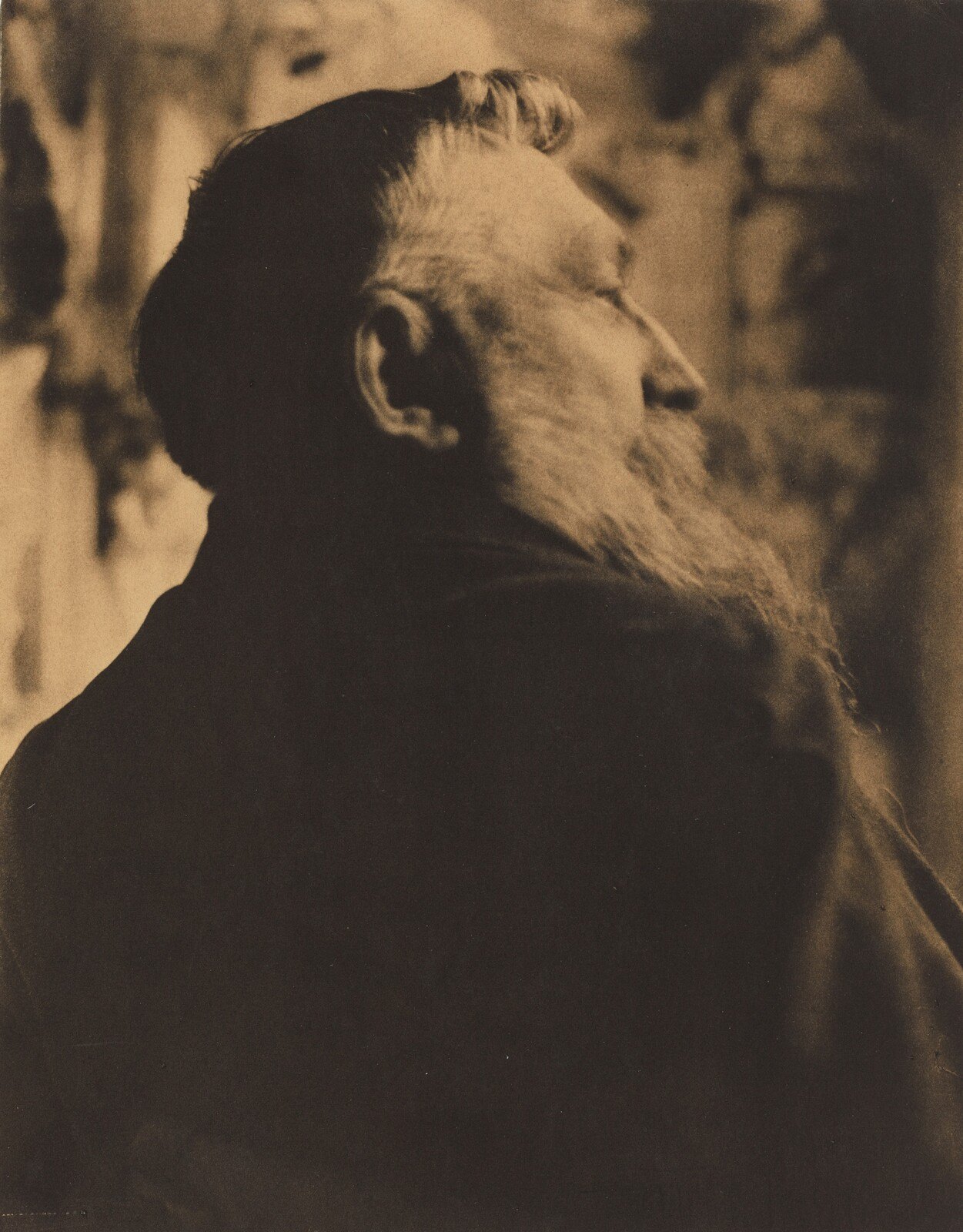
A separate portrait by Gertrude Käsebier gives a comparison for Dornac’s choice to show Rodin within his working space. National Gallery of Art, Washington, Patrons’ Permanent Fund, 2008.65.13. Image source. CC0 / Public domain.
Dornac made more than one view of Rodin in the workshop. The Musée Rodin also catalogues a photograph of him seated in front of the plaster for the first Victor Hugo monument project. That portrait shows a different relationship between the sculptor and the work around him. The seated body takes up less of the height of the frame. In the standing portrait the large light surface behind him makes his head and shoulders easier to read as a silhouette. Titles that mention only Rodin and his studio can make the photographs sound interchangeable. His posture and the catalogue’s identification of the sculpture give much firmer points of reference. [1] [2] [7]
Watch Rodin’s sculpture up close
Five films explore Rodin’s sculpture, from his use of classical models and the figures on his monumental doorway to the work of his studio.
Auguste Rodin – Challenging Beauty
Six sculptures show how Rodin adapted classical models.
Watch on YouTubeFrom Paris to Buenos Aires
The Argentine commission for the Sarmiento monument came to Rodin in 1894. The Museo Nacional de Bellas Artes discusses the role of Eduardo Schiaffino, later the museum’s first director, in promoting Rodin’s work in Argentina and in advancing this commission. The monument arrived in Buenos Aires in April 1900 and was inaugurated on 25 May in the Parque Tres de Febrero. The debate around the work included criticism of the likeness of the former president. The studio portrait predates that public encounter. It brings us close to the project at a time when its appearance in the park was still in the future. [3]
The monument and the portrait each had a different audience and format. A visitor in the park would see the bronze figure in relation to the pedestal and the surrounding grounds. A reader seeing a print from Dornac’s series could examine the workshop project within the bounds of an image small enough to hold or reproduce on a page. At that smaller scale the position of Rodin’s head against the pale background acquires much of its force. A full image of the monument would identify the public commission more readily, while Dornac’s framing gives the spectator a better view of the man beside it. [1] [2] [3] [5]
The photograph also belongs to the visual record of a workshop where different trades contributed to large sculptures. The Musée Rodin’s Meudon dossier uses a Dornac portrait before the Sarmiento monument in its account of sculptural techniques. A tool on a plank can tell us that this was a space arranged for work. Identifying which person used it, or which stage of the project it served, would require evidence beyond its silhouette. The portrait gives Rodin prominence in a place where the objects still show something of the practical arrangements around him. Follow the board and the beam towards the edge of the photograph to see how much of that arrangement extends beyond the figure’s own outline. [1] [4]
The published print and its mount
Beaux-Arts de Paris holds an albumen print of Rodin from Dornac’s series, Ph 15988, measuring 12.5 by 17.5 centimetres. The printed mount identifies the series and names Dornac’s firm as photographer and publisher. The back lists figures whose portraits had appeared, including Émile Zola and Louis Pasteur, and offers the photographer’s services to other sitters who wanted to be pictured at home. That text gave the mounted portrait an audience beyond people interested specifically in how a sculptor’s workshop looked. A purchaser could recognise a format that also took readers into a writer’s study or another public figure’s private surroundings. [8]
The same object has an 1898 legal deposit stamp, and the school records receiving it as a gift from the Ministry of Public Instruction that October. These details belong to the mounted print. They give the picture a documentary history beyond the sitting itself and help distinguish publication and circulation from the date when Dornac stood behind the camera. [8]
Rodin artworks directory
Discussion
Look again at the images and ideas explored in Auguste Rodin Photographed in his Studio by Paul Francois Arnold Cardon (Dornac), 1898. These editorial prompts invite your observations.
Reader Insights
After reading “A portrait in a working space”, what detail would you look for in the object or image?
What extra evidence would help you distinguish the artist’s choices from the effects of material, viewpoint or later display?
Join the Conversation
Share a detail, comparison or question about Auguste Rodin Photographed in his Studio by Paul Francois Arnold Cardon (Dornac), 1898 below.
References
- Musée Rodin. Rodin dans son atelier devant le monument à Sarmiento, Ph.02829. View source.
- Musée Rodin. Dossier de presse, Centenaire Auguste Rodin, p. 43. View source.
- Museo Nacional de Bellas Artes. Rodin en la colección del Museo Nacional de Bellas Artes. View source.
- Musée Rodin, Meudon. Dossier documentaire, section on sculptural techniques. View source.
- Musée d’Orsay. Collection de portraits d’artistes, instrument de recherche. View source.
- Musée d’Orsay. Georges Clemenceau dans sa bibliothèque. View source.
- Musée Rodin. Rodin assis dans son atelier devant le Monument à Victor Hugo, Ph.00179. View source.
- Beaux-Arts de Paris. Nos contemporains chez eux – Auguste Rodin, Ph 15988. View source.
 1898 in Detail.jpg)

 Auguste Rodin.jpg)





