


 Auguste Rodin.jpg)
 by Tom Gurney
Tom Gurney BSc (Hons) is an art history expert with over 20 years experience
Published on June 19, 2020 / Updated on November 18, 2026
Email: tomgurney1@gmail.com / Phone: +44 7429 011000
La Douleur (de la Porte)
In Auguste Rodin’s La Douleur (de la Porte), a kneeling figure lifts both elbows towards her head. The back faces the viewer, and the body rises against a rough mass that closes off much of the space behind her. The face is difficult to see from this angle. Rodin gives the gesture its force through the position of the shoulders and the pressure the body seems to exert against the surface. The French title means sorrow or pain and refers to the doorway, The Gates of Hell. Two museum bronzes cast in 1983 preserve this model at a scale that lets the viewer examine the gesture closely. [1] [2]
The raised elbows and the kneeling figure
The arms extend to either side of the head. The elbow on the left stands out clearly because a dark opening underneath separates it from the shoulder and the surrounding surface. The corresponding dark interval on the right is shallower in the photograph, where the edges of the arm and support are closer together. That difference gives the gesture an uneven bearing. The elbows form a wide outline high in the composition, but the eye is quickly drawn back to the small area in which the head and arms overlap. [1] [2]
Below the shoulders, two areas of light follow the outer planes of the back. They gradually narrow towards the waist before broadening over the hips. The middle of the back stays dark. This makes the sides of the figure especially clear while leaving the spine less defined. At the hips the bright patches are longer and more sharply separated from the rough surfaces beside them. Lower down they break into smaller areas at the bent legs. The bronze base curves out beneath the figure, making a low horizontal ledge against which the whole upward movement of the body can be read. [1] [2]
The pose can initially look upright because the figure’s thighs extend down from the hips. The bend at the knees is easier to see close to the ground, where the forms turn back into the bronze. There is little room for a leg to extend forward without entering the rough surface. That tight relationship between body and surrounding mass helps explain why the raised arms can suggest distress despite the limited view of the face. The upper body appears to reach out and upwards while the lower body stays close to the base. [1] [2]
How the surrounding surface shapes the gesture
The surface behind the figure has deep folds and irregular edges. In the photograph it is visible on both sides of the back and most clearly along the right. There, a series of shallow ridges catches light at several different angles. They lead down towards the base, where the rough modelling continues in front of the knees. These features give the object a continuous outer edge while allowing the finer surfaces of the body to emerge within it. At the top the rough mass nearly reaches the crown, so that the head projects only slightly above the shoulders and surrounding bronze. In profile, the projection of the back and the amount of material behind the head would be easier to judge. [1] [2]
This relation between a figure and its background was one of the problems Rodin faced on The Gates of Hell. The doorway brought together figures projecting by different amounts. Some had to be legible at a distance and from below, while others were closely tied to the surface around them. A small separate version of a model can retain something of that problem. In this case the bronze still puts the figure in close contact with a textured surround. Looking at it on its own gives the viewer more time to see where the figure extends into open space and where its edges meet the support. [1] [2] [3]
The title also deserves care. Rodin’s Head of Sorrow, or Tête de la douleur, is another work associated with the doorway. The Met traces that head in smaller forms across several figures on the doors. In the kneeling composition the face is largely turned away, and the back, arms and knees carry most of the expression. The two titles give voice to a related emotion. The visual evidence for the pose and for the use of each model comes from the individual records and from viewing the works themselves. [1] [2] [4]
Watch Rodin’s sculpture up close
Five films explore Rodin’s sculpture, from his use of classical models and the figures on his monumental doorway to the work of his studio.
Auguste Rodin – Challenging Beauty
Six sculptures show how Rodin adapted classical models.
Watch on YouTubeTwo casts from 1983
The National Gallery of Art in Washington dates the model to 1889 and its bronze to 1983. It records the edition mark II/IV on the base and the Coubertin foundry stamp at the rear. The Los Angeles County Museum of Art dates the model more tentatively to about 1889–92. It catalogues its bronze as IV/IV, also cast in 1983. Its recorded height is just under 28 centimetres, while Washington gives 30.5 centimetres for its example. The edition marks and accession records provide stronger evidence for distinguishing the objects than the apparent size of either one in reproduction. [1] [2]
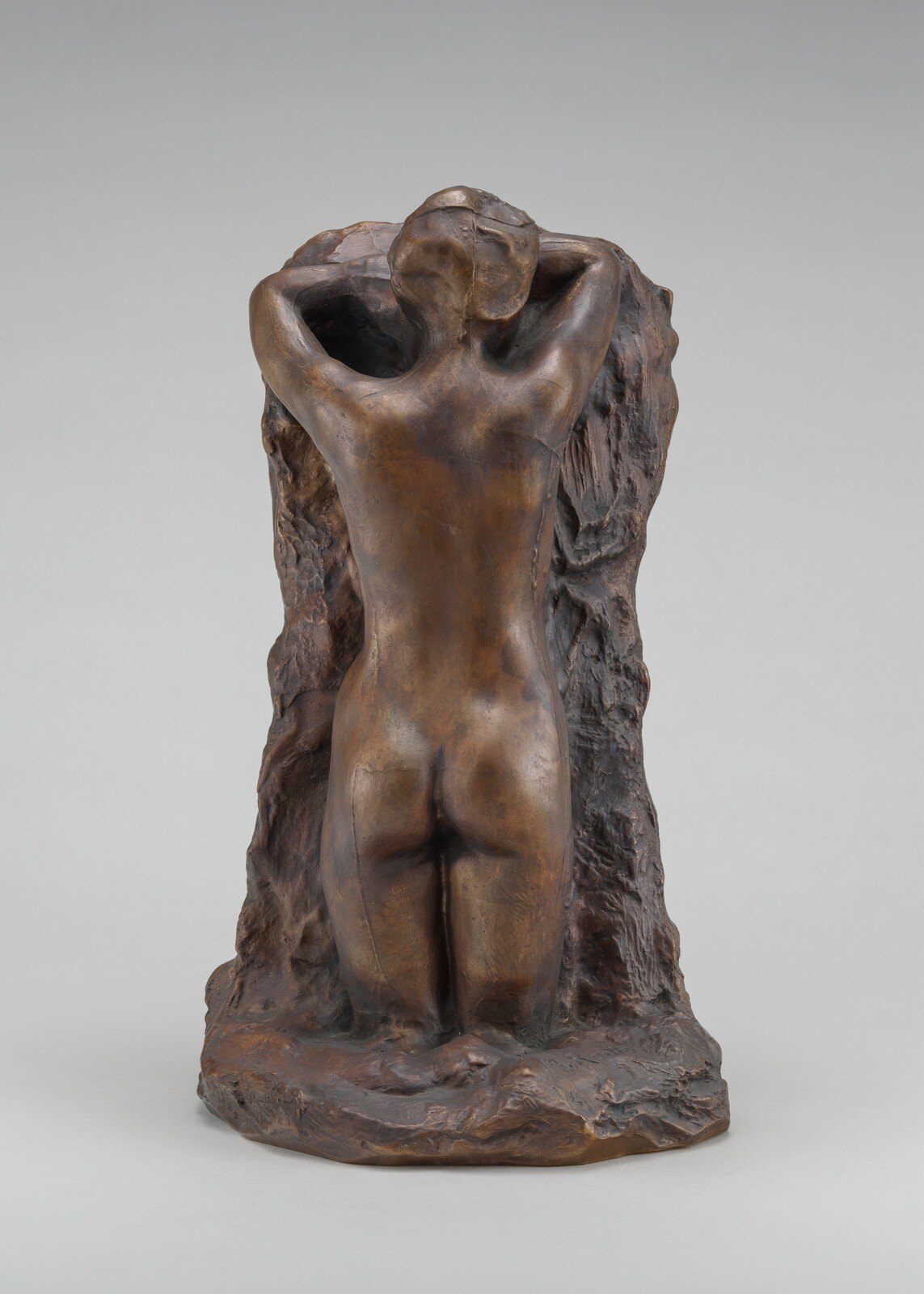
The Washington bronze is inscribed II/IV and was cast in 1983. National Gallery of Art, Washington, Gift of the B. Gerald Cantor Collections, 1992.84.1. Image source. CC0 / Public domain.
The casting date also belongs to a wider history of how modern museums presented Rodin’s work. The Oklahoma City Museum of Art’s True Nature exhibition placed the Los Angeles cast alongside material documenting the lost-wax casting process. The exhibits included objects made in wax, plaster and other materials from the Coubertin Foundry. A finished bronze can preserve quite shallow changes in surface, including those that allow viewers to follow a ridge of the back or distinguish the modelled base from the body above it. Seen alongside evidence of casting, those small details make the relationship between a model and a finished bronze easier to study. [2] [5]
The legacy view is consistent with the composition recorded by both museums. It gives a clear impression of a comparatively smooth body set against a more broken surface, with dark spaces around the raised arms. The exact cast still needs a direct match to an object photograph or an inscription. The inscription locations described in Washington’s record are mostly outside the photographed view. The picture is particularly effective at keeping the figure’s face in shadow. Its strongest evidence is the way the raised shoulders and the lower body, compressed against the support, convey the gesture from behind. [1] [2]
A casting demonstration built around the figure
The National Gallery of Art holds ten demonstration objects made by the Coubertin workshop to show how this composition can be cast by the lost-wax process. The first object is a plaster dated 1990. Later stages show the form with rods or channels attached. Some of those channels appear as bronze conduits on the unfinished casting. They belong to the route by which material reaches the mould and air escapes. The final sculpture gives no immediate indication of these temporary extensions, which would be cut away and their attachment points finished. [1] [6]
The sequence uses the same design as Washington’s 1983 bronze, but it follows the making of a demonstration made later. Its value lies in showing how the bent elbows, the neck and the rough relief behind them could be carried through changes of material. Alongside the finished bronze, it gives the viewer a way to distinguish intermediate features needed for the casting from the ridges and hollows that belong to the figure. [1] [6]
Rodin artworks directory
Discussion
Look again at the images and ideas explored in La Douleur (de la Porte). These editorial prompts invite your observations.
Reader Insights
After reading “The raised elbows and the kneeling figure”, what detail would you look for in the object or image?
What extra evidence would help you distinguish the artist’s choices from the effects of material, viewpoint or later display?
Join the Conversation
Share a detail, comparison or question about La Douleur (de la Porte) below.
References
- National Gallery of Art. La Douleur (de la Porte). View source.
- Los Angeles County Museum of Art. La Douleur (de La Porte), AC1999.45.1. View source.
- Musée Rodin. The Gates of Hell. View source.
- Metropolitan Museum of Art. Head of Sorrow. View source.
- Oklahoma City Museum of Art. True Nature: Rodin and the Age of Impressionism, exhibition labels, casting display. View source.
- National Gallery of Art. Coubertin lost-wax casting demonstration and associated objects. View source.

 Auguste Rodin.jpg)





