


 by Tom Gurney
Tom Gurney BSc (Hons) is an art history expert with over 20 years experience
Published on June 19, 2020 / Updated on November 18, 2026
Email: tomgurney1@gmail.com / Phone: +44 7429 011000
The Sirens
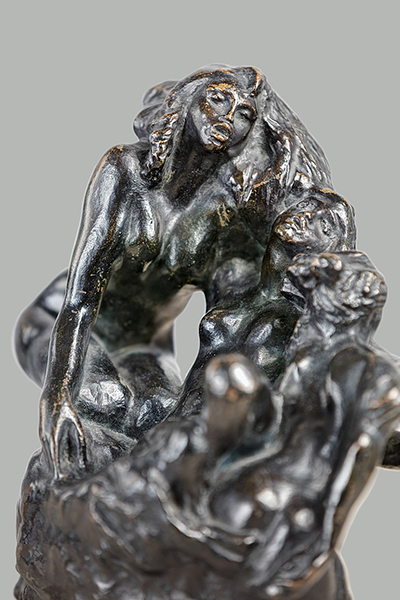
Three women gather at different heights above a rough base in Auguste Rodin’s The Sirens. The tallest leans over the others, her face inclined and her hair falling to either side. A second turns her face up towards her. The third sits lower and turns partly away from the viewer. Rodin developed the group in connection with The Gates of Hell and exhibited a plaster independently. The bronze shown in the legacy photograph gives a close view of the faces and the descending line of the tallest woman’s arm. From farther back, the sculpture opens out into a succession of bent legs, shoulders and hands around the irregular base. [1] [2] [3]
Three faces at different heights
The tallest siren’s forehead and nose catch the light. Her mouth is slightly open, and the curve of her cheek continues into a shadow below the chin. The lines of the hair are more broken than those of the face, particularly beside her ear, where small highlights run down towards the shoulder. The inclined head is close to a raised arm, while the other arm drops through the length of the photograph. Its hand comes to rest low on the base, with enough room between the fingers for their tips to show against the bronze below them. [1] [2]
The middle figure occupies the space below that face. Her chin tilts upwards, and the surface beneath her neck is lit differently from the face above her. From this angle the two heads appear almost to touch, though the direction of each face remains distinct. A little farther forward the third head overlaps the second. The nearest figure’s features are less accessible in the photograph because her head turns away and because the focus is higher in the group. From another angle, the upward turn of her arms is easier to see. The viewer can follow that gesture separately before looking back towards the other women. [1] [2]
An opening below the highest figure’s torso admits a little of the background. It is bounded on one side by the long arm and on the other by the crowded shapes of the lower figures. This small interval makes the diagonal of the body easier to recover from the overlap. It also changes shape as the viewer goes around the sculpture. The Cleveland Museum of Art’s photographs show how the bent leg of the highest woman becomes more conspicuous from the side, where her hip occupies the outer edge. From behind, the arms and the curves of the backs provide a different way into the group. [1]
Giving a shape to song
The title identifies the women as sirens, whose voices draw listeners towards them. The differing heights of the faces give Rodin a way of suggesting sound through visible form. The group has no fixed point at which all three look, and the faces register at different angles to the light. The openings at the mouths and the lifting of the chins can suggest that each is singing. At the same time, their closeness makes it possible to read the individual gestures as parts of a single action. The title gives that action a mythological context without requiring a scene of a ship or its crew. [1] [3]
The Montreal Museum of Fine Arts quotes Gustave Geffroy comparing the uneven group to a set of panpipes. The comparison can be tested by looking from one head to the next. Each ends at a different height, and the distances between the heads are unequal. The sequence also runs through the depth of the sculpture. In the close photograph the lowest figure comes towards the viewer, while the highest one stands a little farther back. The movement between them is carried by the contours of arms and hair. Their irregular spacing permits each figure to register while keeping the bodies gathered around the same area. [1] [3]
Watch Rodin’s sculpture up close
Five films explore Rodin’s sculpture, from his use of classical models and the figures on his monumental doorway to the work of his studio.
Auguste Rodin – Challenging Beauty
Six sculptures show how Rodin adapted classical models.
Watch on YouTubeFrom the doorway to a work in the round
The Musée Rodin identifies the three sirens on The Gates of Hell in its exhibition dossier. On the doorway a spectator sees them amid many other bodies and against an architectural surface. In the detached sculpture, the edge of the group is open on every side and the base becomes a feature in its own right. Its textured surface takes over where some of the lower bodies disappear from view. The eye can follow the rough changes in level around to the place where the tallest woman braces her hand. That contact helps establish her height in relation to the lower figures. [1] [4]
The Musée Rodin records a terracotta group, S.02249, dated 1888. The Montreal Museum of Fine Arts records a plaster shown at the joint Monet–Rodin exhibition at the Galerie Georges Petit in 1889. Showing the work on its own made it possible to look at the arrangement from several positions. It also brought out qualities that differed from those of the crowded doorway, including the extent of the base and the depth of the spaces between the bodies. The Musée Rodin documents that Rodin sometimes isolated one of the sirens again and used her in new assemblages, including a plaster in which she holds a partial figure associated with the doorway. [3] [5] [6]
Marble and bronze versions
Montreal’s marble is just over 44 centimetres high. The museum attributes its execution to Jean Escoula between 1889 and 1892 and identifies it as the earliest of four known marbles. The Cleveland bronze, accession 1946.350, is 43.2 centimetres high. A different bronze of the same height at the National Gallery of Art bears the mark of Alexis Rudier. The National Gallery dates the model before 1887 and places the casting of its own object probably between 1900 and 1920. These figures refer to individual objects and to different stages of their production. [1] [2] [3]
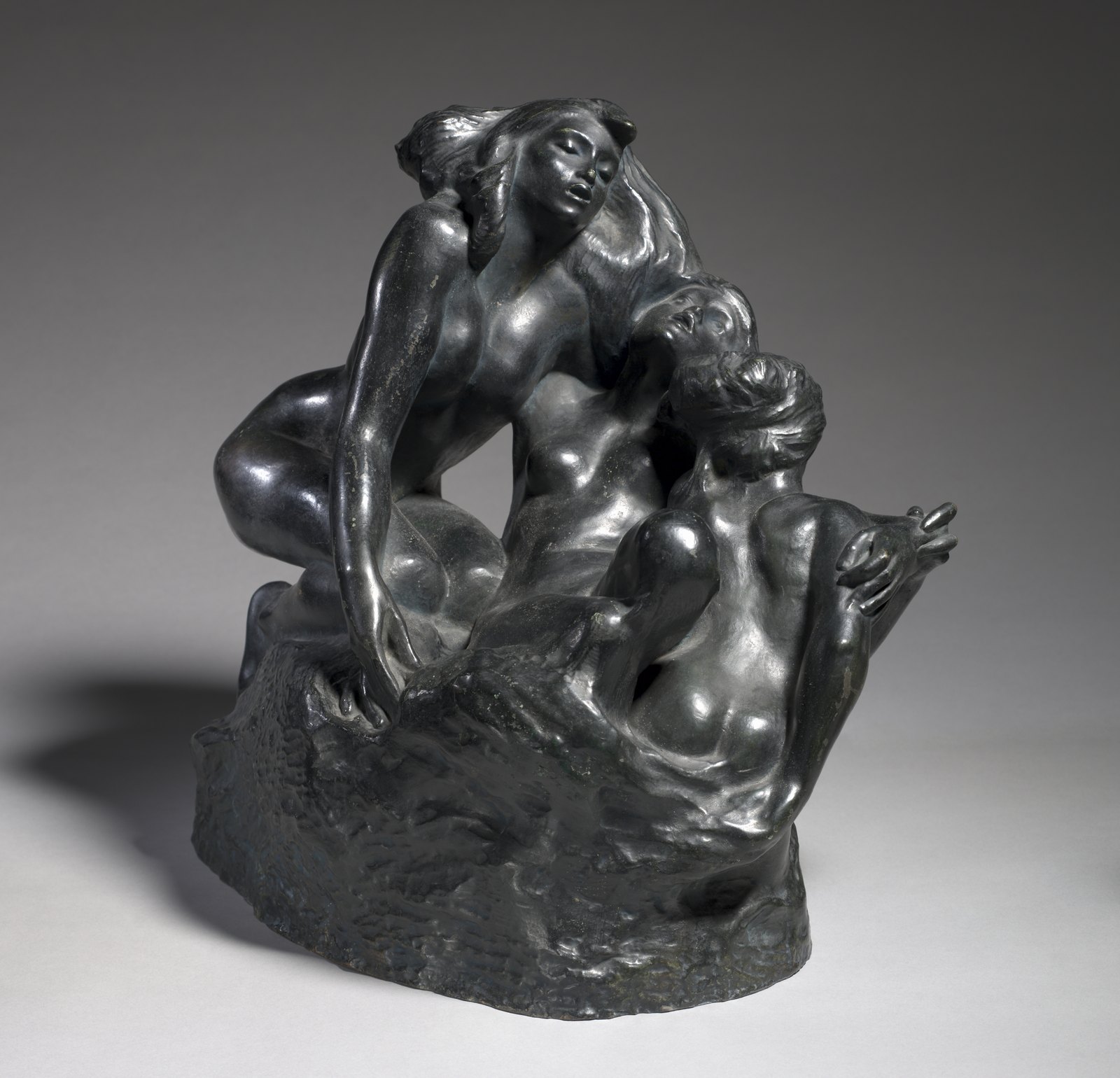
The Cleveland bronze gives a view of the three-figure group in the round. The Cleveland Museum of Art, In memory of Ralph King, gift of Mrs. Ralph King; Ralph T. Woods, Charles G. King; and Frances King Schafer, 1946.350. Image source. CC0 / Public domain.
The close photograph shows the bronze composition, with light breaking in spots on the heads and upper bodies. The Cleveland views show a closely corresponding arrangement, including the long supporting arm and the hand reaching towards the base, although the photograph’s cropping and angle leave the exact cast unconfirmed. The detail it records most clearly is the way the faces gather above the same point while remaining independent in direction and height. [1] [2]
Two sirens and a separate foundry model
The Musée Rodin holds a sand-cast bronze called Two Sirens, S.06677. It is 15 centimetres high and 25 wide, with the Alexis Rudier foundry mark at the rear of the base and Rodin’s signature at the front. The museum dates the design to around 1895–1900 and gives 1931 as a possible casting date. A tinted plaster of the same title, S.00360, has nearly the same dimensions. Its signature is on the edge of the base and one of its catalogue marks lies beneath the paint. The records distinguish objects of almost identical size and show how the support can supply evidence about the way each was made. [7] [8]
The photographic collection also includes a carbon print by Stephen Haweis and Henry Coles of a bronze Two Sirens, dated 1903–04. The image is substantially smaller than its mount, measuring 18.5 by 16 centimetres against 50 by 32.5 for the outer support. It documents the two-figure subject before the possible casting date of S.06677 and gives the pair a vertical field on paper despite the sculpture’s low, broad proportions. Separately, a small plaster titled Sirène, S.05460, preserves a single figure associated with the doorway. The group of three, a pair and a single figure belong to related lines of studio work. The individual records give each form a scale, material and setting. [5] [7] [9] [10]
Rodin artworks directory
Discussion
Look again at the images and ideas explored in The Sirens. These editorial prompts invite your observations.
Reader Insights
After reading “Three faces at different heights”, what detail would you look for in the object or image?
What extra evidence would help you distinguish the artist’s choices from the effects of material, viewpoint or later display?
Join the Conversation
Share a detail, comparison or question about The Sirens below.
References
- Cleveland Museum of Art. The Sirens, 1946.350. View source.
- National Gallery of Art. The Sirens, 1978.71.1. View source.
- Montreal Museum of Fine Arts. The Sirens, 1958.1192. View source.
- Musée Rodin. L’Enfer selon Rodin exhibition dossier, diagram of the doorway. View source.
- Musée Rodin. Les trois Sirènes, S.02249. View source.
- Musée Rodin. Assemblage of two female nudes, S.02612. View source.
- Musée Rodin. Deux sirènes, bronze S.06677. View source.
- Musée Rodin. Deux sirènes, plaster S.00360. View source.
- Musée Rodin. Les Deux Sirènes, Haweis and Coles photograph Ph.05818. View source.
- Musée Rodin. Sirène, foundry plaster S.05460. View source.

 Auguste Rodin.jpg)





