


 by Tom Gurney
Tom Gurney BSc (Hons) is an art history expert with over 20 years experience
Published on June 19, 2020 / Updated on November 18, 2026
Email: tomgurney1@gmail.com / Phone: +44 7429 011000
Eternal Idol
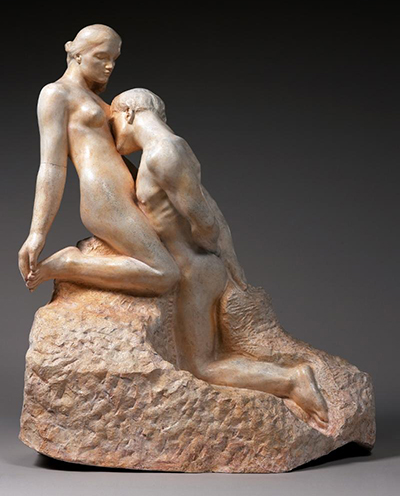
In Auguste Rodin’s The Eternal Idol, a man kneels below a woman and inclines his head towards her breast. They are close enough to touch, yet the positions of their arms make the gesture difficult to read. His are drawn behind him. The arm visible on her far side descends towards her folded leg. She looks down from a higher part of the rocky support, with her torso nearly upright. Rodin developed the group around the turn of the 1890s. Versions in plaster, marble and bronze offer different views of an encounter whose meaning depends in part on how we read the balance of the two bodies. [1] [2] [3] [4]
The two figures and the rock
The tiers of the support are easiest to see in the side view. The woman’s lower leg lies almost horizontally on a high ledge. Her other visible contour rises from the hip through the back towards the shoulder, making her seem quite tall even though her knees are bent. The man’s knee sits lower in the block. His shin continues towards the right until the toes turn down against the rough base. The gap in height between the two positions allows him to bring his face close to her while his back remains almost upright. [1] [2]
The surface just under the woman’s leg has a broad edge that runs out to the left. Look below it and the chisel-like texture breaks up into small facets. The ridges are clearest in the lower foreground, where darker lines separate the planes. Higher up the light spreads across the bare skin, especially over the woman’s shoulder and chest. The man’s shoulder interrupts that smooth passage with a darker turn towards his arm. The photograph’s oblique lighting makes the step between the figures clear as it moves from the bearing surfaces towards the upper bodies. [1] [2]
The woman’s visible hand reaches nearly to her toes. From this angle it completes a long line which starts at the shoulder and continues past the knee, enclosing part of the open background. The man’s arms follow his back and are partly concealed by the turn of his torso. In a museum view taken from another angle, more of the placement of the hands becomes apparent. That difference matters. Seen at a distance the two heads and the bend of the man’s back give the impression of a close embrace. The arms become more important as the viewer comes near enough to see where the figures touch and where they keep their distance. [1] [2] [3]
A title with several readings
The title invites a comparison with a devotee before an object of worship. In front of the sculpture that suggestion has a physical basis. One figure is higher than the other, the man leans in, and the higher figure lowers her gaze. The Montreal Museum of Fine Arts notes that the piece has also been known as Sacrificial Victim. That name makes the hands behind the man’s back especially noticeable. Montreal also cites the writer Jules Renard’s response to a small version of the work. He read sadness in the woman’s face and found it difficult to put the sculpture out of his mind. [3]
The Leopold Museum reads the backward inclination of the woman’s body as a gesture of rejection in the bronze it shows. The place where the man bows his head gives the bodies an intimate proximity at the same time. These observations bring attention to two lines that can be followed separately. His shoulder and neck travel forwards towards the point of contact. The line from her waist to her neck keeps a greater distance from his approach. Seen together, the lines can suggest an effort to hold a position while receiving attention, or an effort to draw away. The sculpture gives each figure a distinct bearing for the viewer to interpret. [1] [3] [4]
Watch Rodin’s sculpture up close
Five films explore Rodin’s sculpture, from his use of classical models and the figures on his monumental doorway to the work of his studio.
Auguste Rodin – Challenging Beauty
Six sculptures show how Rodin adapted classical models.
Watch on YouTubeRodin, Claudel and Carrière
The Musée Rodin places The Eternal Idol alongside Camille Claudel’s Sakuntala and The Waltz. It dates Rodin’s start on the composition to 1890 and suggests that his group can be understood in relation to those sculptures. In Sakuntala, supplication is also expressed through a kneeling figure. The different positions of the arms make a comparison of the two groups particularly revealing. The kneeling posture can give the figures an unequal height while the reach of their arms determines whether the viewer sees an offered, returned or withheld embrace. The institutional comparison offers a way to consider how artists working at the same time gave different shapes to related subjects. [5]
The Musée Camille Claudel dates the patinated plaster S.3136 to around 1889. It is 73.2 centimetres high. The Harvard Art Museums’ marble is about the same height and records Jean Escoula as carver. Harvard dates the carving to 1893 and lists a commission from the artist by the painter Eugène Carrière through Léopold Blondin in 1900 in its provenance. The Musée Rodin places Carrière’s acquisition in 1893. The different dates in the two accounts are worth preserving when describing the object’s early history. Harvard records that the marble later went to Sir Edmund Davis and then to Grenville L. Winthrop, whose bequest brought it to the Fogg Museum in 1943. [1] [2] [5] [6]
Changes of scale and material
The Montreal bronze is 29.5 centimetres high. The museum dates the design to 1889 and the casting to between 1960 and 1963, naming Georges Rudier as founder. The bronze shown by the Leopold Museum is 73 centimetres high and was cast in 1971. At the smaller size a spectator can take in the whole contour, from the woman’s head to the man’s trailing feet, in a single glance. A larger version gives those elements more physical distance from one another and allows the difference in elevation to register as the observer moves around the sculpture. [3] [4]
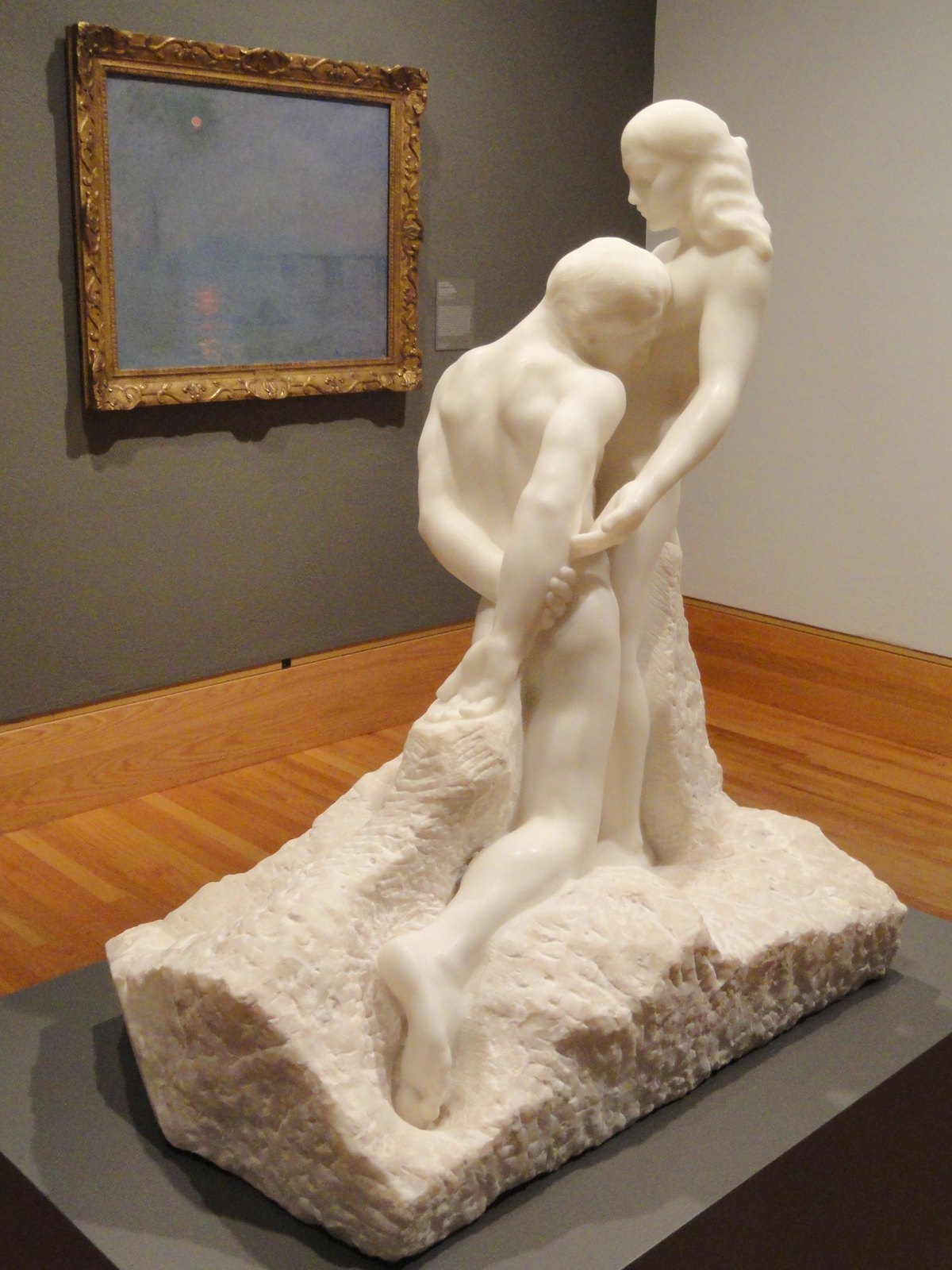
The Harvard marble was executed by Jean Escoula. The pale stone makes the separation between the upper bodies easy to follow. Photograph by Daderot, Wikimedia Commons. Image source. CC0 / Public domain. Resized for the web.
The colour of the pale surfaces and base in the photograph can be compared with the darker patinated plaster and the comparatively even light tone of Harvard’s marble in museum photographs. The bent knee, high seat and prominent unfinished-looking block are more dependable features for recognising the composition. Each version can then be described from details particular to it. Those may include tool marks visible under changing light, a joint in a plaster, or an inscription that identifies the foundry on a bronze. What comes through strongly in the pictured side view is the way the rough support sets the figures at separate heights and gives their small point of contact its force. [1] [2] [3] [4] [6]
Workshop plasters at different scales
The Musée Rodin preserves a 17.5-centimetre plaster, S.03255, catalogued as a foundry model. The museum records release agent on its surface and an annotation in the section between the figures and the mound. A second foundry model, S.00048, stands 29.8 centimetres high. Its base bears separate annotations for moulding the woman and the man in June 1927. The date of the annotation belongs to a later use of the plaster. The museum also relates this example to the marble in the Fogg collection and identifies its use in pointing, the transfer of measurements to a block. [2] [7] [8]
A third plaster, S.01044, measures 73.2 centimetres and is catalogued as a cast from the Fogg marble with a patina intended to imitate its appearance. In that case information travelled from stone back into plaster. The three plasters show different workshop uses for the composition. Below the figures, differences in depth also matter. A small model whose base is only 8.2 centimetres deep gives the encounter a compressed footprint, while a cast over 40 centimetres deep leaves much more room for the folds and slopes of the mound to come into view as the spectator moves around it. [7] [8] [9]
Rodin artworks directory
Discussion
Look again at the images and ideas explored in Eternal Idol. These editorial prompts invite your observations.
Reader Insights
After reading “The two figures and the rock”, what detail would you look for in the object or image?
What extra evidence would help you distinguish the artist’s choices from the effects of material, viewpoint or later display?
Join the Conversation
Share a detail, comparison or question about Eternal Idol below.
References
- Musée Camille Claudel. The Eternal Idol, S.3136. View source.
- Harvard Art Museums. Eternal Idol, 1943.1034, collection manifest. View source.
- Montreal Museum of Fine Arts. The Eternal Idol, 2016.164. View source.
- Leopold Museum. The Eternal Idol. View source.
- Musée Rodin. Camille Claudel. View source.
- Harvard Art Museums. Eternal Idol, collection photograph and object data. View source.
- Musée Rodin. L’Éternelle Idole, small foundry model S.03255. View source.
- Musée Rodin. L’Éternelle Idole, plaster S.00048. View source.
- Musée Rodin. L’Éternelle Idole, large plaster S.01044. View source.

 Auguste Rodin.jpg)





