


 by Tom Gurney
Tom Gurney BSc (Hons) is an art history expert with over 20 years experience
Published on June 19, 2020 / Updated on November 18, 2026
Email: tomgurney1@gmail.com / Phone: +44 7429 011000
Cambodian Dancer, 1906
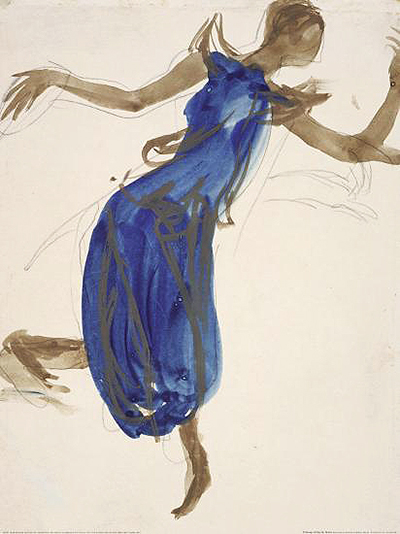
A dancer leans across the sheet in a blue garment, with one arm extended towards the left and the other rising at the right. Her feet turn in different directions below the broad area of colour. Around the body, fine lines extend past the painted shapes. They make some contours appear to continue even where the wash has stopped. Auguste Rodin made a series of drawings of members of the Royal Ballet of Cambodia after encountering the troupe during King Sisowath’s visit to France in 1906. The blue-garbed figure illustrates his interest in how a gesture can be carried across an entire body. [1] [2]
The figure in blue
Begin with the slant from the hips to the head. The upper body inclines towards the right, where the face comes close to the top edge. At the hips the blue spreads towards the left, then drops into rounded folds. This change of direction lets the figure occupy much of the sheet without needing a setting behind her. A faint line continues into the unpainted area near the hip. The painted contour makes the body easy to find at first glance, while the longer marks give the eye more than one way to follow its movement. Look in particular at the point where the wash narrows at the waist and the thin lines spread apart again. [1] [2]
The arms carry that movement across the page. On the left, a long curve runs through the elbow and ends in fingers bent downwards. The outline beyond the fingers is much fainter. On the right, a darker brush mark follows the lower edge of the arm towards the frame, where the upward gesture is partly cut off in the reproduction. The two arms give the torso a breadth that the garment’s dark vertical folds alone would never suggest. It is possible to read the overall position before looking for the exact edges of the hands. The different textures and weights of the marks then reward a slower look. [1] [2]
The patches of colour organise the lower half as well. The larger area of blue gathers into a dark rounded hem before the ankle comes into view. The descending foot occupies a small patch of untouched paper. At the left, another painted passage breaks across the pale space below the sweeping line at the hip. These touches of colour draw attention to the feet, even though much more of the paper is given to the garment. The isolated descending foot makes an especially clear end to the long dark shape. Its small curve returns towards the left, which sends the eye back across the blue to the brown marks at the other side of the garment. Looking at that small interval below the hem helps explain why the drawing can suggest a movement continuing beyond the moment it records. [1] [2]
The ballet and the 1906 visit
The Royal Ballet accompanied King Sisowath on his official visit to France. The Musée Rodin places his encounter with the dancers in July, at a performance at the Pré Catelan in Paris. He followed the troupe to Marseille, where they were due to sail home. The visit took place in the context of French colonial rule and the Colonial Exhibition at Marseille. The drawings preserve Rodin’s perspective on an encounter that also brought a Cambodian court tradition before French audiences. The troupe had a practice and repertoire of its own, which supplied the movements to which the artist responded. [1] [3] [4]
Cambodia’s Ministry of Culture and Fine Arts describes how the Royal Ballet conveys meaning through gesture, with singers taking part in the performance. UNESCO also describes distinct character types and the close relationship of the dance with the Khmer court. Rodin’s image gives considerable space to the hands and arms, but a single drawn position leaves out much of what a performance could convey with music, costume and successive movements. The hands are worth looking at both for how they balance the body and for the sense that they came from a trained vocabulary of movement. The individual role and the precise meaning of the gesture would require evidence beyond the sketch. [1] [3] [4]
Watch Rodin’s sculpture up close
Five films explore Rodin’s sculpture, from his use of classical models and the figures on his monumental doorway to the work of his studio.
Auguste Rodin – Challenging Beauty
Six sculptures show how Rodin adapted classical models.
Watch on YouTubeLine and wash across the series
Research for the Courtauld’s exhibition on Rodin and dance examined several drawings with the aid of a microscope. The researchers described cases in which pencil preceded paint and in which a brushstroke of flesh colour gave more body to a drawn shape. That helps explain why a pencil line can remain legible beside a stronger wash. The precise sequence in the sheet illustrated here cannot be established from its reproduction. Visually, the line around the waist and the stronger sweep of the garment do different kinds of work. The line carries the movement into the paper, while the denser blue gives the figure weight and brings the tilt of the upper body into focus. [2] [5]
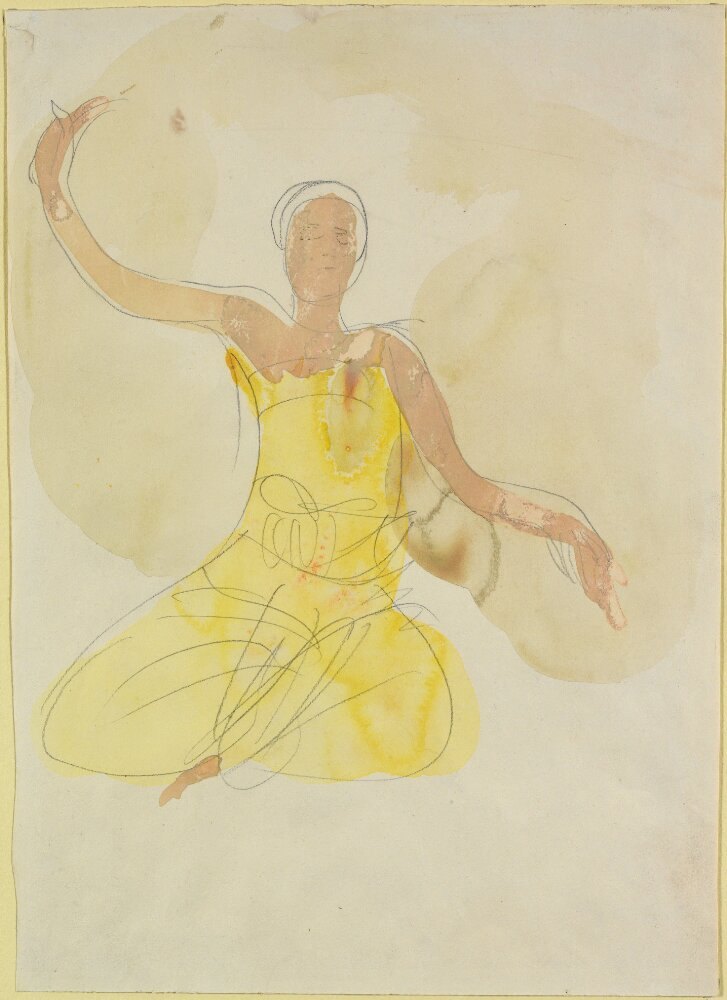
Rodin made several studies of individual dancers. This separate sheet in Stockholm gives a comparison for his treatment of the figure and costume. Nationalmuseum, Stockholm, via Wikimedia Commons. Image source. Public domain. Resized for the web.
The Musée Rodin records sheets with several dancers as well as those that concentrate on one performer. A multiple study lets the eye move between poses without leaving the page. The figure in this image has enough space for the directions of the arms and legs to be compared within a single pose. Other individual sheets also differ in scale and material. Stockholm’s Nationalmuseum records its Dancer from Royal Cambodian Ballet, NMH 186/1918, as pencil and watercolour on paper, with its own measurements and accession. The names recur across the series, and the colours or direction of a figure may be more immediate points of comparison before an accession can be assigned. [1] [6] [7]
It is worth returning to the edge of the right arm after looking at other sheets. The picture allows that gesture to carry beyond the frame while the lowered foot still has a margin beneath it. The distribution of space gives the arm a different force from the pointed foot, despite the relatively small amount of colour in either. The body can appear to move across the paper and to hang for a moment above its lower field. That effect depends as much on where Rodin lets the marks end as on the sweep of the central blue garment. [1] [2]
A signed sheet with several kinds of mark
The Musée Rodin’s D.05066 gives a documented comparison for the layering of materials. The museum records graphite, watercolor, gouache and touches of greasy crayon on wove paper. The sheet is 31.2 centimetres high and 19.5 wide. The narrow format gives a single figure relatively little room from side to side. The mixed materials give Rodin several ways to keep nearby forms distinct, from the fine limits of a pencil contour to passages of color with varying opacity. The signature and the annotation at the lower right are further marks on that particular sheet, accessible through the museum’s record and separate from the drawing’s handling of the garment. [8]
That inventory illustrates the limits of identifying a medium from a reproduction. An opaque patch may call attention to the possibility of gouache, while the edges of a translucent wash show how far the liquid moved on the paper. A color reproduction can convey both effects without resolving what went into the mixture. D.05066 and the Stockholm sheet have separate technical descriptions. Their records allow a comparison of Rodin’s range across the series while the exact identity of the illustrated blue figure remains open. [5] [7] [8]
Rodin artworks directory
Discussion
Look again at the images and ideas explored in Cambodian Dancer, 1906. These editorial prompts invite your observations.
Reader Insights
After reading “The figure in blue”, what detail would you look for in the object or image?
What extra evidence would help you distinguish the artist’s choices from the effects of material, viewpoint or later display?
Join the Conversation
Share a detail, comparison or question about Cambodian Dancer, 1906 below.
References
- Musée Rodin. Rodin and the Cambodian Dancers. View source.
- The Courtauld. Rodin and Dance: The Essence of Movement. View source.
- Musée Rodin. Rodin et les danseuses cambodgiennes. View source.
- Ministry of Culture and Fine Arts, Cambodia. Royal Ballet of Cambodia. See also UNESCO’s Royal Ballet of Cambodia. View source 1. View source 2.
- The Courtauld. The Body in Motion, teachers’ resource, interview on materials and conservation. View source.
- Musée Rodin. Six études de danseuses cambodgiennes. View source.
- Nationalmuseum, Stockholm. Dancer from Royal Cambodian Ballet, NMH 186/1918. View source.
- Musée Rodin. Danseuse cambodgienne, D.05066. View source.

 Auguste Rodin.jpg)





