


 by Tom Gurney
Tom Gurney BSc (Hons) is an art history expert with over 20 years experience
Published on June 19, 2020 / Updated on November 18, 2026
Email: tomgurney1@gmail.com / Phone: +44 7429 011000
Youth Triumphant
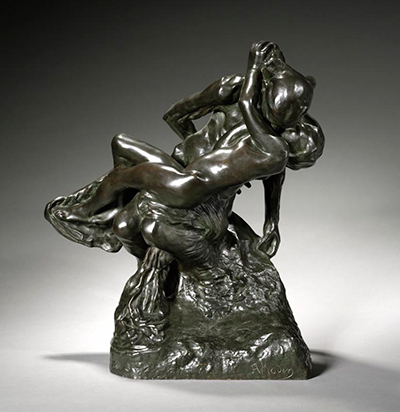
A young woman reaches across the lap of an older woman in Auguste Rodin’s Youth Triumphant. Their heads are close together at the top of the group, while the younger body stretches across the sculpture on a diagonal. Rodin adapted the seated figure from She Who Was the Helmet Maker’s Beautiful Wife, a work inspired by François Villon. Bringing the two bodies together changes the meaning of the seated pose. The legacy photograph matches the Cleveland Museum of Art’s bronze, where the smooth surface of the younger figure catches the light above a deeply textured base. Cleveland catalogues the work as Triumphant Youth. [1] [2] [3]
The long diagonal across the group
The group rises from a broad, rough base. The figures are set off to one side at the top, while the legs of the younger woman extend towards the other. The line of the foreground leg crosses the sculpture above the widest area of the base. Its shin and thigh catch relatively even bands of light. Greater changes of surface are visible directly beneath them, where the older body emerges from the support. A viewer can begin with the long diagonal and follow it upwards until it turns into the compressed forms at the women’s heads. That change in spacing helps give the group its sense of movement. [1]
Around the shoulders the position of one figure becomes difficult to distinguish from that of the other. The nearer arm makes a clear bend, and the elbow gives the eye a point from which to follow the forearm up. At the side, another arm drops almost vertically towards the stone, its hand just above a rough area. The downward arm is visible against a small opening, while the raised one belongs to the more closely packed upper section. The difference gives the eye two ways to travel between the heads and the low part of the group. [1]
The Cleveland photographs show how the contact changes with the viewing angle. In the front view the legs extend a long way to the left, and the joined heads occupy a position high above the support. From one side the dropping arm can be followed more distinctly, and more of the seated woman’s torso comes into view. From behind, the smooth curves of the upper bodies stand apart from several shallow hollows in the base. Those views help locate the places where the two women support each other. They also show how a leg can seem to project free of the group in one photograph and pass close to the seated body in another. [1]
The older figure and Villon
The Musée Rodin records She Who Was the Helmet Maker’s Beautiful Wife as a work conceived between 1885 and 1887. It traces the subject to a poem by François Villon and identifies an early appearance of the figure on a pilaster of The Gates of Hell. The independent sculpture gives much of its attention to the older woman’s seated body, including the bend of the back and the irregularities of the flesh. The Musée Rodin’s 1891 bronze gives a comparison for the body Rodin reworked for the group. The hand, shoulders and base can be looked at separately there before considering how the second figure alters them. [2] [3]
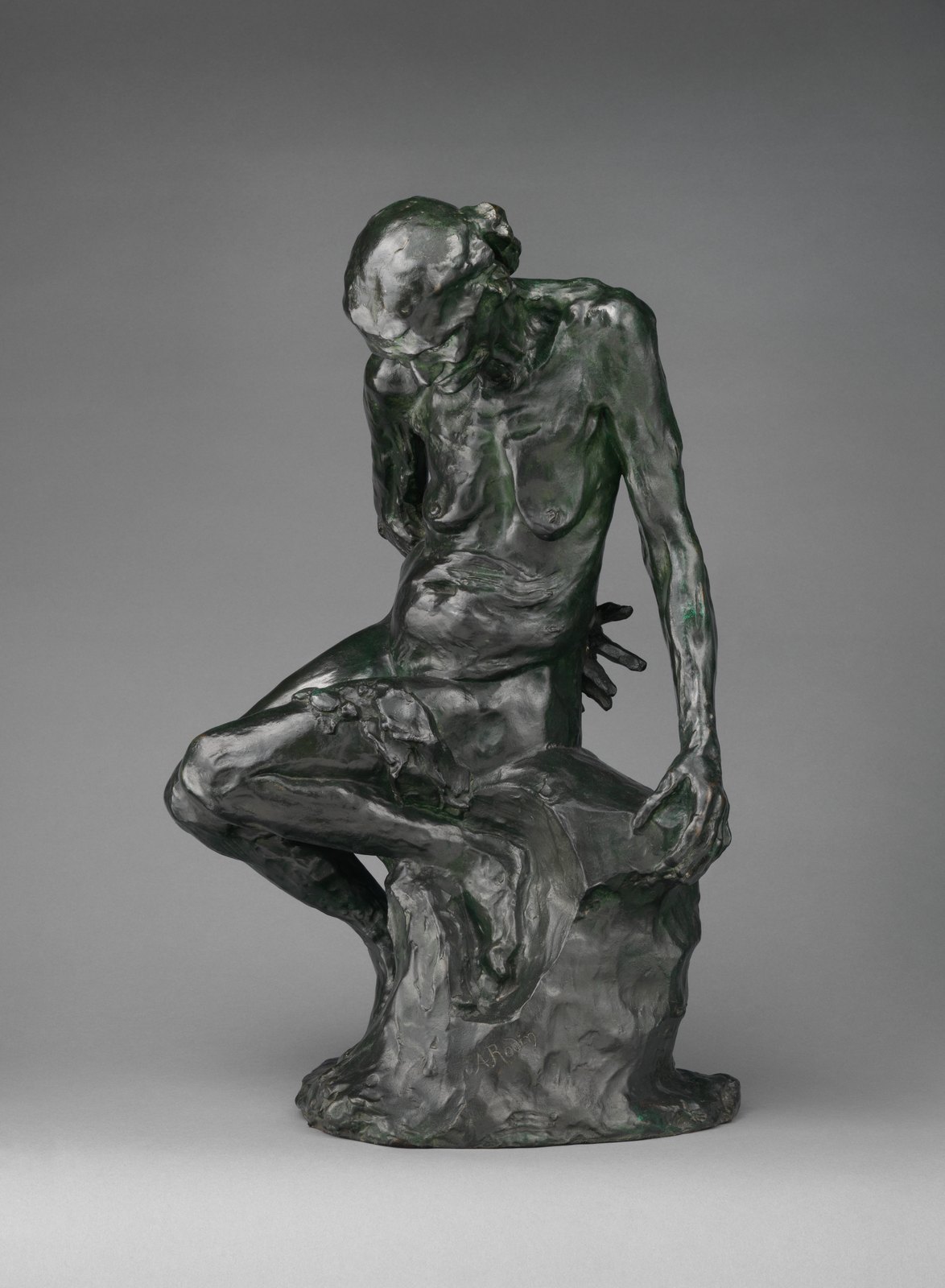
The Old Courtesan lets the viewer compare the older figure in isolation with the role she takes on in Triumphant Youth. The Metropolitan Museum of Art, Gift of Thomas F. Ryan, 1910, 11.173.3. Image source. CC0 / Public domain.
In Youth Triumphant the older figure remains low and close to the rough support. Her body provides a place against which the younger woman can extend herself. The smooth upper surfaces of the younger figure are picked out more clearly in the main Cleveland photograph. The older figure’s body is partly hidden by them, and some of its curves appear through the shadows under the crossing leg. Rodin makes the difference in age legible through both the modelling and the space each woman occupies. The younger body takes up much of the air around the seated figure, whose outline leads back down to the base. [1] [2] [3]
Watch Rodin’s sculpture up close
Five films explore Rodin’s sculpture, from his use of classical models and the figures on his monumental doorway to the work of his studio.
Auguste Rodin – Challenging Beauty
Six sculptures show how Rodin adapted classical models.
Watch on YouTubeAn embrace interpreted from several angles
The title makes the difference of ages an explicit part of the work. In the Cleveland view, the younger body takes the most extended position and sets the direction of the diagonal. The heads offer a smaller, quieter point of contact. The older figure’s closeness to the younger appears in the inclination near the top of the group, while the support she gives can be traced lower down. The sculpture brings those gestures together within a position that can look active and precarious from one angle and more closely supported from another. [1] [3]
Rodin’s use of a figure from an existing work meant that the gesture could acquire new emphasis through contact. A seated pose in the individual sculpture leads the eye inward through the woman’s bent limbs. In the group, the young woman’s body carries that movement onward, out over the edge of the support and up towards the meeting faces. The separate original still helps explain where the older body folds and which areas remain close to the ground. The new arrangement draws attention to the space between two people as well as to the particular shapes of their bodies. [1] [2] [3]
A narrow patch of background beside the lowered hand is especially distinct in the side views. The hand approaches the base with the fingers loosely bent, giving the eye a measure of its distance from the supporting mass. Above it, the raised elbow partly hides the other woman’s head. The two ends of the composition thus have different degrees of openness, even when the group is seen against a plain background. [1]
The Cleveland bronze
Cleveland dates its bronze to about 1894 and records a height of 52.1 centimetres. The legacy photograph has the same arrangement of highlights, shadow on the ground and outline of the base as the museum’s main image of accession 1960.88. The Musée Rodin also documents a plaster pointing model associated with the Vienna marble. Those records make it possible to distinguish the photographed bronze from other versions of the composition. In the Cleveland view, the bottom of the sculpture occupies a substantial area of the image. Its rough finish brings the viewer back to the ground from the lit curve of the young woman’s leg and the narrow passage around the women’s shoulders. [1] [4]
The reclining figure considered separately
The Arkın collection relates the younger figure to an independent work called Fatigue. That title gives a different emphasis to the same inclination. Alone, the reclining figure’s weight and the extension of her body suggest the effort of lying down or remaining still. In Youth Triumphant her posture carries the viewer towards the older woman, where the bodies meet. The diagonal that describes the reclining form becomes part of an encounter. The connection with Fatigue makes the younger figure easier to read as a form Rodin could adapt to a different subject. [1] [3]
The Cantor Arts Center’s exhibition checklist records a separate bronze of Youth Triumphant and associates the design with 1894. The Musée Rodin’s pointing model is linked specifically to a marble in Vienna. Comparing the records keeps the dates, material and workshop function attached to the relevant objects. The recurrence of the diagonal across those records belongs to Rodin’s design, while the texture and shadows may change with the medium and the way each version is displayed. [1] [4] [5]
Rodin artworks directory
Discussion
Look again at the images and ideas explored in Youth Triumphant. These editorial prompts invite your observations.
Reader Insights
After reading “The long diagonal across the group”, what detail would you look for in the object or image?
What extra evidence would help you distinguish the artist’s choices from the effects of material, viewpoint or later display?
Join the Conversation
Share a detail, comparison or question about Youth Triumphant below.
References
- Cleveland Museum of Art. Triumphant Youth, 1960.88. View source.
- Musée Rodin. Celle qui fut la belle Heaulmière. View source.
- Arkin Rodin Collection. La Jeunesse Triomphante. View source.
- Musée Rodin. Jeunesse triomphante, pointing model for the Vienna marble. View source.
- Cantor Arts Center. Rodin: The Shock of the Modern Body, exhibition checklist. View source.

 Auguste Rodin.jpg)





