


 by Tom Gurney
Tom Gurney BSc (Hons) is an art history expert with over 20 years experience
Published on June 19, 2020 / Updated on November 18, 2026
Email: tomgurney1@gmail.com / Phone: +44 7429 011000
Young Woman
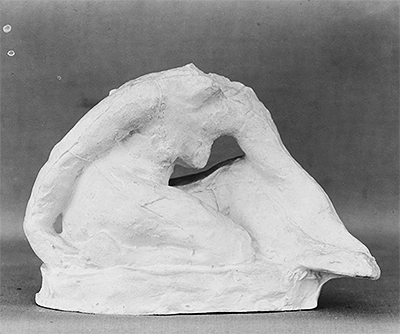
A small plaster figure bends into a tight arc in Auguste Rodin’s Young Woman. The pale mass rises from a low foot, reaches a crest near the middle and comes down on either side of a dark opening. The Metropolitan Museum of Art records the height as 10.2 centimetres. It dates the modelling to probably before 1889 and the casting to before 1912, the year Rodin gave the work to the museum. The sculpture’s scale brings the outline and the shallow changes in its surface close together. In the photograph, the dark opening makes the figure’s inward turn visible even before its parts come into focus. [1]
The outer contour and the opening
The left edge rises in a long curve. It begins just above the low base, where a narrow strip of plaster turns back towards the figure, then thickens as it approaches the crest. The right side takes a different route down. It is broader and forms a sloping surface that comes to a point beyond the end of the base. Between those two sides lies the triangular opening. Its upper edge is rounded, and its lower edge rises at an angle. Those boundaries give the opening a direction of its own, drawing the eye into the fold of the figure rather than straight through the middle. [1]
Moving along the top contour gives an impression of one continuous movement over the whole work. The opening interrupts that impression. It reveals that the pale forms belong to different surfaces separated by a clear interval. Just below it a dark line extends inward between those surfaces. The line is narrow enough to be missed on a first look, but it continues the darker area into the plaster and helps distinguish the portions that overlap. The edges of the opening are especially important because most of the sculpture is lit in similar tones. The difference between plaster and background supplies a much firmer division than the shadows across the plaster itself. [1]
There is more open background above the sides than above the crest. The mass spreads outward close to the support, while the top narrows to a short ridge. Compare the shadow at the foot of that ridge with the shadow on the ground. One lies inside the contour and turns with it, while the other runs along the bottom edge. Together they locate the figure’s highest and lowest points and give the unbroken pale surface between them a sense of depth. [1]
A sculpture barely four inches high
The low base extends across most of the width of the photograph. Its front has a nearly level stretch where it meets the ground, but the upper edge is irregular and rises towards the parts it supports. The broader form at the right extends out over it. A shallow recess below that projection leaves a second dark area, smaller and closer to the ground than the opening in the middle. At the far left, the curve of the figure approaches the support almost vertically. The base gives these changing contours a common level and makes the projection at the right seem longer than its size alone might suggest. [1]
The museum’s measurement helps put these details in scale. At about four inches high, the sculpture has to be viewed from quite close to see the short lines that run across the surface. The photograph fills most of the frame with the object and makes those marks easier to compare. It also keeps the main opening visible at the level of the bent figure. A higher view would make the upper surfaces more prominent and shorten the visible height of the base. In this position the viewer can read the different depths of the pale mass without losing the outline against the darker background. [1]
Watch Rodin’s sculpture up close
Five films explore Rodin’s sculpture, from his use of classical models and the figures on his monumental doorway to the work of his studio.
Auguste Rodin – Challenging Beauty
Six sculptures show how Rodin adapted classical models.
Watch on YouTubePlaster as a record of Rodin’s working process
The Met identifies the material as cast plaster. Plaster could preserve the form of a model while making it easier to retain or repeat a small figure. The museum’s history of its Rodin collection describes how he developed figures from individually modelled parts and how parts of existing sculptures could serve again elsewhere. It also documents gifts of plaster studies, including casts of limbs, that the artist made to the museum. That history gives context to the presence of such a small object in the collection. The museum records this work under its own title and accession number, 12.12.5. [1] [2]
Rodin’s broader practice helps explain why a sharply finished anatomy is only one way of reading a work of this scale. On the left, short changes of slope give definition to the curve without breaking its direction. Around the crest, there are rougher passages that leave the edge less even. The right-hand form is broader and shows a shallower transition towards the base. The amount of detail varies across the object, but the broad relation of the silhouettes remains clear. Looking from the crest down to the bottom of the opening gives a sense of the joined shapes before the eye approaches the smaller marks within them. [1] [2]
The gift of 1912
The Met dates the modelling and casting separately. Its catalogue leaves the date of modelling approximate, while the 1912 gift provides a documented point in the history of this particular plaster. That year the museum opened a gallery devoted to Rodin’s work. Its account of the collection describes objects entering through commissions, acquisitions from the artist’s studio and gifts of studies and models. A plaster like Young Woman allows the work of modelling to be seen at a scale very different from the large marbles and bronzes often associated with Rodin. [1] [2] [3]
The museum’s photograph and the reproduction on this page share the same viewpoint. The crest, the black interval at the centre and the overhang at the right align, as do small spots in the background. The match identifies the plaster even though the title is general. The paired images make a useful distinction between the object’s recorded height and the size at which it can appear on a page. Close framing gives unusual prominence to both the recess at the base and the shape held within the bent figure. [1]
Another plaster in the 1912 gift
The Met also received Old Woman Standing with Folded Arms, 12.12.1, from Rodin in 1912. At 31.1 centimetres high, it stands about three times as tall as Young Woman. The museum associates the older figure with the model who posed for The Old Courtesan. Its published collection history also records an exhibition stamp from Prague and suggests that the plaster may have been shown there in 1909. The records for the small Young Woman identify the cast and date of the gift while leaving its model date approximate. The two accession records preserve different amounts of evidence about the works before their arrival. [1] [2] [4]
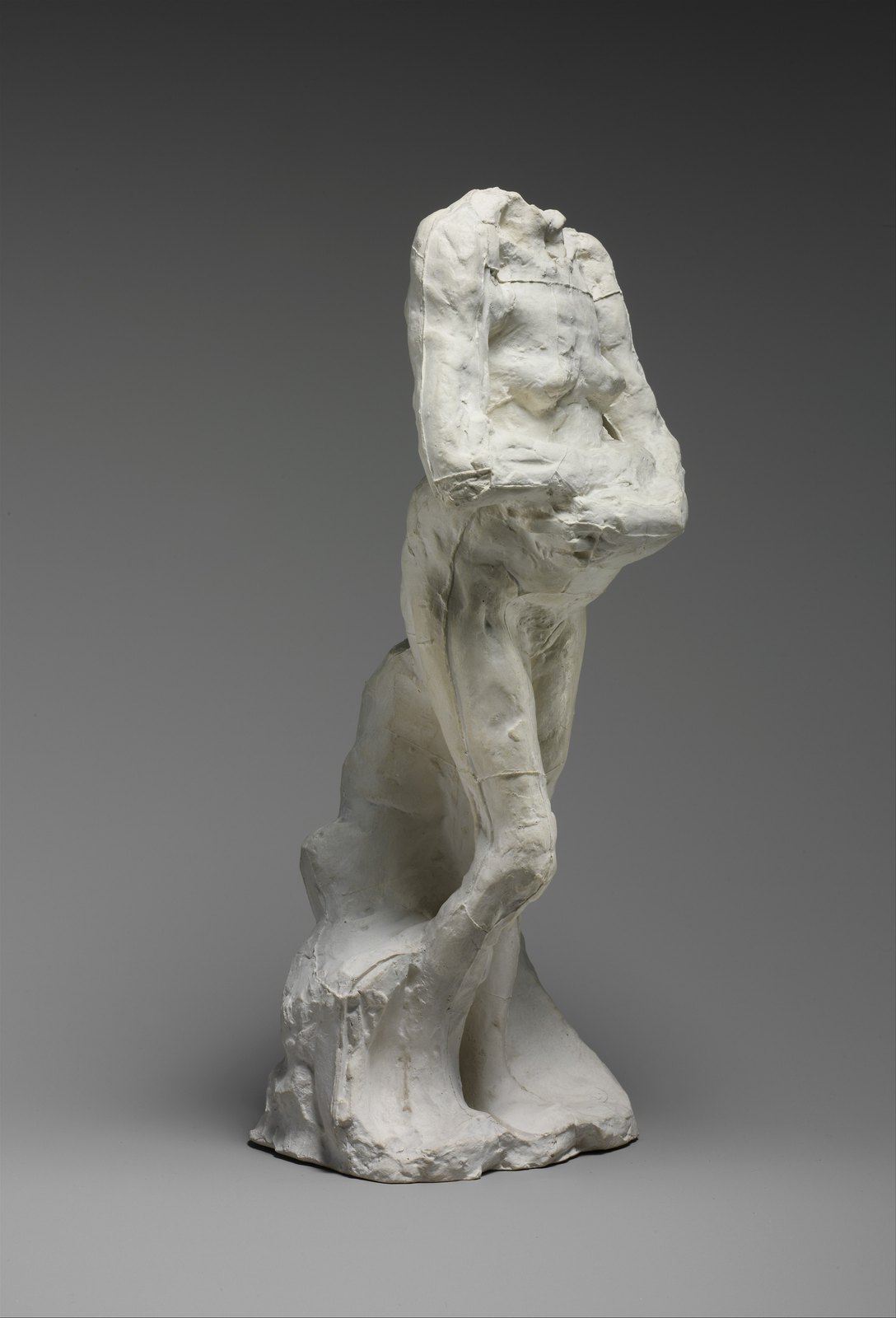
Old Woman Standing with Folded Arms was also part of Rodin’s 1912 gift to the Met. Its upright pose gives a comparison for the tightly bent Young Woman. The Metropolitan Museum of Art, Gift of Auguste Rodin, 1912, 12.12.1. Image source. CC0 / Public domain.
The comparison also shows how much scale determines the reading of plaster. In the taller figure the viewer can study how forearms cross in front of the torso and how the legs bear the weight. In Young Woman, the outline and the small opening through the form catch the eye sooner. The plasters belong to the same gift, and the two objects show how widely the scale and purpose of figure studies in that gift could vary. [1] [4]
Rodin artworks directory
Discussion
Look again at the images and ideas explored in Young Woman. These editorial prompts invite your observations.
Reader Insights
After reading “The outer contour and the opening”, what detail would you look for in the object or image?
What extra evidence would help you distinguish the artist’s choices from the effects of material, viewpoint or later display?
Join the Conversation
Share a detail, comparison or question about Young Woman below.
References
- Metropolitan Museum of Art. Young woman, 12.12.5. View source.
- Metropolitan Museum of Art. Rodin at The Metropolitan Museum of Art: A History of the Collection. View source.
- Metropolitan Museum of Art. Rodin centenary and the history of the Met’s collection. View source.
- Metropolitan Museum of Art. Old Woman Standing with Folded Arms, 12.12.1. View source.

 Auguste Rodin.jpg)





