



 by Tom Gurney
Tom Gurney BSc (Hons) is an art history expert with over 20 years experience
Published on June 19, 2020 / Updated on November 18, 2026
Email: tomgurney1@gmail.com / Phone: +44 7429 011000
Prints
The face of Victor Hugo takes shape in one of Auguste Rodin’s drypoints through short strokes around the eyes, the forehead and the beard. The image is smaller than a page of ordinary writing paper. Yet the person in it seems close enough to be caught looking back. Rodin made more than one print of Hugo, and one plate could pass through several alterations. An impression in the Metropolitan Museum of Art is the second of nine states of the full-face portrait. The state identifies a point in the making of the image. It gives the viewer a way to follow what Rodin changed before another sheet of paper was printed. [1] [2]
Drawing into the plate
The Musée Rodin connects his interest in printmaking with the example and encouragement of his friend Alphonse Legros, who taught the art. Rodin worked especially in drypoint. A needle is drawn straight into the plate, raising a tiny ridge of metal along the cut. The ridge can hold ink and give the edge of a stroke a soft, dark quality. The resulting line can look direct enough to suggest a drawing, although its appearance also depends on the way the plate is inked, wiped and printed. The paper can preserve the impression of the plate’s edge as well as the marks made into the metal. [3] [4]
A state records a change made to a printing plate. Two impressions printed from the same state can still differ in tone, because ink and pressure can vary. A second state means the artist changed the plate after the first state was established. The difference might be a few added strokes, stronger modelling around an eye, or changes elsewhere that shift the balance of the whole head. To check what happened, find impressions catalogued by state and look for the lines themselves before deciding what a change of darkness means. A small difference in a portrait can become important when it gives a brow more weight or draws attention to the direction of the sitter’s eyes. [1] [2] [4]
Prints and reproductions


 Auguste Rodin.jpg)





Two views of Victor Hugo
Rodin had been allowed to observe Hugo, although the poet did not formally pose for him according to the early accounts discussed by the Met. Working in those circumstances gave the sculptor reason to attend to how a face changes as it turns and to preserve impressions before they disappeared. The museum’s three-quarter view, 16.37.2, is catalogued as the second of eight states. Its full-face drypoint, 16.37.1, is the second of nine. The numbers belong to two distinct plates. The prints keep different views available, much as sketches might, while the possibility of revision let Rodin continue working through what he had seen. [1] [2] [5]
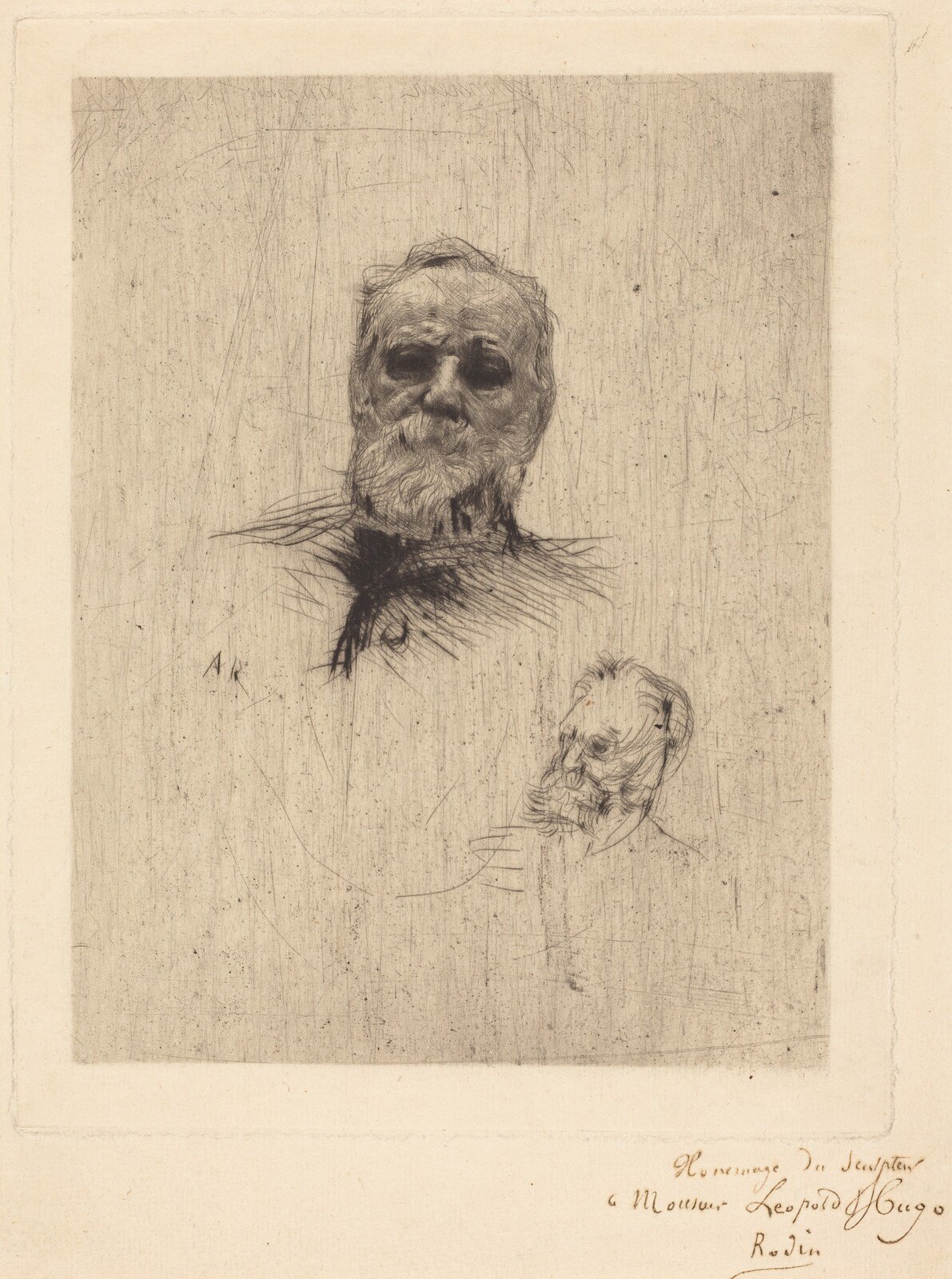
Rodin’s frontal drypoint of Hugo shows how closely spaced lines can build tone around the face. National Gallery of Art, Washington, Rosenwald Collection, 1943.3.7406. Image source. CC0 / Public domain.
In the full-face print the two halves of the beard help hold the head within the sheet. In the other view the slope of a cheek and the distance from one eye to the edge of the face give a stronger sense of the head turning. Compare either with a sculpted bust and the paper makes different things visible. A line that would become an edge or a ridge in a three-dimensional portrait can be given a separate darkness on paper. One medium lets the viewer choose a position, while the other lets Rodin crop and hold a single view. [1] [2] [5]
Watch Rodin’s sculpture up close
Five films explore Rodin’s sculpture, from his use of classical models and the figures on his monumental doorway to the work of his studio.
Auguste Rodin – Challenging Beauty
Six sculptures show how Rodin adapted classical models.
Watch on YouTubeHenri Becque and the printed edition
A portrait of Henri Becque shows another reason to ask who made and issued a print. The National Gallery of Art records a drypoint in its first of five states. The Met holds an example associated with L’Estampe Originale. The relationship between a working impression and a print issued as part of a publication matters to the life of the image. A plate can begin as a way of investigating the shape of a face, then take that portrait to subscribers who will see it beside work by other artists. The publication gives one impression a context that is separate from what can be seen in the lines of the face. [6] [7]
The Musée Rodin’s catalogue also lists graphic works such as La Ronde and Le Printemps. The entries point to Victoria Thorson’s catalogue raisonné of drypoints and book illustrations. This is useful for tracing the history of a printed work when the title is also found on another kind of object. A reader should expect a full catalogue record to distinguish the subject, the printing process, the artist or maker, and the impression. A sheet with a signature in the margin is itself a thing to be examined, with information the image alone may not provide. [8] [9]
A drypoint could also be made for a very specific occasion. In 1916 Rodin made an image for a notice acknowledging donations to a hospital in Paris that treated face and jaw injuries. The Met holds examples of both its states. Here the individual sheet has a purpose beyond representing a sitter or circulating among print collectors. It was meant to reach people who had contributed to the hospital and to record that connection. [4]
Prints by Rodin and prints he owned
Rodin collected prints made by others. Gifts, exchanges and purchases brought a range of European artists into that collection, including Legros and Félix Bracquemond. He collected Japanese prints as well, with works associated with artists such as Hiroshige, Kuniyoshi and Hokusai. The Musée Rodin’s collection register can therefore list an image under a maker quite different from the person who owned it. A print after a Rodin sculpture raises a further question. A maker might have translated a sculpted surface into lines, or a publisher might have reproduced a photograph of the work. The sculptor helped supply the subject, while the image on the paper has a history and a maker of its own. [3] [10]
When comparing prints, start with the name of the maker, then check the technique, the state if one is given, and the collection number. In the two Hugo portraits, those few details can lead you from the physical sheet back towards the work on the plate. They also give you a way to tell an impression of Rodin’s drypoint from a reproduction of the same face. Both can make the likeness available, but in the original impression it is possible to look closely at the kind of mark by which Rodin brought that face into view. [1] [2] [10]
A lithographer translates Rodin’s drawings
The Met credits Auguste Clot as lithographer on the 1902 frontispiece for Octave Mirbeau’s Le Jardin des Supplices. Rodin supplied the artwork and Clot translated it into color lithography. The printed sheet measures 32.7 by 25.1 centimetres. Its size is close to that of one of Rodin’s large figure drawings. In the book the image has another function, marking the beginning of the text and establishing the visual register for the plates that follow. A viewer of the separate impression can look at its color and contour while the book explains the position for which it was made. [11] [12]
The museum’s paper conservators also examined a composition of two figures that had been catalogued as a drawing. Under magnification the apparent drawn lines proved to have been printed. The print now bears Clot’s name after Rodin, and the underlying drawing is in the Musée Rodin. This is a different relationship from the one in the Hugo drypoints, in which Rodin worked directly on the plate. With Clot, the means of printmaking had to carry the appearance of a mark made in another medium. The catalogue therefore credits a second maker whose contribution can be easy to miss when the printed surface convincingly resembles a drawing. [1] [2] [12]
Rodin artworks directory
Discussion
Look again at the images and ideas explored in Prints. These editorial prompts invite your observations.
Reader Insights
After reading “Drawing into the plate”, what detail would you look for in the object or image?
What extra evidence would help you distinguish the artist’s choices from the effects of material, viewpoint or later display?
Join the Conversation
Share a detail, comparison or question about Prints below.
References
- The Metropolitan Museum of Art. Victor Hugo (full face), 16.37.1. View source.
- The Metropolitan Museum of Art. Victor Hugo (three-quarter view), 16.37.2. View source.
- Musée Rodin. Gravures. View source.
- The Metropolitan Museum of Art. The Scarred Face of Beauty: Rodin and World War I. View source.
- The Metropolitan Museum of Art. Auguste Rodin (1840–1917). View source.
- National Gallery of Art. Henri Becque. View source.
- The Metropolitan Museum of Art. Portrait of Henri Becque, from L’Estampe Originale. View source.
- Musée Rodin. La Ronde. View source.
- Musée Rodin. Le Printemps. View source.
- Musée Rodin. Gravures, collection portal. View source.
- Metropolitan Museum of Art. Frontispiece for Le Jardin des Supplices, 23.19.1(2). View source.
- Ashley E. Dunn, Metropolitan Museum of Art. Misattributed Drawings in The Met Collection. View source.



