


 by Tom Gurney
Tom Gurney BSc (Hons) is an art history expert with over 20 years experience
Published on June 19, 2020 / Updated on November 18, 2026
Email: tomgurney1@gmail.com / Phone: +44 7429 011000
Eternal Springtime
Two lovers meet above a sloping piece of rock in Auguste Rodin’s Eternal Springtime. The woman’s torso bends backwards while the man bends towards her face. An arm extends away from the embrace and draws attention to the space beyond the bodies. The sculpture is also called Eternal Spring, a translation of L’Éternel Printemps. Rodin developed the group in the early 1880s and produced or authorised versions in several materials and sizes. The shape of the support is one way to distinguish them. In some marbles it rises as high as the man’s extended arm, while bronzes and other versions handle that part of the composition differently. [1] [2] [3] [4]
The arch of the woman’s body
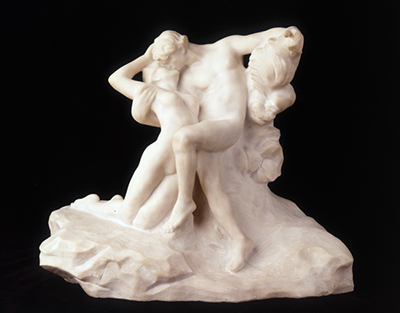
The photograph shows the lovers from the side at an angle that brings out the sweep of the woman’s back. From the base, follow the long slope of the nearer leg up towards her hip. The torso curves away from that line and gathers again at the neck, where the two heads meet. A bent arm makes a small opening beside the heads. Its triangular shape is especially distinct against the dark background. The hollow beneath the arm provides a pause between the broad sweep of the woman’s body and the smaller forms of the faces. [1] [4]
The man’s bent knee crosses the composition closer to the viewer. It is higher than the place where his other leg meets the base. This makes the point of contact between the lovers seem suspended above the ground, even though there is considerable rock beneath them. His shoulders establish a different direction. They extend across the top of the group and lead away from the woman’s uplifted face. In the picture much of the weight sits on the right, where the support rises to meet the extended limb. The contour is more open around the woman’s back, where light separates the figure from the background. [1] [4]
The Musée Rodin identifies the woman’s torso as a variation on its Torso of Adèle. The small study records a body stretching and turning at the waist. Rodin developed another version with arms and legs for the upper left of The Gates of Hell, where it helps link parts of the crowded doorway. He modified the torso and added a head to make it part of the embracing pair. The angle of the breast and the long curve at the side of the torso show what Rodin could carry from one work into another. For the doorway that movement links neighbouring forms. Here it gives the woman’s whole body a direction towards the man. [2]
Zephyr and Earth, Cupid and Psyche
The Metropolitan Museum of Art records Zephyr and Earth as an early title and Cupid and Psyche as the title used at the Paris Salon of 1897. The first brings to mind a personification of the wind and the earth it touches. The second gives the pair names from a well-known story of divine and mortal love. The title Eternal Springtime directs attention towards renewal and desire more broadly. A spectator can follow the same physical action under any of these titles, but the name influences whether the movement seems like an incident in a story or a description of the way the two bodies respond to one another. [1] [5]
Tokyo’s National Museum of Western Art also relates the work to The Kiss and to the subject of love in Dante. The two pairs are arranged quite differently. In The Kiss, the broad seated grouping draws the eye around both figures and back to their shared seat. Eternal Springtime gives greater emphasis to the diagonal of the woman’s rising body. Her lower limbs remain down by the base while her head lifts towards the man. The space near the extended arm gives the pair an outward reach. The movement can be followed from the low strip of support all the way up past the meeting of the faces. [1] [3]
Watch Rodin’s sculpture up close
Five films explore Rodin’s sculpture, from his use of classical models and the figures on his monumental doorway to the work of his studio.
Auguste Rodin – Challenging Beauty
Six sculptures show how Rodin adapted classical models.
Watch on YouTubeMarble commissions and bronze editions
The Met’s marble was carved in 1907. The collector Isaac D. Fletcher commissioned it in 1906 and the work entered the museum with his bequest. The Hungarian National Gallery traces the origin of its marble to Gábor Térey’s encounter with Rodin and his work at the 1900 Paris exposition. Budapest’s version and Fletcher’s both incorporate the rock beneath the extended arm. Their surfaces show how a support can be carried through the composition without giving every part the same finish. Compare the fully modelled figures with the tool marks on the wall of stone at the side. The places where the transition occurs are easier to see from an oblique view. [1] [4] [5] [6]
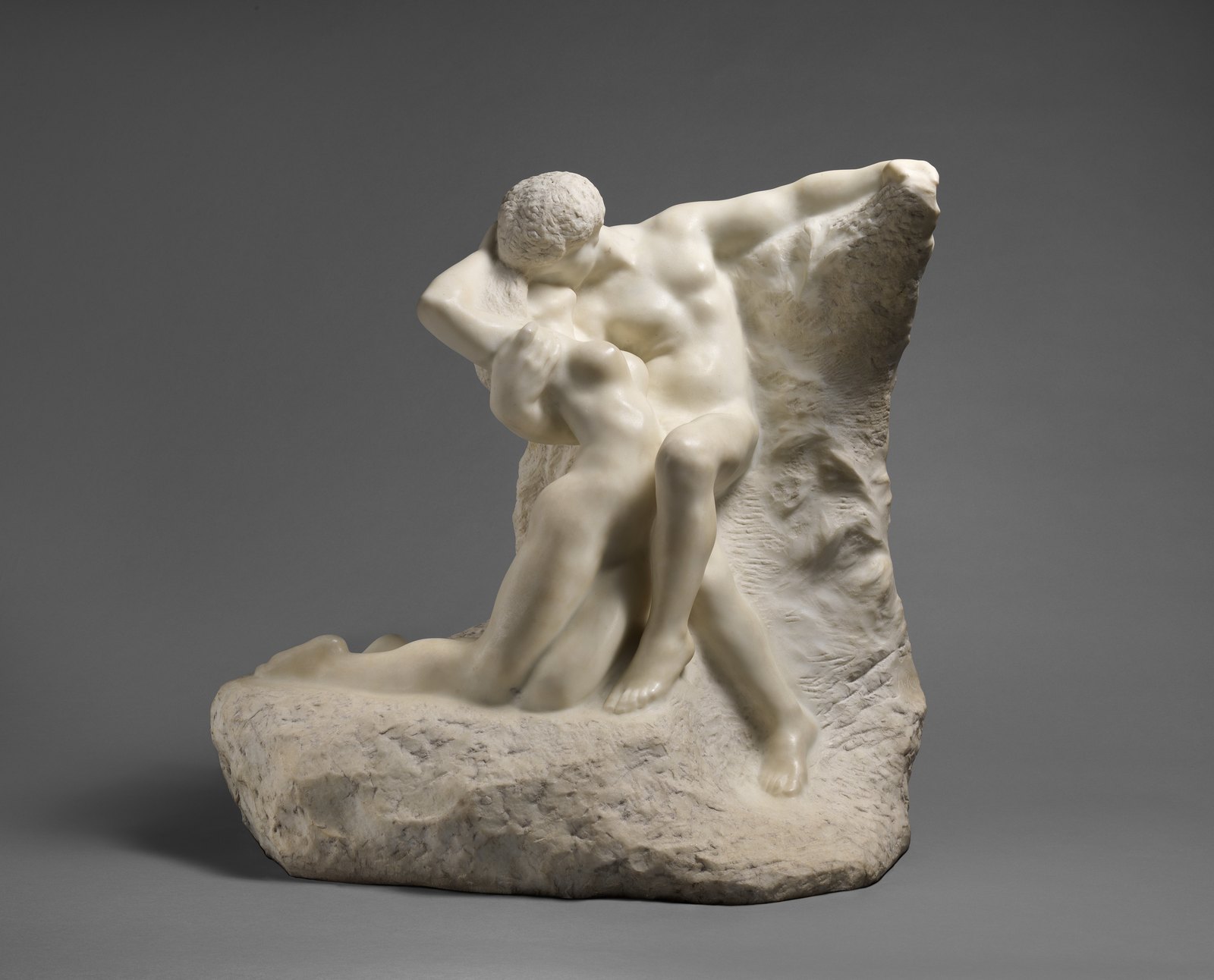
The Met marble shows how the two bodies join across the central opening. The Metropolitan Museum of Art, Bequest of Isaac D. Fletcher, 1917, 17.120.184. Image source. CC0 / Public domain.
The Calouste Gulbenkian Museum’s bronze presents a further comparison. The museum relates its base to a plaster model at the Musée Rodin and notes that the form of the base points to a version developed before 1900. The University of Michigan Museum of Art records a Barbedienne bronze cast between 1898 and 1918 and documents editions in four sizes. These editions gave collectors a choice of scale. In a small sculpture viewed from above, the grouping of the heads and shoulders can be apprehended quickly. At a larger scale the viewer can see the outline of the bent knee and trailing foot from different heights and can follow more of the relationship between the rock and the projecting arm. [7] [8]
The photographed work has the pale tone of the marble versions, but its low, spreading base and the shapes beneath the outstretched arm differ from the published views of the Fletcher and Budapest marbles. The broad slope at the front is especially noticeable. Keep the photograph in view while tracing the shape of the stone from the arm down to the corner at the right. It helps explain the way the support leads the eye back towards the rising figure. Light reduces the outlines near the place where the faces meet, while the irregular contours of the base remain distinct. The junction at the right is especially clear where the projecting mass curves inwards beneath the man’s shoulder before widening again near his foot. Together these features give the group a stable footing and leave the impression of a moment still unfolding above it. [1] [4] [6]
Plaster between bronze and marble
The Musée Rodin’s S.02442 is a plaster foundry model with release agent on its surface. It stands 51.8 centimetres high and carries marks on sections of the man’s head, neck and left leg. The museum transcribes the same number, MB112, on the head and leg. These marks record points in the physical object that could be dealt with separately. In the finished composition the stretch of the man’s body takes the eye from the embrace out towards the edge of the group. The foundry model preserves the same movement while giving the sections their own identifying marks. [9]
Another plaster, S.02817, is catalogued as a cast of the marble at Sunnylands in Rancho Mirage. It is 67.9 centimetres high and 80 wide. Its measurements capture the span of that version, while its material records a further step in the reproduction of an existing marble. The two plasters give evidence of different journeys. One is a model prepared for foundry work. The other records what an already carved version looked like. Looking at the plasters together broadens a comparison that might otherwise begin with a marble and end with a bronze edition. [1] [9] [10]
Rodin artworks directory
Discussion
Look again at the images and ideas explored in Eternal Springtime. These editorial prompts invite your observations.
Reader Insights
After reading “The arch of the woman’s body”, what detail would you look for in the object or image?
What extra evidence would help you distinguish the artist’s choices from the effects of material, viewpoint or later display?
Join the Conversation
Share a detail, comparison or question about Eternal Springtime below.
References
- Metropolitan Museum of Art. Eternal Spring, 17.120.184. View source.
- Musée Rodin. Torso of Adèle. View source.
- National Museum of Western Art, Tokyo. Eternal Springtime, S.1959-0016. View source.
- Hungarian National Gallery. Eternal Springtime. View source.
- Metropolitan Museum of Art. Rodin at The Metropolitan Museum of Art, spring 1981. View source.
- Hungarian National Gallery. Eternal Springtime, collection photograph and history. View source.
- Calouste Gulbenkian Museum. Eternal Springtime. View source.
- University of Michigan Museum of Art. Eternal Spring. View source.
- Musée Rodin. L’Éternel Printemps, foundry model S.02442. View source.
- Musée Rodin. L’Éternel Printemps, cast from the Sunnylands marble, S.02817. View source.

 Auguste Rodin.jpg)





