


 by Tom Gurney
Tom Gurney BSc (Hons) is an art history expert with over 20 years experience
Published on June 19, 2020 / Updated on November 18, 2026
Email: tomgurney1@gmail.com / Phone: +44 7429 011000
Man with the Broken Nose
The nose in Auguste Rodin’s Man with the Broken Nose bends sharply above a heavy moustache and beard. The face is deeply modelled around the eyes, and one side catches more light than the other. Rodin began the portrait in the 1860s, using a man known as Bibi as his sitter. A damaged model became the basis of a mask, which was refused by the Paris Salon in 1865. A marble bust based on the portrait was accepted a decade later. This sequence explains how the same face came to be known in different sculptural forms. [1] [2] [3] [4]
The face in the bronze
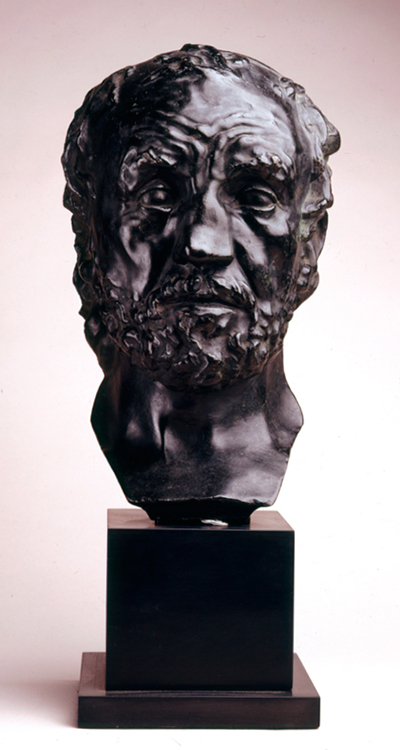
The legacy photograph shows the head almost from the front. The upper part of the forehead is broad and rounded, but the eyebrows rise in irregular ridges. Above the nose, those ridges turn and cross several shorter lines in the forehead. The deeper areas beneath them make the eyes appear further back than the brow. One side is largely in shadow. The other allows the viewer to follow the upper edge of the cheek from the eye to the change of angle beside the nose. Small changes in position and lighting would alter the depth of those shadows substantially. [3] [4]
On the bridge of the nose the light breaks into two patches. Their relative position brings out the change of angle. Below them, the moustache stretches across the upper lip, and the shadow below makes the line of the mouth narrow. The beard occupies a much larger area. It breaks into overlapping locks, some of which catch only a point of light. There is a strong transition at its lower edge, where the surface of the neck is broader and comparatively smooth. From this direction, the beard conceals much of the path from the chin to the throat. [3] [4]
The bottom of the neck ends in an uneven edge above a rectangular support. That sharp break makes the length below the beard unusually conspicuous. The photograph also shows a small space underneath the sculpted edge before the main block of the mount. It lets the neck appear to hang forward from the sculpture’s centre. A side view could supply information the photograph leaves out, particularly the amount of modelling behind the cheeks and where the object actually meets the support. Those distinctions matter in a design that survives as a mask and as a more fully developed bust. [1] [3] [4]
Bibi and the Salon
The Musée Rodin identifies Bibi as an older labourer from the Saint-Marcel district of Paris. The face’s irregularities gave Rodin plenty to work with when building up the cheeks and brow. They also made it possible to show the weight of age in a way that depended on individual features. The damage to the clay model was a separate matter from the appearance of the sitter. The museum relates that the model suffered from frost. Rodin pursued the surviving face as a mask, so the damage changed the shape of the work he could present. [1] [2] [5]
The 1865 Salon refused the mask. The marble bust that was accepted in 1875 was the first work by Rodin to gain admission to the Paris Salon. The Musée Rodin attributes its carving to Léon Fourquet, whose name belongs to the production history alongside Rodin’s as the sculptor who devised the portrait. The marble bears the date 1875. Seeing the two forms together invites comparison of how much of the head and shoulders each version gives the viewer. In the bust those surfaces give the head a broader physical setting. The mask narrows the field of attention to the face and its surviving edges. [1] [2] [6]
The Musée Rodin discusses the portrait in connection with Rodin’s study of antiquity. A sculpted head could suggest the bearing of an ancient portrait while retaining the details of a person who lived in his own time. In this case the nose, the set of the eyes and the individual locks of the beard keep the face specific. In later sculpture Rodin repeatedly made expressive use of fragments, which he could show independently or combine with other parts. The history of this early mask offers a different starting point for that interest. An interrupted model gave him the opportunity to exhibit a face whose expressive force could survive a change in its physical extent. [1] [3] [5]
The marble and bronze also allow different parts of the modelling to register first. In a dark bronze photographed against a light background, the eyebrow and cheek may seem to project because reflections interrupt the shadows. In marble a similar detail can be visible through a gradual change in brightness across a pale surface. The difference becomes evident where the beard meets the neck. Small cuts separate the hair into locks, while the larger surface below changes much more slowly. [3] [4] [6]
Watch Rodin’s sculpture up close
Five films explore Rodin’s sculpture, from his use of classical models and the figures on his monumental doorway to the work of his studio.
Auguste Rodin – Challenging Beauty
Six sculptures show how Rodin adapted classical models.
Watch on YouTubeIdentifying the later bronzes
The Metropolitan Museum of Art records a bronze Mask of the Man with the Broken Nose. The National Museum of Western Art in Tokyo has two bronzes under the same general title. One, from the Matsukata Collection, carries an Alexis Rudier foundry mark and was purchased from the Musée Rodin around 1919. Another bears a 1979 Musée Rodin inscription. The Tokyo records attach a date of 1865 to the design and preserve information about the histories of the individual casts. A date associated with the original modelling therefore has to be read alongside the foundry information and provenance. [3] [7] [8]
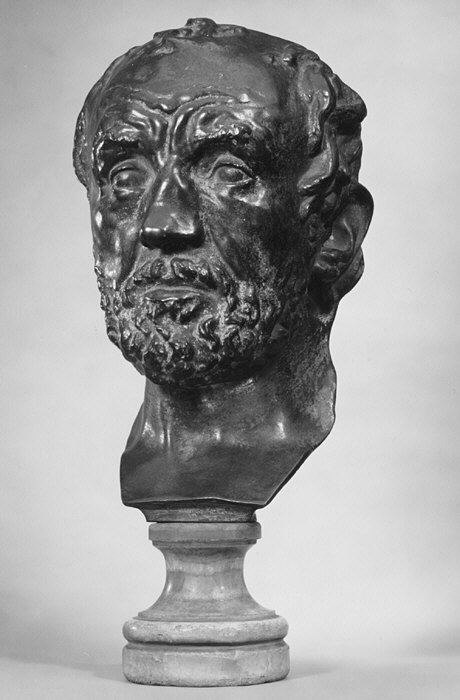
The Met catalogues this bronze as a mask, a format that isolates the face. The Metropolitan Museum of Art, Bequest of Susan Vanderpoel Clark, 1967, 67.155.13. Image source. CC0 / Public domain.
The Los Angeles County Museum of Art catalogues another bronze and places its casting after Rodin’s death, with the precise date unknown. Its published view gives a useful comparison for the features and the mounting of the head. The long visible section below the beard in the legacy image and the tall rectangular mount help describe the illustrated version, but the exact cast remains unverified. The rear of a neck or the lower part of a base can carry evidence invisible in a frontal portrait. In the available view the strongest points of recognition are the uneven bridge of the nose and the way the eyes sit under the ridged forehead. They are also where the changing light makes the head most distinct. [3] [4] [7] [8]
A mask donated in Geneva
The Musée d’Art et d’Histoire de Genève records that Rodin gave the city a bronze of the broken-nose portrait in 1896, during an exhibition at the Musée Rath that brought his work together with that of Eugène Carrière and Pierre Puvis de Chavannes. By then the face could represent Rodin in a public exhibition alongside two painters. The gift belongs to a later moment in his career than the early rejection of the plaster. The Geneva museum returned to that bronze for an exhibition on accident and chance in Rodin’s work, where the loss of the back of the head offered one way to examine how a damaged model became a form he continued to exhibit. [2] [9]
The French national inventory distinguishes groups of masks and shorter-necked heads from versions of the reconstructed bust and a small head. A bronze with a partial head and a marble with fuller shoulders can both preserve the broken nose while describing the sitter with different amounts of material around the face. The Geneva gift and the Paris Salon marble mark separate points in that history of public display. [9] [10]
Rodin artworks directory
Discussion
Look again at the images and ideas explored in Man with the Broken Nose. These editorial prompts invite your observations.
Reader Insights
After reading “The face in the bronze”, what detail would you look for in the object or image?
What extra evidence would help you distinguish the artist’s choices from the effects of material, viewpoint or later display?
Join the Conversation
Share a detail, comparison or question about Man with the Broken Nose below.
References
- Musée Rodin. Rodin et l’antique, portrait section. View source.
- Musée Rodin. Rodin chronology, 1840–2015. View source.
- Metropolitan Museum of Art. Mask of the Man with the Broken Nose. View source.
- Los Angeles County Museum of Art. Man with the Broken Nose. View source.
- Philadelphia Museum of Art. Rodin teaching kit, Mask of the Man with the Broken Nose. View source.
- Musée Rodin. L’Homme au nez cassé, S.00974. View source.
- National Museum of Western Art, Tokyo. Man with the Broken Nose, S.1959-0027. View source.
- National Museum of Western Art, Tokyo. Man with the Broken Nose, S.1990-0001. View source.
- Musée d’Art et d’Histoire de Genève. Rodin. L’accident. L’aléatoire, exhibition dossier. View source.
- French Ministry of Culture. L’Homme au nez cassé, variants and exhibition record. View source.

 Auguste Rodin.jpg)





