


 by Tom Gurney
Tom Gurney BSc (Hons) is an art history expert with over 20 years experience
Published on June 19, 2020 / Updated on November 18, 2026
Email: tomgurney1@gmail.com / Phone: +44 7429 011000
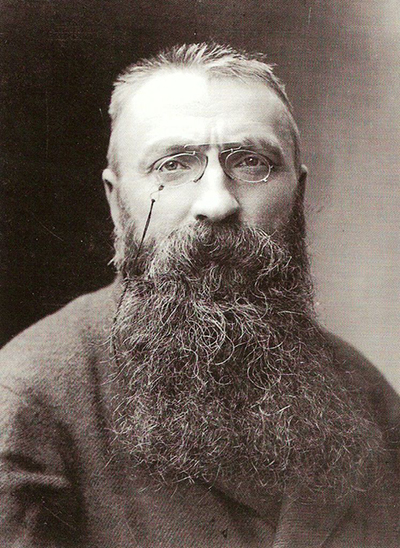
Auguste Rodin Portrait by Nadar, 1891
In this portrait by Nadar, Auguste Rodin faces the camera with his spectacles perched high on his nose. The hair above his forehead catches a strong light, and the beard fills much of the image below his eyes. Behind him the field is dark on one side and lighter on the other. The Musée Rodin lists several photographs under a title describing Rodin’s brushed-up hair and spectacles, with Félix Tournachon Nadar named as the author. A published catalogue of a print from the museum dates this image to 1891. The close view leaves the viewer with the face, the clothing around it and the small optical instrument through which Rodin returns the camera’s gaze. [1] [2]
Looking at the face
The rims of the spectacles are thin enough to disappear in places against the brighter parts of the face. Each lens catches a small amount of light. The narrow bridge and the darker line that drops from the side of the spectacles are easier to see when the image is enlarged. Follow the line down the cheek and it soon becomes hard to distinguish from the beard. The object lies at a meeting point between the best lit parts of the portrait and the busy texture beneath them. It draws attention to the eyes without enclosing them in a heavy frame. [1] [2]
The beard has both a broad shape and a much finer pattern. At a distance it reads as a dark mass widening below the cheeks. Up close, lighter strands cut across it in different directions. Some stand out especially clearly where they cross a dark area. The photograph holds enough of that detail for the nose and brow to feel comparatively plain and open. There is a similar change near the top of the image, where the hair makes a broken edge against the background. These borders help give the head a presence beyond the flat arrangement of light and dark on the print. [1] [2]
Rodin’s shoulders take up most of the lower width of the frame. The outline on the left is particularly distinct where the jacket meets the dark ground. On the right the distinction is made by a lighter background, and the contour sweeps down to the edge of the image. The head is nearly frontal, yet the different values on either side keep the photograph from feeling rigidly symmetrical. The jacket gives the portrait a stable base while the face holds the strongest light. At a smaller reproduction size the broad divisions remain visible even when the individual strands of the beard and the rim of a lens become difficult to follow. [1] [2]
The studio name and the archive
The Nadar name links more than one photographer and generation. The Bibliothèque nationale de France’s exhibition traces the careers of Félix, his brother Adrien and his son Paul. Paul developed the business and launched Paris-Photographe in 1891. Photographs issued under the studio name could therefore have both an individual maker and an institutional history. The Musée Rodin names Félix on its entries for the brushed-hair portrait. In the BnF catalogue, by comparison, the reference album prints appear under the collective credit Atelier Nadar. Those descriptions tell us which name each institution uses for the material it holds and the way it places that material within a collection. [1] [3] [4] [5] [6]
Volume 39 of the BnF’s Nadar reference albums contains two demonstration prints catalogued as 9115 A and 9115 B, both identifying the sitter as Rodin. The library dates the records within a broader range than the specific year of 1891 attached to the Musée Rodin example in the published catalogue. A reference album entry fixes the place of a print in the studio’s record. The date attributed to a portrait can come from other evidence. Keeping those details in view makes it possible to follow the picture between collections without treating every impression or catalogue entry as if it referred to the same sheet. [2] [3] [4]
The published catalogue identifies its example as a matte collodion aristotype. That material belongs to the print described in the caption. A digital reproduction can show the portrait at the size of a screen, with the edges and mount outside the crop. The condition of the paper and the original size then become difficult to judge. In this reproduction the spectacles and the join between beard and jacket are still available for close looking. To identify a particular print, its dimensions, inscriptions, mount and archive location are more informative than the colour cast of a digital file. Those details matter when two catalogues reproduce closely related views of the same sitter. They also give a reason to look at the margin of the photograph, where a studio might identify itself even when its name was absent from the image. [2] [3] [4]
Watch Rodin’s sculpture up close
Five films explore Rodin’s sculpture, from his use of classical models and the figures on his monumental doorway to the work of his studio.
Auguste Rodin – Challenging Beauty
Six sculptures show how Rodin adapted classical models.
Watch on YouTubeRodin away from the workshop
Dornac’s photograph of Rodin from 1898 presents him standing in his workshop before the Monument to Sarmiento. Its tools, cloth and large pale surface let viewers explore how a public sculpture occupied the room. In the Nadar portrait the workshop gives way to a plain field. A viewer looking for the sculptor’s occupation has the title to go on and the face that circulated under his name. Comparing the two pictures also shows how readily the spectacles change their role. In the workshop portrait they hang against a dark waistcoat and are a small detail within the body and room. In the earlier portrait they are part of the encounter with the face. [1] [2] [7]
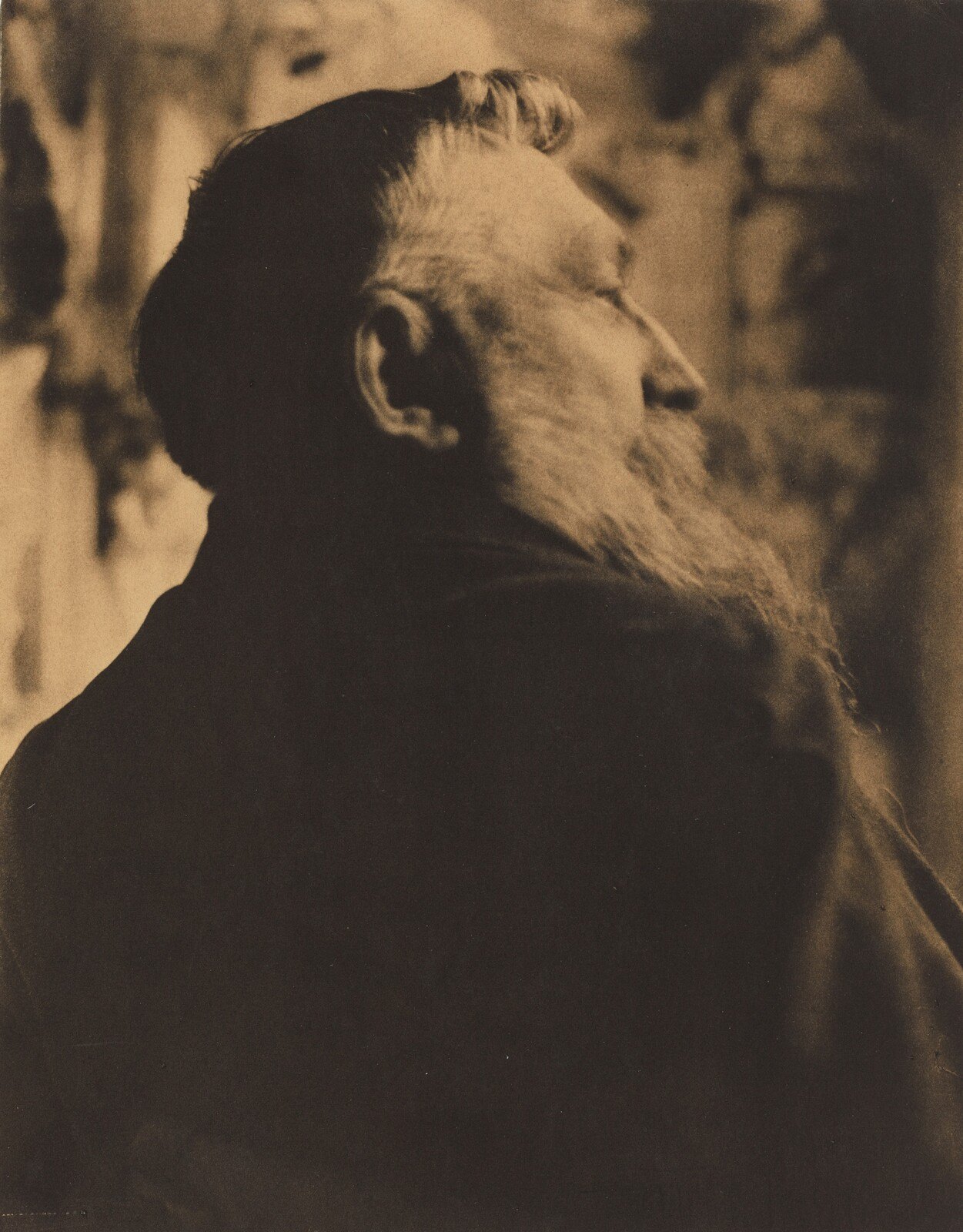
Käsebier’s portrait offers a comparison with the earlier Nadar studio photograph. National Gallery of Art, Washington, Patrons’ Permanent Fund, 2008.65.13. Image source. CC0 / Public domain.
The year traditionally given for the photograph also marks the start of Rodin’s commission for the Monument to Balzac. A portrait of a living sitter and a monument to a deceased writer call for different kinds of evidence. For Balzac, Rodin had to work with earlier likenesses and other records. In the Nadar photograph a slight change in the sitter’s expression or the direction of the light could alter the image within a session. Look at the eyes again after taking in the shoulders and beard. Their directness depends on how close the portrait brings us, and on the photographer’s decision to let the surrounding field carry so little descriptive detail. [2] [8]
A later portrait with a similar title
The Musée Rodin also catalogues portraits in which Rodin’s hair rises from the forehead and the title again describes it as brushed up. The example Ph.00880 belongs to a different sitting by Claude Harris at the Hôtel Biron in December 1913. The museum records three poses from that session and notes that Rodin was given twelve examples of each in January 1914. The repeated wording in the titles describes the sitter’s appearance. The name of the photographer, date and inventory number establish which series a print belongs to. [1] [9]
The Harris record gives separate measurements for the print and its two mounting supports, from 27 by 17 centimetres for the primary support to 37 by 24 for the outer one. It also records a printed photographer’s name. Those details are easy to lose when the photograph is reproduced as a head and shoulders. In a collection record the supports help identify the object, while the face establishes the pose and the person shown. Together they explain how a group of similar-looking portraits can represent several prints, mountings and sittings. [1] [9]
Rodin artworks directory
Discussion
Look again at the images and ideas explored in Auguste Rodin Portrait by Nadar, 1891. These editorial prompts invite your observations.
Reader Insights
After reading “Looking at the face”, what detail would you look for in the object or image?
What extra evidence would help you distinguish the artist’s choices from the effects of material, viewpoint or later display?
Join the Conversation
Share a detail, comparison or question about Auguste Rodin Portrait by Nadar, 1891 below.
References
- Musée Rodin. Photographies, catalogue entries for Portrait de Rodin coiffé en brosse avec des lorgnons, Ph.00174–Ph.00177. View source.
- Le droit de la sculpture, catalogue reproduction of the Musée Rodin portrait, p. 11. View source.
- Bibliothèque nationale de France. Atelier Nadar, 9115 A. M. Rodin. View source.
- Bibliothèque nationale de France. Atelier Nadar, 9115 B. M. Rodin. View source.
- Bibliothèque nationale de France. The Nadars. View source.
- Bibliothèque nationale de France. Chronology of the Nadars. View source.
- Musée Rodin. Dossier de presse, Centenaire Auguste Rodin, p. 43. View source.
- Musée Rodin. Study for Balzac’s Dressing Gown. View source.
- Musée Rodin. Claude Harris, Portrait de Rodin coiffé en brosse, Ph.00880. View source.

 Auguste Rodin.jpg)





