


 by Tom Gurney
Tom Gurney BSc (Hons) is an art history expert with over 20 years experience
Published on June 19, 2020 / Updated on November 18, 2026
Email: tomgurney1@gmail.com / Phone: +44 7429 011000
Jean de Fiennes
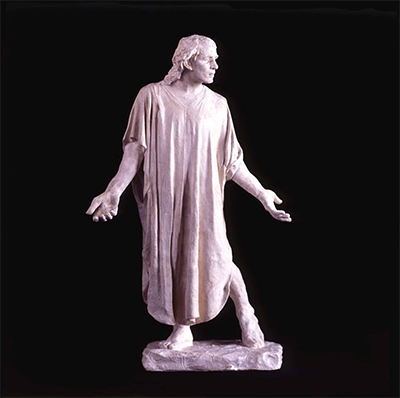
Jean de Fiennes turns his head to one side and holds his hands open in Auguste Rodin’s The Burghers of Calais. Both arms extend out from the body, and one foot shows well beyond the edge of the garment. The gesture makes this figure recognisable among the six citizens of the French port. Rodin explored it in several forms, including a figure with the torso exposed for the second maquette and a robed version for the monument. The pale figure in the photograph has the long hair and relatively continuous drapery of the developed design. [1] [2] [3]
The open hands and the turn of the head
The spread of the figure is most apparent just above the hands. In the photograph, the arm on the left drops well away from the side of the robe, leaving a triangular part of the background visible. The other projects at a shallower angle. Both wrists turn enough to expose part of the palms. The fingers are separated at the ends, so the silhouette breaks into small elements after the relatively long line of each forearm. The arms draw the eye out in two directions at once. The face, by contrast, looks decisively towards one side. [1] [2]
The light reaches the front of the robe almost without interruption. Small ridges cast shadows close to the neck, where the fabric angles across the chest. These short folds lengthen down the front and gather at the lower edge. The silhouette changes near the extended leg, which appears at the side before reaching the base. That opening in the robe gives the eye a way to infer the position of the knee beneath it. It also balances the direction of the head. Both extend towards the same side in this view, while much of the figure’s weight is legible in the foot below the central folds. [1] [2]
Near the shoulder, the hair draws a comparatively rough edge against the dark background. It falls towards the neck and is particularly visible where the turned head exposes its outline. The hand below it reaches farther out than the face. This gives the illuminated profile room to register as a small, precise shape above a more expansive gesture. A view from the opposite side would bring the other palm forward and obscure part of the profile, shifting the emphasis from the direction of Jean’s gaze to the distance between his arms and body. [1] [2]
A citizen in the siege of Calais
Rodin’s monument commemorates the six citizens who offered themselves to Edward III after the siege of Calais in 1347. Jean Froissart’s chronicle informed the project. The Metropolitan Museum of Art’s Cantor catalogue explains that Jean de Fiennes is one of two burghers whose names are absent from Froissart’s account and were identified through other evidence. Rodin treated Jean as the youngest of the six. That choice shows in the exposed torso in the second maquette, in which the body looks comparatively slight and the upturned hands are already prominent. [1] [3] [4]
In the finished monument, the gesture is one of several ways in which Rodin imagined his figures reacting to the same demand. Jean d’Aire steadies the keys between his hands, drawing his arms towards the centre of the body. Jean de Fiennes carries his hands away from the body and seems to address people to either side. The monument was inaugurated in Calais in 1895. A visitor moving around the group can see the arms of Jean de Fiennes emerge between other figures and then disappear as different bodies come into the foreground. The independent figure gives those spaces a much clearer outline. [1] [2] [3]
Watch Rodin’s sculpture up close
Five films explore Rodin’s sculpture, from his use of classical models and the figures on his monumental doorway to the work of his studio.
Auguste Rodin – Challenging Beauty
Six sculptures show how Rodin adapted classical models.
Watch on YouTubeHow the figure changed
The Musée Rodin records a figure for the second maquette and a related variant with the torso exposed. In its account of the series, the Met distinguishes the youthful figure in the second maquette from an early study in heavier drapery. The final large form keeps the basic stance and the position of the arms. Its longer hair and lighter-looking folds give more prominence to the feet. These changes affect the balance between the upper body and the base. In the more heavily draped study the folds conceal more of the direction of the step. The developed form allows the foot to project independently of the hem. [1] [5] [6]
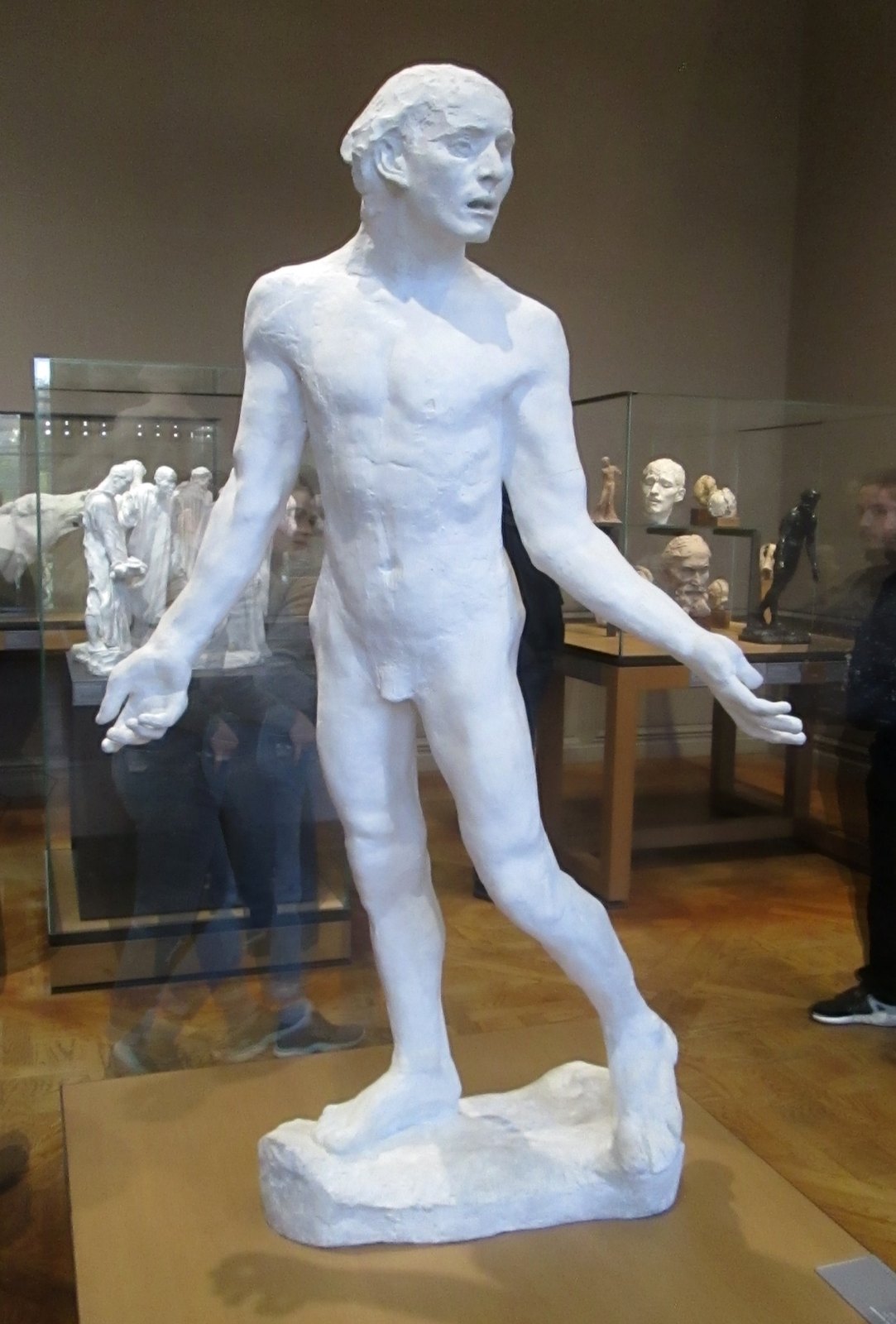
The plaster study shows how Rodin worked out the gesture before clothing the figure. Photograph by Beyond My Ken, Wikimedia Commons. Image source. CC BY-SA 4.0. Resized for the web.
The French national collections database documents another stage, a nude plaster for the monument dated 1886 and measuring 202 centimetres high. Its catalogue links to clothed and bare-chested maquette variants in plaster and bronze, as well as a reduction of the final design. The nude study allows a visitor to examine the turn of the hips and the relation of the legs beneath the arms at greater scale. The clothed version in the photograph shows how a straight descending line of cloth can make that movement seem more restrained, even with the arms still extended and the feet set apart. [1] [6] [7]
In the photographed figure, most of the fabric hangs freely from the upper torso. The folds tighten abruptly at the sleeve openings, where the arms emerge, and again at the point where the advancing leg meets the hem. These are the places where the cloth gives the clearest indication of the movement beneath it. [1] [2]
Identifying versions outside the monument
The Musée d’Orsay catalogues a bronze statuette, RF 2915, with a height of 46 centimetres and an approximate date of 1885. It has a green patina and is deposited at the Palais des Beaux-Arts in Lille. Those details belong to a specific bronze. The legacy photograph shows a pale, clothed figure with a rough rectangular base. Its exact material and accession remain uncertain. The robe, the head and the placement of the hands give the strongest evidence about which stage of Rodin’s work it resembles. [1] [7] [8]
The small size of a reproduction can make the model look more regular than it is. Enlarging the image brings out how the right and left sleeves end at different angles and how the front hem curves above the nearer foot. The figure has enough symmetry to seem steady at first, yet the transferred weight and the turn of the head keep the gesture from feeling settled. That combination persists when the figure is taken out of the group and seen by itself. [1] [2]
A head separated from the gesture
The Musée Rodin holds a bronze head of Jean de Fiennes, S.01381, cast by the Émile Godard foundry in 1982 from a design dated about 1887. The head and neck measure 30.6 centimetres high before the addition of a separate pedestal. The foundry mark lies at the edge of the hair, while the signature and cast number sit on the neck. The smaller plaster head S.02729 also has marks on the hair, but the museum gives its identification as Jean de Fiennes with a question mark. Names and inscriptions therefore carry different kinds of evidence. The signature helps document what is on the object, while the title shows the museum’s assessment of the figure it represents. [9] [10]
A head on its own makes the direction of the face easier to study. In the complete figure, the open hands and the fall of the garment spread the gesture across the monument. Viewed as a separate bronze, the line of the neck and the hair frame the turn of the face, with enough room to look closely at what the viewer might first notice only after following one of the arms inward. [2] [9]
Rodin artworks directory
Discussion
Look again at the images and ideas explored in Jean de Fiennes. These editorial prompts invite your observations.
Reader Insights
After reading “The open hands and the turn of the head”, what detail would you look for in the object or image?
What extra evidence would help you distinguish the artist’s choices from the effects of material, viewpoint or later display?
Join the Conversation
Share a detail, comparison or question about Jean de Fiennes below.
References
- Metropolitan Museum of Art. Rodin: The B. Gerald Cantor Collection, Jean de Fiennes entries. View source.
- Metropolitan Museum of Art. The Burghers of Calais, an educator’s resource. View source.
- Musée Rodin, Meudon. Monument aux Bourgeois de Calais. View source.
- Musée Rodin. Le Monument des Bourgeois de Calais, commission and maquettes. View source.
- Musée Rodin. Jean de Fiennes, personnage de la deuxième maquette. View source.
- Musée Rodin. Jean de Fiennes, variante du personnage de la deuxième maquette, torse nu. View source.
- French Ministry of Culture. Jean de Fiennes, nu pour le monument, S 151, Joconde. View source.
- Musée d’Orsay. Jean de Fiennes, RF 2915. View source.
- Musée Rodin. Tête de Jean de Fiennes, bronze S.01381. View source.
- Musée Rodin. Jean de Fiennes ?, tête, plaster S.02729. View source.

 Auguste Rodin.jpg)





