


 by Tom Gurney
Tom Gurney BSc (Hons) is an art history expert with over 20 years experience
Published on June 19, 2020 / Updated on November 18, 2026
Email: tomgurney1@gmail.com / Phone: +44 7429 011000
Glaucus
In Auguste Rodin’s Glaucus, a bearded man bends towards a second figure seated across his lap. One head inclines over the other, while the legs and arms of the pair spread outward around a rough base. The title connects the sculpture with the sea god Glaucus and Scylla in Ovid’s Metamorphoses. The composition also belongs to Rodin’s work on The Gates of Hell, where the Musée Rodin identifies Glaucus among the groups on the doorway. A related plaster is known as Glaucus or La Confidence. Its name draws attention to the closeness of the heads and suggests how differently the encounter can be read. [1] [2] [3] [4]
Two figures above a rough base
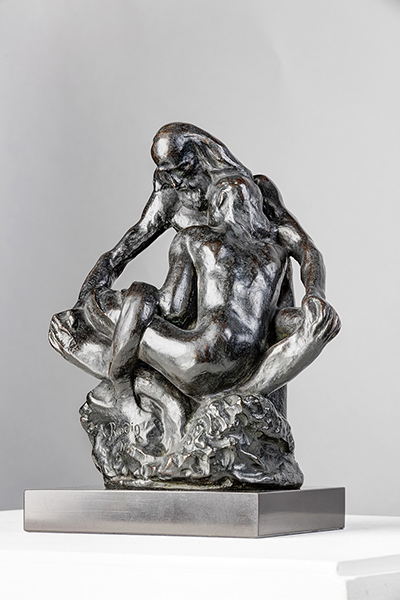
The photograph gives a clear view of the back of the nearer figure. The shoulder blades catch the light on either side of a darker central line. Lower down, the back turns towards the hip, where the figure’s outline gives way to the bent leg. The position of that leg becomes clear through the patch of shadow below the knee. Seen from this angle, the group is partly screened by the nearer body. The man’s face appears above and to the left, and a dark line between the two heads helps establish which belongs to each figure. [1] [5]
The man’s arms extend down on either side. To the left, one arm makes a long diagonal from his shoulder to the outside edge of the group. A wedge of pale background separates it from the other body. To the right the compact outline makes the relationship of the hand to the leg more difficult to see. Both sides bring the eye back to the middle, where the two bodies overlap. Their shoulders occupy a much smaller area than the spread of the limbs below. From a viewpoint closer to the centre of the man’s chest, his head would loom more directly over the face that turns towards him. [1] [5]
The base is modelled in a different way from the rounded surfaces of the figures. Small depressions and raised edges take up much of its face. In the photograph they collect reflections in scattered patches. A rectangular support below has clear straight edges, giving the group a horizontal reference and making the irregular shape above it easier to see. The contrast is particularly clear beneath the bent leg at the left. There the surface changes from a long continuous curve to a cluster of small forms, and the boundary between body and support has to be worked out from their different textures. [1] [5]
What Ovid tells us about Glaucus and Scylla
In Book XIII of Ovid’s Metamorphoses, Glaucus tells Scylla that he had once been a fisherman. He saw his catch revive after touching the grass on a shore, tasted the grass himself and felt compelled to plunge into the sea. He became a sea god there. When he approaches Scylla, she flees to a high point where she can look down at him. In the following book, he asks Circe for help. Circe desires Glaucus herself and treats the water where Scylla bathes with a mixture that transforms her. Ovid describes the new forms around Scylla’s lower body as dogs. [4] [6]
The Musée de Boulogne-sur-Mer interprets its plaster as an intimate encounter at the moment of Scylla’s transformation. It identifies Glaucus as the older bearded man and reads the tapering forms of the other figure as tentacles. The close contact is an interpretation of the story. Ovid describes Scylla’s flight from Glaucus and later gives separate attention to her discovery of the transformation. The sculpture brings the two figures together and sets the change in bodily form alongside the almost conversational inclination of the heads. The name La Confidence, recorded for a related object, makes that quiet aspect of the group especially legible. [1] [3] [4] [6]
Watch Rodin’s sculpture up close
Five films explore Rodin’s sculpture, from his use of classical models and the figures on his monumental doorway to the work of his studio.
Auguste Rodin – Challenging Beauty
Six sculptures show how Rodin adapted classical models.
Watch on YouTubeA figure group on The Gates of Hell
Rodin received the commission for the doorway in 1880. Dante’s Inferno supplied the main literary setting, and the project came to incorporate compositions associated with other texts. The Musée Rodin’s diagram of the bronze in its garden identifies Glaucus as figure group 19. In the presentation of the plaster Gates at the Musée d’Orsay, a related Glaucus ou la Confidence is displayed alongside other sculptures developed in connection with the doorway. These settings offer different scales of encounter. In the monumental doorway, the bowed shapes have to be picked out among many others. Seen in isolation, the closeness of the heads and the changes of direction at the hips can hold the eye for longer. [2] [7] [8]
A doorway relief also gives the group a fixed background. The exposed backs, shoulders and knees have to convey the depth of the encounter from the front or from below. A small separate version can be turned so that the nearer figure gradually uncovers the older man. The amount of the face that comes into view changes the balance between the embrace and the sense of a private exchange. [1] [2] [7]
Plasters and bronze casts
The French national collections database records a high-relief plaster with the joint titles Glaucus and La Confidence. It measures 11 centimetres high and 23.2 centimetres across. The Musée de Boulogne-sur-Mer describes its statuette as a plaster reproduction. A catalogue entry based on Musée Rodin archives documents a separate bronze in Brooklyn, close to 20 centimetres high, given by the Iris and B. Gerald Cantor Foundation in 1984. These material and dimensional details matter when comparing the works. A group that sits low across the surface of a relief will have a different profile from a small sculpture that a viewer can approach from several sides. [1] [3] [5]
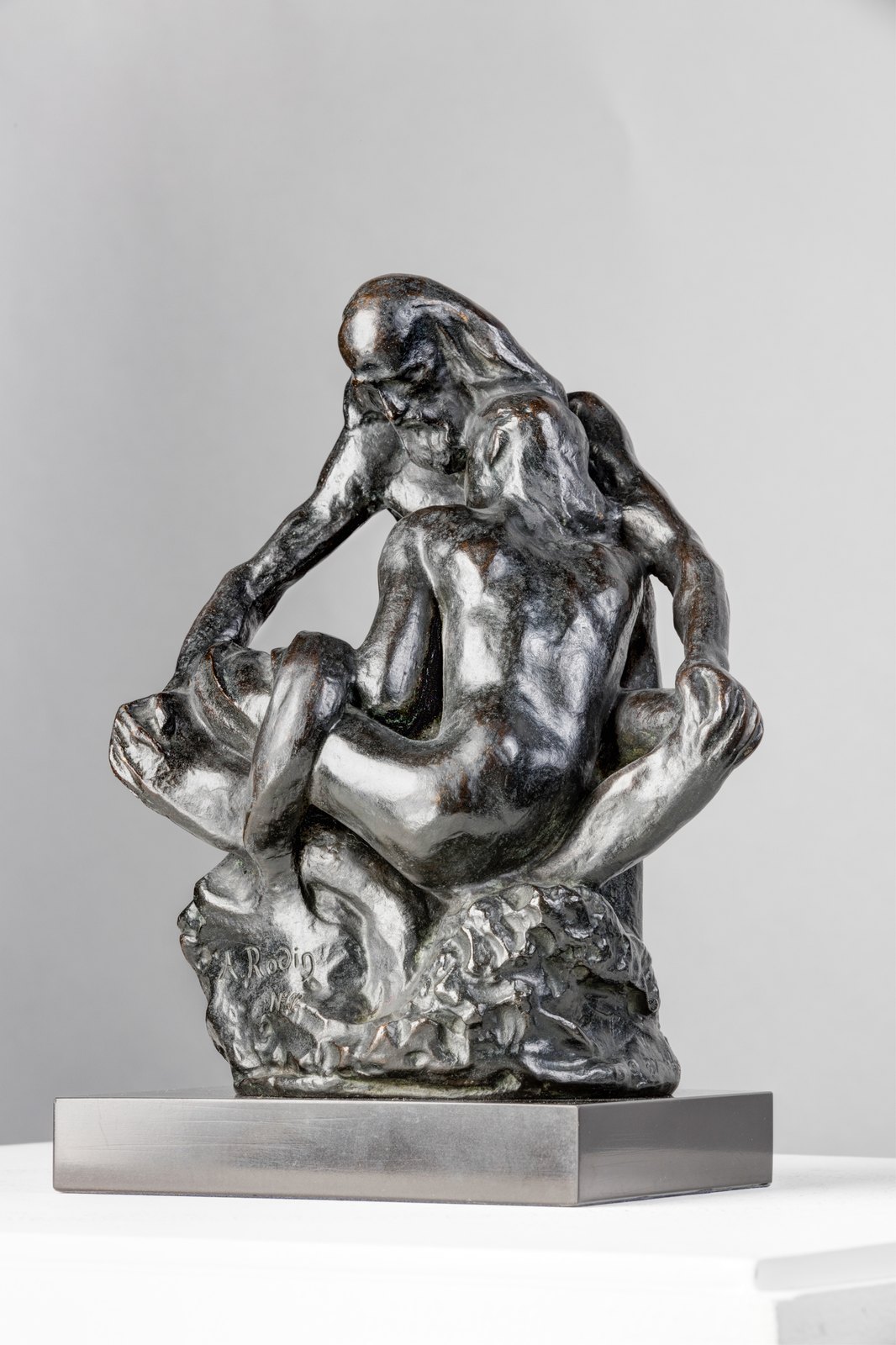
A view of Glaucus in the Museo Soumaya collection provides a named comparison for the composition. Museo Soumaya, via Wikimedia Commons. Image source. CC BY-SA 4.0. Resized for the web.
The photographed group has a metallic surface and an upright silhouette above its rectangular mount. The view makes the curve of the nearer back especially easy to see. The exact bronze and its casting date require a closer comparison with an object record, dimensions or marks. The photograph already shows how much the composition depends on the relation between the upper and lower parts. At the top the heads come together over a short distance. Below them the bent limbs carry the eye in several directions before they meet the uneven base. This change of scale within the group gives the close encounter much of its force. [1] [3] [5]
Two upright plasters
The Musée Rodin catalogues an independent plaster, S.00919, dated 1900. It is 20 centimetres high and carries the number 1396 underneath the base. The Musée d’Orsay records a second plaster under both La Confidence and Glaucus. That object, S.00944, stands 21.8 centimetres high. The Orsay dates the model to 1882 and the plaster to 1917, and records fibre reinforcement and the use of a reusable piece mould. The material and dimensions give this object a different profile from the much lower high relief also called La Confidence. [3] [9] [10]
On a group scarcely taller than a hand, a small change to the edge of the base can change which parts of the pose are visible at eye level. The two upright examples provide documented views around the pair. Turn from the bearded face to the outer edge where the legs extend and the intimate scene is also a study in how far the figures project from their support. In the doorway the architecture sets the direction of approach. For the small plaster the base can be approached from either side, so the meeting of the heads and the reach of the limbs can be studied in sequence. [2] [9] [10]
Rodin artworks directory
Discussion
Look again at the images and ideas explored in Glaucus. These editorial prompts invite your observations.
Reader Insights
After reading “Two figures above a rough base”, what detail would you look for in the object or image?
What extra evidence would help you distinguish the artist’s choices from the effects of material, viewpoint or later display?
Join the Conversation
Share a detail, comparison or question about Glaucus below.
References
- Musée de Boulogne-sur-Mer. Glaucus. View source.
- Musée Rodin. L’Enfer selon Rodin, diagram of the garden bronze, p. 21. View source.
- French Ministry of Culture. Glaucus, also known as La Confidence, Joconde. View source.
- Ovid. Metamorphoses, Book XIII, University of Virginia Ovid Collection. View source.
- French Sculpture Census. Glaucus, Brooklyn Museum bronze, with Musée Rodin archival references. View source.
- Ovid. Metamorphoses, Book XIV, University of Virginia Ovid Collection. View source.
- Musée d’Orsay. A new presentation of The Gates of Hell. View source.
- Musée d’Orsay. La Porte de l’Enfer, chapter 2, illustration caption for Glaucus ou la Confidence. View source.
- Musée Rodin. Glaucus, plaster S.00919. View source.
- Musée d’Orsay. La Confidence, also known as Glaucus, S.00944. View source.

 Auguste Rodin.jpg)





