



 by Tom Gurney
Tom Gurney BSc (Hons) is an art history expert with over 20 years experience
Published on June 19, 2020 / Updated on November 18, 2026
Email: tomgurney1@gmail.com / Phone: +44 7429 011000
The Thinker
The longer you look at Auguste Rodin’s The Thinker, the harder it is to imagine holding the pose. The right elbow reaches across to the left thigh. The chin presses against the back of the hand. The shoulders tilt and the back curves into them, while the feet press down into the rock. The pose gives nearly every part of the body something to do, although the figure remains fixed in place. That combination of stillness and strain gave Rodin a way of making an inward act visible. It also helped the sculpture find a life beyond the doorway for which it was made. [1] [2]
The figure above the door
Rodin conceived the figure around 1880 while working on The Gates of Hell. The French state had commissioned doors for a museum of decorative arts, and Rodin chose Dante’s Divine Comedy as his starting point. The Musée Rodin describes the seated figure, about seventy centimetres high in its early form, as the Poet. High on the tympanum, he leans forward over the figures beneath him. The turn of his head has a visible direction within the architecture. A visitor can look from the seated body down through the reliefs and imagine Dante looking into the world he described. [1] [3]
In that setting, the figure shares something of the physical intensity of the people below. His bare body belongs among the bodies on the doors, even though his seated pose sets him apart from their movement. Above him are the Three Shades, whose leaning bodies make the outline of the portal point downward. The Poet takes up a smaller space and gathers it inward. His elbows and knees form a triangle of support, and the face is set far enough forward to direct the eye from the tympanum towards the doors. The figure helps organise the surface as well as giving it a character who can be read in relation to Dante. [1] [3]
Annotated Details from The Thinker
Select a numbered point to see the detail below.
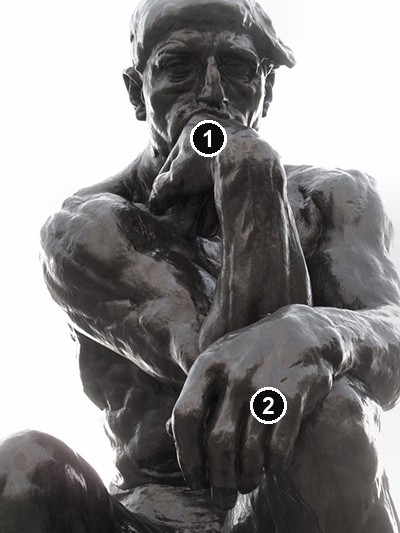
Details from THE THINKER
These broad details use the original resolution of the legacy photograph.
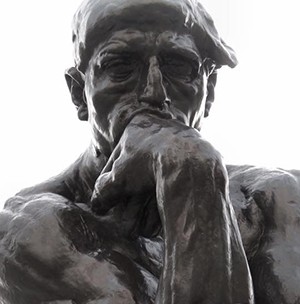
Chin and supporting hand
The hand presses against the mouth and chin, drawing the head down towards the bent forearm.
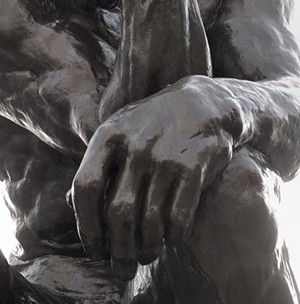
Hand over the knee
The lower hand hangs over the knee. Its relaxed fingers contrast with the hand bearing the weight of the head.
The effort in the pose
Seen from the side, the line of the back describes most of the action. The upper body seems to follow its own weight forward while the bent arm props it up. Seen from the front, the crossed support becomes clearer. There is tension between the shoulder serving the bent arm and the opposite leg taking the pressure. The left arm hangs across the thigh in a different relation to the hand under the chin. The unevenness keeps the body alert. Even a small change to the placement of the elbow would give the figure a different distribution of weight and a different expression. [1] [2]
The Musée Rodin draws attention to two sculptural precedents, Michelangelo’s seated Lorenzo de’ Medici and Jean-Baptiste Carpeaux’s Ugolino. The pose of a pensive figure has a long history, and the Medici monument gives a particularly telling example of a body that seems absorbed. Carpeaux’s figure belongs to Dante’s story of starvation and carries anguish in the grip and tension of the body. In Rodin’s work, the support of hand, arm and thigh creates its own physical pattern. The comparisons help explain how a configuration read as contemplation in one setting and as distress in another could become the basis for a figure on the threshold of Hell. [1]
Carpeaux’s Ugolino and the weight of a hand
Jean-Baptiste Carpeaux’s Ugolino and His Sons gives the seated father a relationship to four other bodies. The Met dates its marble to 1865–67 and connects the scene with Canto XXXIII of the Inferno. A spectator sees the father’s concentration in the presence of the people who depend on him. Their poses draw the eye up to his head, but they also give it somewhere else to rest. The scale of the group allows a person standing in front of it to take in the crouched and clinging children against the very different tension of the father. The setting of imprisonment belongs to the story. Its pressure is also present in the arrangement, where bodies crowd close and one figure’s movement can be understood in relation to another’s. [10]
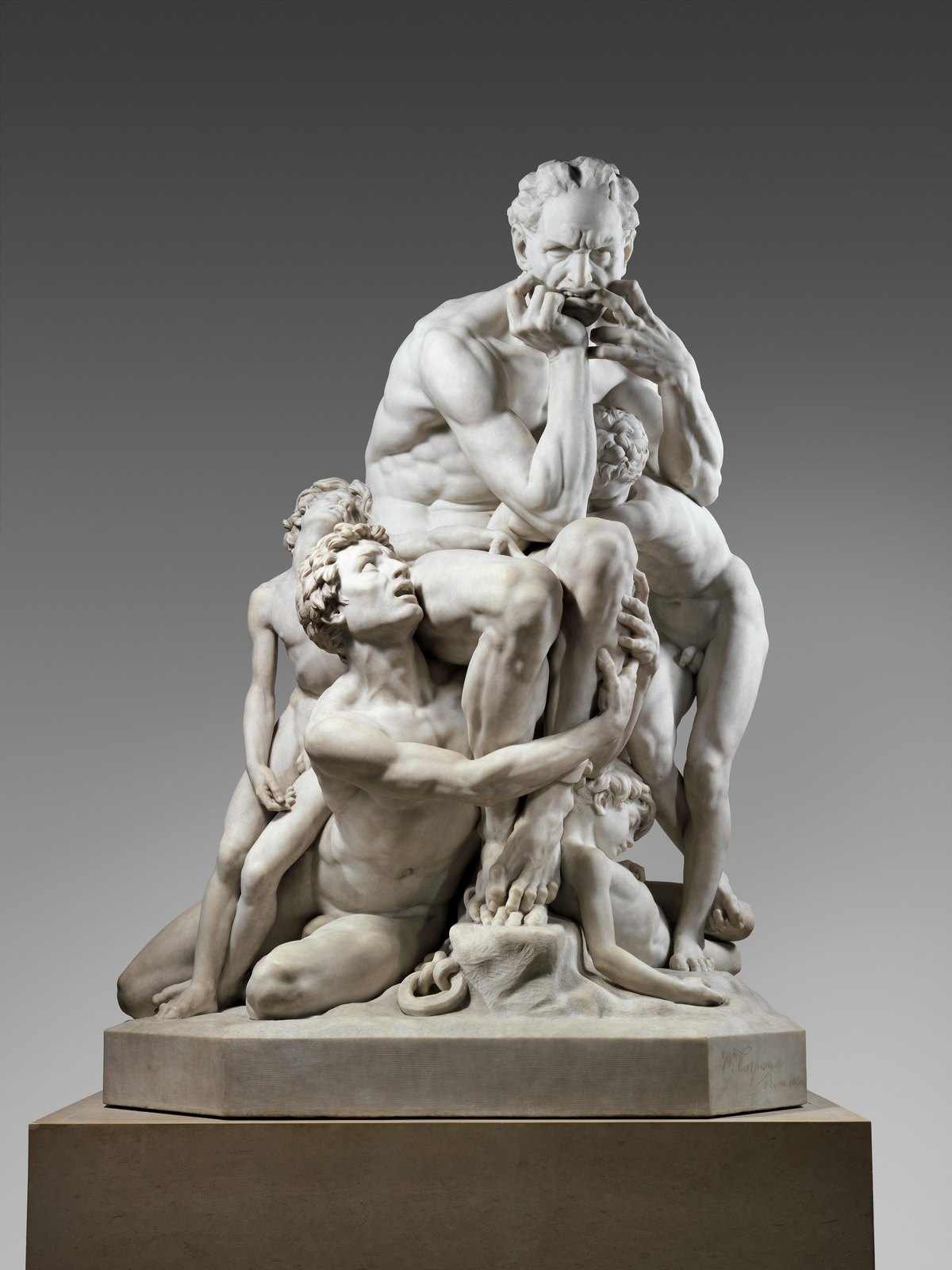
Compare the crossing of the elbow and the hunched pose in Carpeaux’s group with Rodin’s seated Thinker. The Metropolitan Museum of Art, Purchase, Josephine Bay Paul and C. Michael Paul Foundation Inc. Gift, Charles Ulrick and Josephine Bay Foundation Inc. Gift, and Fletcher Fund, 1967, 67.250. Image source. CC0 / Public domain. Resized for the web.
The Tokyo catalogue identifies Carpeaux’s crossing of the right elbow towards the left thigh as a particularly close precedent for Rodin. Looking for that connection makes the difference in the two sculptures easier to see. A crossing of limbs can emphasise the grip of fear in a group whose story is known, or gather attention towards an unidentified man’s mouth in an isolated figure. Rodin’s figure still has points of contact around it, but they are all within the same body or between that body and its rocky seat. The knees, feet and wrist have to supply the relations that Carpeaux could give to other figures. That is one reason the outline feels so tightly bound. When the left hand falls over the thigh, even the free arm reinforces the enclosure rather than reaching for anything beyond it. [1] [10] [11]
The relationship also helps explain why The Thinker can look both attentive and tormented. A viewer might first see a posture of deliberate thought, then recognise something closer to a strained effort to stay upright. The museum discussion of Michelangelo introduces a different comparison. The seated Lorenzo de’ Medici has a setting, costume and public identity that help determine how his absorption is read. Rodin could borrow the concentration of a seated body while leaving the independent figure without the identifying costume or surroundings of an individual portrait. In the portal, the figure acquired meaning through the mass of bodies below. In an independent cast, it is possible to approach him from a direction that does not reveal even the eyes at first. The tension in the hand or the left shoulder may be the first indication of what the sitter is doing. [1] [11]
From the Poet to The Thinker
An independent exhibition changed where viewers stood in relation to the figure and what evidence they had for its subject. On the Gates the surrounding figures make Dante a natural point of reference. In an isolated bronze there are no surrounding episodes to identify. A visitor can spend time with the outline, the muscles of the hand, or the angle of the head and arrive at a more general image of someone absorbed in difficult thought. The title The Thinker fits that broader experience. The Musée Rodin dates the figure’s independent exhibition to 1888, while the Philadelphia Museum of Art places its independent display under that title in 1889. The two museum accounts agree on the move from the door to separate exhibition in the late 1880s. [1] [2]
Enlargement changed the encounter again. Philadelphia’s record places the making of its enlarged model in 1902–04 and dates the bronze itself to 1919. The Musée Rodin describes the Paris bronze as a cast of 1904 by the Alexis Rudier foundry. That casting belonged to the enlarged form. The bronze given to the City of Paris was installed outside the Panthéon in 1906 and later entered the Musée Rodin. In front of the Panthéon, a visitor met a work at a public scale, with the closed pose visible across an open space. In a smaller bronze the viewer can approach and look down at the figure, changing the relative weight of the head, the rock and the enclosure made by the limbs. [1] [2] [4]
The Copenhagen plaster and what can be traced
The Musée Rodin places the first separate showing in Copenhagen in 1888. Its chronology describes a plaster at the original scale, and its essay on Munch gives the context of an exhibition of French art. There is evidence for two quite different ways of seeing the figure that year. The museum records a lithographic reproduction of the upper part of the door in the 4 February issue of L’Art Français. A reader of the journal could see the seated figure among the damned. A visitor to the Copenhagen exhibition could stand in front of the plaster as an object. The same body was available to different publics through different media, one of which retained the composition around him while the other let the figure occupy the viewer’s attention alone. [7] [20]
The Copenhagen record establishes an exhibition. Identifying the plaster that travelled there requires a further step. Tonny Beentjes’s technical study discusses an original-size plaster acquired by the Béziers museum in 1900. He considers the possibility that it was used in earlier exhibitions, including Copenhagen, but judges it more likely to have been made for Béziers. That distinction affects the way an image should be captioned. The surviving plaster makes an early stage of the work available for close study. Its appearance is valuable evidence even if its link to a particular show remains conjectural. We can compare the two without asking a specimen from one collection to stand in for an object whose movements remain uncertain. [20] [21]
On the Béziers example, the signature is part of the cast and can be seen near the right foot. The study also identifies mould lines left visible at the surface. At a damaged edge Beentjes could examine the structure behind the outer layer of fine plaster and see reinforcement in the backing. That evidence is different from what a normal display photograph shows. The bright surface may suggest that every ridge was worked directly by hand, while a close examination of the edge and the seams reveals how a surface could be carried from a model into another material. Looking at a mould line and looking at a wrinkle in the body are different operations. The former describes how the object was made. The latter may carry something of the work that happened before any mould was taken. [21]
The figure in a room of paintings
At the Galerie Georges Petit in 1889, Rodin and Claude Monet put sculpture and painting into the same exhibition. The Musée Rodin traces the joint exhibition to discussions between the two artists and places it alongside the Universal Exposition. The Walters study identifies the portal-size Thinker among the sculpture Rodin showed. This records a specific Paris display even though the accounts of the first independent exhibition give different years. The important change for someone in that gallery was the proximity of the figure. A sculpture made for a position above a monumental door now had to establish its shape at the scale of an object in a room. It could be seen while approaching a wall or walking towards another work, without the visitor having first to locate a figure in a relief. [8] [12] [17]
Sculpture also asks for a different kind of movement in a mixed exhibition. The inward curve of the back and the forward thrust of the elbow can be taken in almost as a silhouette from one side. A small step makes the dark interval between the forearm and the body change shape. At the door, where the figure stands high and its surroundings belong to the same composition, the interval has to compete with other shadows. Seen near a wall of paintings, the profile behaves more like a shape the viewer can carry across the room and check again from the other side. Presenting the individual sculpture made that freedom of movement part of the work’s public life. [1] [3] [12]
How an enlargement became a bronze
Making the enlarged figure brought other people into the work. The Tokyo catalogue names Henri Lebossé as Rodin’s collaborator on the enlargement. Research published by the Walters Art Museum draws on Lebossé’s correspondence, including a letter of November 1902 recording progress on bringing the head and torso together. That glimpse of work in stages is helpful. A viewer may experience the enlarged statue as one tightly wound body, but the enlargement had to establish positions and joins among parts. The important relationships, such as the placement of the mouth against the hand, had to remain intelligible on the bigger model. The dates museums give for enlargement cover a period of work, and a later date for a bronze identifies a further operation. [2] [11] [12]
The correspondence studied by the Walters also gives a sense of why a bronze could remain open to criticism after casting. In preparing a version for the St Louis fair in 1904, Rodin dealt with a bronze from the Hébrard foundry and took issue with its chasing, the work of finishing the metal surface. The article follows his exchanges with André Saglio, who oversaw French contributions to the fair, and his preference for the plaster that had been sent there. The disagreement turns on the appearance of a particular object. Earlier enlargement had established the pose in a new size. Casting and finishing then determined what a visitor would see of the texture of the surface. A sharp transition across a crease, or a softened edge where an area has been worked, affects what the eye can read even when the limb itself occupies the right position. [12]
The first public encounters with the large figure consequently depend on the object in question. The Musée Rodin chronology singles out a large bronze shown in London in 1904. The Detroit Institute records the presentation of an enlargement at the Paris Salon that year. The Walters study distinguishes a bronze and a plaster in the arrangements for St Louis. The exhibitions can be placed in relation to one another by keeping the medium, city and example in view. The large figure circulated soon after the enlargement, and the plaster and bronze could travel as different objects through the same network of patrons, foundries and exhibitions. [4] [12] [13]
From London and St Louis to two objects in New York
The display of an enlarged bronze in London belonged to a network Rodin had joined before the figure reached monumental scale. The Musée Rodin traces this connection through James McNeill Whistler and the International Society of Painters, Sculptors and Gravers. The earlier British subscription supported the purchase of a Saint John the Baptist now in the Victoria and Albert Museum. Rodin succeeded Whistler as president of the society after his death in 1903. The London Thinker was thus seen in the context of an established interest in Rodin’s sculpture rather than by an audience newly discovering him. The Musée Rodin also places commissions for portrait busts during the London display. These records show an opportunity to see a large, unnamed figure in public at a moment when British patrons were asking him to make likenesses of particular people. They leave the precise identity of the London cast a separate question. [4] [17]
The St Louis plaster, by contrast, can be tied to an accession. The Metropolitan Museum catalogues its 1904 plaster, 04.36, as the example exhibited at the Louisiana Purchase Exposition. It gives André Saglio’s role in the French representation and credits him as its donor. It also lists the plaster at 179.1 centimetres high with its base. That example provides a physical counterpart to the letters about Rodin’s preference for plaster at the fair. Together the two kinds of record tell us that a monumental exhibition object could circulate as plaster in its own right and enter a museum with a specific connection to a public display. The bronze associated with Hébrard and later Henry Walters has an independent record. Reading those documents together only works if the physical examples remain distinct. [12] [22]
A photograph at the Met from 1913 even shows both sizes in a single view. Four boys stand near the large plaster, with the smaller bronze visible farther back. The presence of the boys gives an immediate measure of the enlarged figure that no dimension on a label can supply by itself. The bronze at the rear gives another measure. It shows how the same pose can occupy a small field inside the larger field of the gallery, whereas the plaster requires viewers to place their own bodies around it. A photograph taken for documentary purposes can make this difference accessible more than a century later. It preserves two works and the positions from which a group of people happened to attend to them. [14] [22] [23]
Watch Rodin’s sculpture up close
Five films explore Rodin’s sculpture, from his use of classical models and the figures on his monumental doorway to the work of his studio.
Auguste Rodin – Challenging Beauty
Six sculptures show how Rodin adapted classical models.
Watch on YouTubeComparing individual bronzes
Four records illustrate how several histories can belong to the same image. The Musée Rodin lists the Paris garden bronze as S.01295 and the Meudon bronze as S.02838. The latter stands at the tomb of Rodin and Rose Beuret. In Philadelphia a monumental bronze cast in 1919 and a smaller example cast in 1924 share the title. The 1924 date belongs to that smaller bronze. Its reported model date still takes the composition back to 1880–81. Dimensions and accession numbers help when a label, book or photograph uses only the short title. [1] [2] [5] [6]
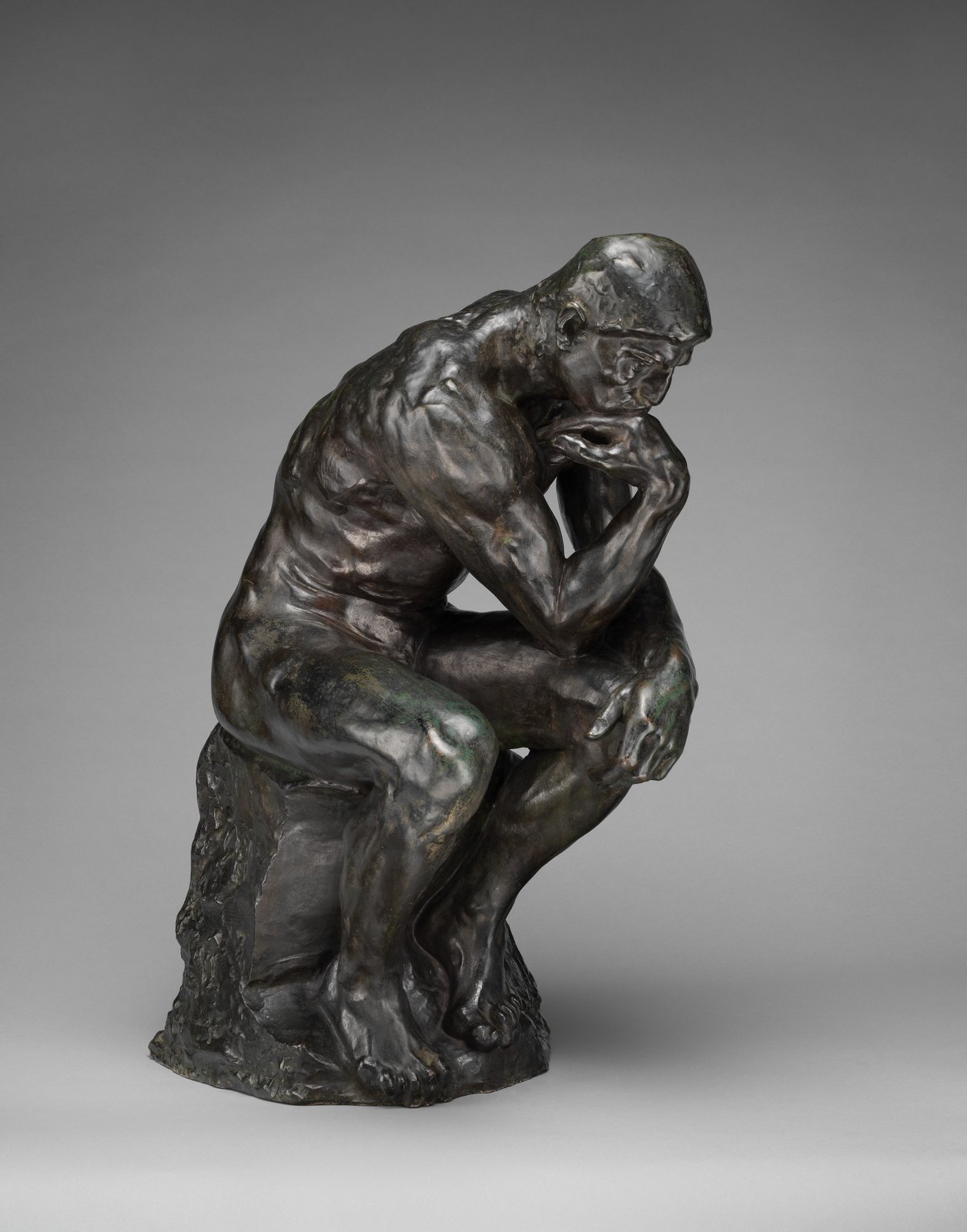
This smaller bronze, cast by Alexis Rudier around 1910, was commissioned by Thomas Fortune Ryan. The Metropolitan Museum of Art, Gift of Thomas F. Ryan, 1910, 11.173.9. Image source. CC0 / Public domain. Resized for the web.
The setting can be part of an object’s history too. When Edvard Munch painted Rodin’s Thinker in Dr Linde’s Garden in Lübeck, he recorded the effect of seeing the sculpture in a private garden where he could encounter it repeatedly. A cast could be experienced amidst trees or seen from indoors, with the weather and time of day changing how the figure emerges from the surroundings. At Meudon the placement at the tomb gives the pose a memorial context. In front of the Panthéon it addressed an urban public. On the portal the same body made a different demand on the viewer, since its inward concentration directs attention towards a world in turmoil below. [3] [6] [7]
The move to a public square also made the work available to political interpretation. In 1904 Gabriel Mourey organised a subscription to give an enlarged bronze to Paris. Claude Monet contributed two hundred francs. The Musée Rodin records the interest of socialist critics, who saw in the figure a kind of intellectual power that could act upon the world. That reading gives the installation outside the Panthéon a particular significance. This was an unnamed, physically powerful man placed at a site associated with the remembrance of national figures. The public campaign and the response to the sculpture are part of the history of this particular bronze. [8] [9]
Two sizes in New York and Tokyo
The Met’s bronze, 11.173.9, gives a sense of the figure at about the scale at which Rodin originally conceived it. It is 70.2 centimetres high and was cast by Alexis Rudier around 1910. Thomas Fortune Ryan commissioned it from Rodin’s studio and gave it to the museum. At that size a viewer close to the object can look across the arm supporting the chin and see the rock as part of the same small territory the sitter occupies. The museum’s catalogue gives the weight as nearly 84 kilograms. Thus a bronze that allows intimate looking can still require considerable work to move and mount. Its physical weight and the scale of the person it depicts are different things, even if both become part of the impression of a body pressing down. [14]
The National Museum of Western Art holds an enlarged bronze measuring 186 centimetres high, S.1959-0040. Its catalogue dates the cast to 1926 and transcribes the Rudier mark from the back of the base. A letter trail through Léonce Bénédite and the dealer Suzuki & Co. documents a purchase for Kōjirō Matsukata around August 1919. The museum lists 50,000 francs for the colossal size. Its record of the smaller Thinker, S.1959-0039, gives 12,000 francs and uses the description demi-nature. Both were sequestered in France in 1944 and transferred to Japan in 1959. Those dates concern the two objects’ ownership and movement. They belong alongside the individual dates of manufacture, so that a catalogue reader can follow two scales through a shared collection history. [11] [15]
Lübeck, Detroit and the Panthéon
The bronze that went to Max Linde gives the Munch painting a more specific object history. The Detroit Institute of Arts identifies its bronze, 22.143, as having belonged to the Lindes in Lübeck. Horace Rackham purchased it in 1922 and gave it to the museum. The catalogue dates the Detroit bronze to 1903 and discusses its relation to the Paris exhibition of 1904. The Lübeck garden and the Detroit collection are successive settings for a physical cast. Munch’s painted view is evidence of the kind of attention the work could receive in the first setting. A painted garden scene lets the figure share the picture with the space around it. In a catalogue view selected to show the sculpture, that environment can fall away almost completely. [7] [13]
Marcel Hutin’s photograph Ph.02087 gives the Paris installation a different kind of record. The Musée Rodin identifies the event as the inauguration outside the Panthéon on 21 April 1906. Its account of the negotiations notes Rodin’s proposal to install the figure near the neighbourhood of his childhood and the difficulty of finding a site acceptable to the authorities. A sculpture made famous in a collective campaign still had to be put on a particular piece of ground. At the inauguration it could be seen in relation to the architecture of public commemoration. The independent bronze’s bent body had already been detached from the crowd of figures on the portal. Now the place itself supplied an association with public life, giving political commentators and other spectators a setting in which to interpret the act of thought. [1] [9] [16]
A bronze goes from Baltimore to Louisville
Henry Walters acquired the Hébrard bronze associated with the St Louis fair. The Walters Art Museum’s study cites a note prepared shortly after the fair that set the price at 25,000 francs. How Walters learned that the sculpture was available remains unclear. His willingness to purchase it, after Rodin had objected to its appearance as his representative work at the fair, marks a further change in the bronze’s history. A buyer could value a cast that the sculptor had declined to use for a particular public occasion. The early archive photograph reproduced by the Walters places the sculpture in the central court around 1933. That setting gave the enlarged figure a prominent place indoors, where the distance from surrounding architecture and works could be judged differently from a position outside a civic building. [12]
In 1934 the bronze went into storage. A decade later Arthur E. Hopkins asked his estate to acquire a colossal bronze Thinker for Louisville. The Walters study finds a further part of the explanation for the sale in Baltimore. The Baltimore Museum of Art was receiving another monumental example through Jacob Epstein, which the Walters trustees expected to be on permanent display. The acquisition for Louisville therefore depended on the existence of a different bronze of the same design in the city where the Hébrard example had been kept. It is a concrete instance of how multiples affect the decisions made about individual objects. The prospect of a local audience seeing the composition could be met by one cast while another was moved to a different city. [12]
The records also give a reason to examine what a museum label means by the sculptor’s name. Each cast bears the history of manufacture, finishing and reception that made it an object available to buy and display. In the Hébrard case, Rodin’s assessment of the finish, Walters’s decision to acquire the cast and the trustees’ decision to sell it are three different judgements. They concern the same bronze, made from a design that survives in other examples. Conflating them would make it difficult to explain how the figure appeared in a fair’s correspondence, a museum’s photographs and the terms of a collector’s will. [12]
A painted view from the garden at Lübeck
Max Linde’s letter to Rodin shows that the garden was part of the idea before the bronze was installed. The Musée Rodin reproduces the collector’s account of a solitary figure sheltered by mature trees. Linde set human intelligence against the surrounding life of the garden. Looking at the work outside thus came with a reading the collector had developed while deciding what to buy. The bronze’s own travel preceded that encounter. The museum dates the casting to 1903 and records exhibitions in Leipzig in 1904 and Berlin early in 1905 before it was installed in the garden. A description of the work at a venue in that period has to take account of those movements. The garden scene was one destination within a history of movement and display. [7] [13]
Munch painted the garden view in spring 1907. The Musée Rodin notes that he could see the bronze repeatedly through his friendship with Linde. The painting stayed in Munch’s studio for a long time, and the museum finds no evidence that Linde knew of it. Its route into a public collection was therefore separate from the bronze’s. A collector who wanted the figure to contrast with the life around it had made a large space for the sculpture. A painter could give that space a frame and decide how much visual weight the grounds should have. The painting belongs to the history of interpretations of The Thinker as well as to the history of this particular cast. It captures an encounter in Lübeck that cannot be reconstructed merely by seeing the same object in Detroit. [7] [13]
Cleveland and the decision to keep the damage visible
Cleveland’s monumental lifetime cast, 1917.42, entered the museum as a gift from Ralph King. Its catalogue records a height of 182.9 centimetres and places it at the south entrance. The museum reinstalled the bronze after it was damaged in March 1970. Director Sherman Lee chose to leave the visible damage, arguing that accident could become part of a work’s history and relating that view to Rodin’s attitude towards his working models. Lee’s argument is part of the museum’s discussion of the decision. The damage itself belongs to a later event in the life of the Cleveland cast. A reader comparing two bronzes needs to know which changes came from modelling and casting and which took place in the course of an object’s public life. [18] [19]
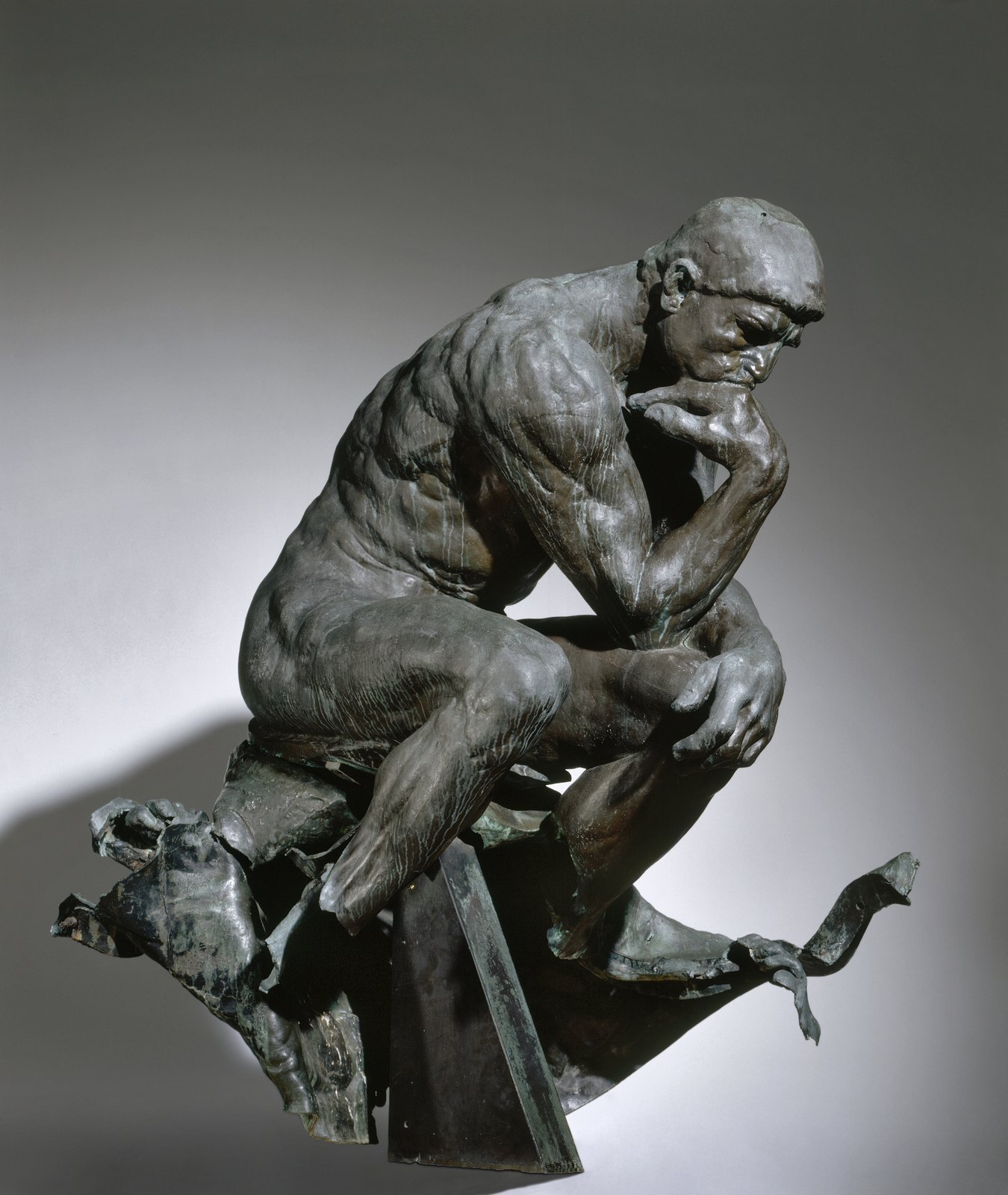
The Cleveland enlargement retains visible damage at the feet and base. The Cleveland Museum of Art, Gift of Ralph King, 1917.42. Image source. CC0 / Public domain.
That distinction matters when looking at the feet. In better-preserved casts the feet help show the effort of the pose. The right elbow crosses the body and the head pitches forward, but the pressure downward is answered at the base. In Cleveland the damaged bronze interrupts the lower outline and leaves jagged edges where a visitor expects to read that support. The tension of the upper body survives. Its relation to the ground is now experienced through evidence of two histories, the pose Rodin designed and the damage a later museum visitor can see. A photograph of the Cleveland work can therefore be particularly informative if it carries the object number. With a generic caption it risks turning the appearance of one cast after 1970 into an account of Rodin’s design. [1] [18] [19]
A figure above two graves at Meudon
The facts of the burial change what the bronze at Meudon asks of those who approach it. Rodin and Rose Beuret married in January 1917. She died in February and he died in November. They were buried together at Meudon, where they had made a home and where the large figure now stands at the tomb. The Musée Rodin gives the bronze the inventory number S.02838 and a height of 189 centimetres. The date of conception in its record concerns the enlarged model. The burial is another event in the work’s history, tied to two people and a particular site. The commemorative setting calls for attention to both names even though the sculpture itself presents only one anonymous figure. [4] [6] [24]
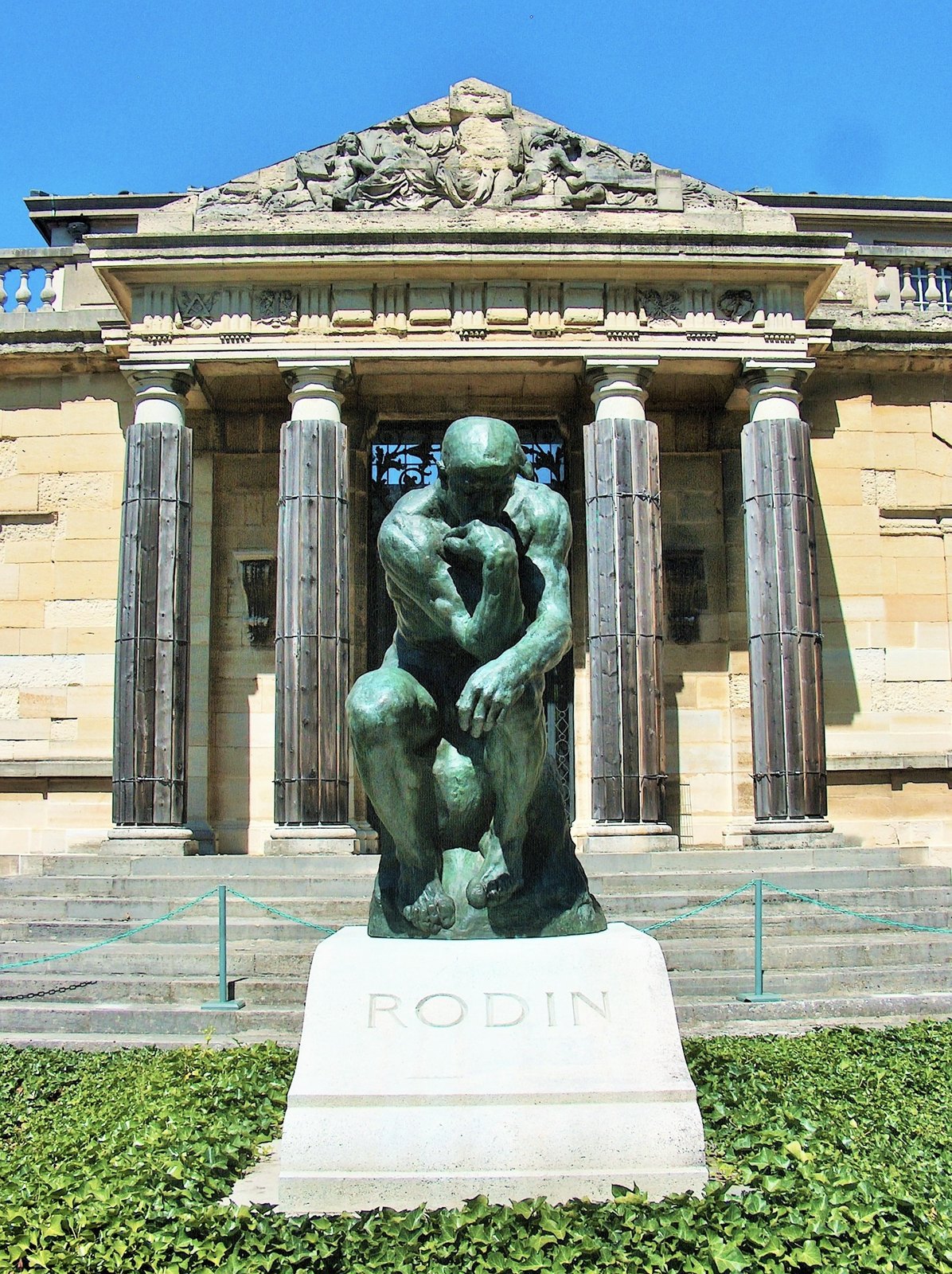
The Meudon setting shows the enlarged bronze serving as a grave monument. Photograph by Ibex73, Wikimedia Commons. Image source. CC BY-SA 4.0. Resized for the web.
At the Panthéon the bronze could be read against a building dedicated to the public commemoration of named figures. At Meudon the bronze stands within the grounds of the house Rodin and Beuret occupied. What had been a public assertion of the work’s importance in Paris can have the character of a pause in a garden here. The seated figure has no need to turn and face the approaching visitor. Its angle of concentration, which first directed attention to bodies beneath a portal, can lead a viewer from the bronze to the place under it. The crossing of arm and thigh is the same sculpture in either setting. The route by which the viewer reaches it, and what there is to see below it, help explain why the work can be at home both outside a civic building and at a grave. [1] [6] [24]
What a foundry mark can establish
Comparing the names on the bases of the cast in New York and the enlarged cast in Tokyo shows what an inscription adds to a reading of the sculpture. Both catalogue entries name Rudier. That relationship places the bronzes within the work of a particular foundry. The heights in the same entries, about 70 centimetres and 186 centimetres, show that naming the founder cannot by itself identify the scale of the work. Nor can a photograph with the base cut off readily distinguish every cast in a series. The marks, accession numbers, dimensions and provenance answer different parts of the identification question. A view of the shoulders or the hands can then be used for what it does best, namely following the pose rather than determining the foundry. [11] [14]
The Walters bronze shows why evidence about manufacture can matter to the appearance of an individual object. Hébrard’s foundry made it by lost-wax casting. The museum’s study follows the cast from the foundry to surface finishing and work by Jean Limet, the patinator, before its shipment. An account of the design alone would not explain Rodin’s reaction, since the work he objected to had already been successfully enlarged. In a comparison of photographs, a shadow at the wrist might come from the angle of the light, or a raised edge might belong to the physical surface. The casting and finishing records give the comparison a basis in the history of an object. They also explain why a cast that belonged to a famous design could still be judged by Rodin on its own merits. [12] [21]
The surface can also carry a history of its own after a sculpture leaves a foundry. In the Cleveland example, the later damage is visible even from a distance. The Béziers plaster offers nearly the opposite problem. Its seams and the edge that exposes the backing are small enough to be overlooked when the eye is drawn towards the face. Both objects reward looking at the base before returning to the figure. At Cleveland that means locating the break between the pressure the pose suggests and the damaged metal that remains. At Béziers it means distinguishing the rocky seat that belongs to the design from the material at the edge that tells how the plaster was made. The marks provide evidence even when they are hard to reconcile with a remembered image of the whole sculpture. Once they are noticed, it is easier to tell which details can be expected in another version and which belong to the object in front of you. [18] [19] [21]
Rodin artworks directory
Discussion
Look again at the images and ideas explored in The Thinker. These editorial prompts invite your observations.
Reader Insights
After reading “The figure above the door”, what detail would you look for in the object or image?
What extra evidence would help you distinguish the artist’s choices from the effects of material, viewpoint or later display?
Join the Conversation
Share a detail, comparison or question about The Thinker below.
References
- Musée Rodin. The Thinker, S.01295. View source.
- Philadelphia Museum of Art. The Thinker, monumental bronze cast in 1919. View source.
- Musée Rodin. The Gates of Hell. View source.
- Musée Rodin. 1840–2015. View source.
- Philadelphia Museum of Art. The Thinker, smaller bronze cast in 1924. View source.
- Musée Rodin. The Thinker, Meudon, S.02838. View source.
- Musée Rodin. Rodin and Munch. View source.
- Musée Rodin. Rodin and Monet. View source.
- Musée Rodin. Rodin, sculpteur dans la troisième République. View source.
- The Metropolitan Museum of Art. Jean-Baptiste Carpeaux, Ugolino and His Sons. View source.
- National Museum of Western Art. The Thinker (Enlarged), S.1959-0040. View source.
- The Journal of the Walters Art Museum. Volumes 70–71, study of the Walters Thinker. View source.
- Detroit Institute of Arts. The Thinker, 22.143. View source.
- The Metropolitan Museum of Art. The Thinker, 11.173.9. View source.
- National Museum of Western Art. The Thinker, S.1959-0039. View source.
- Musée Rodin. Marcel Hutin, inauguration of The Thinker at the Panthéon, Ph.02087. View source.
- Musée Rodin. Rodin and modernism. View source.
- Cleveland Museum of Art. The Thinker, 1917.42. View source.
- Cleveland Museum of Art. Was Sherman Lee Ever Wrong?. View source.
- Musée Rodin. Auguste Rodin et l’Égypte, chronologie croisée. View source.
- Tonny Beentjes. Casting Rodin’s Thinker. University of Amsterdam, 2019. View source.
- The Metropolitan Museum of Art. The Thinker, plaster, 04.36. View source.
- Elyse Nelson. Sculpture on the Move, a Century of Rodin at The Met. The Metropolitan Museum of Art. View source.
- Musée Rodin. Du pavillon de l’Alma à la galerie des plâtres, Meudon dossier. View source.
 Auguste Rodin.jpg)





