


 Auguste Rodin.jpg)
 by Tom Gurney
Tom Gurney BSc (Hons) is an art history expert with over 20 years experience
Published on June 19, 2020 / Updated on November 18, 2026
Email: tomgurney1@gmail.com / Phone: +44 7429 011000
La Defense (The Call to Arms)
A winged woman throws her arms apart above a wounded soldier in Auguste Rodin’s The Defense. The man’s head drops back below her, while her face turns outwards and her mouth opens. Their movements give the group two directions at once. His weight brings the eye down and her raised fist takes it back up. Rodin designed the group for an 1879 competition to commemorate the defence of Paris during the Franco-Prussian War. The design was rejected for that commission and later enlarged for a different monument, at Verdun. The interval between those two occasions is part of the history of the sculpture and of the different objects bearing its name. [1] [2]
The soldier and the winged figure
In the oblique photograph, one arm reaches nearly to the top of the frame. The fist stands above a broad wing, and the small scale of the hand becomes apparent against the surface behind it. The other arm stretches across the image at a much lower angle. It is closer to the height of the woman’s head. Together they give the gesture a reach both upwards and sideways. The head sits between the two directions, with the mouth open and the forehead catching the light. Follow the line of the lower arm from the fist towards the chest. It leads into the turn of the torso, where the raised arm becomes easier to understand as part of a single action. [1] [3]
The wings extend the gesture past the shoulders. Individual ridges can be followed near the outer edge, where they are set against the background. Near the body, shadow brings several surfaces together. The wings partly fill the interval between the two arms, but the fists still project clearly enough to mark the ends of the movement. The arrangement can look very different from the side, where one wing may obscure part of the back or overlap the other wing. The oblique view gives a particularly clear sense of the spread above the wounded man. The higher wing rises almost directly behind the lifted forearm. The other projects beyond the shoulder in a thinner line, leaving a wedge of background between its edge and the arm below. This wedge separates the hand from the tips of the feathers. [1] [3]
The soldier’s face is visible much lower in the photograph, turned towards the light. The crop gives only part of his body. A full view shows how the fallen figure runs across the lower part of the group. His bent limbs occupy space near the base, while the winged woman seems to rise from their point of contact. That contrast gives the sculpture its balance. For a viewer approaching the complete group, the soldier’s body first establishes where the weight lies. The woman’s arms then carry the eye beyond the narrow area in which the two bodies meet. [1] [3]
Two precedents for the composition
The Musée Rodin identifies Michelangelo’s Florentine Pietà as a source for the wounded man and François Rude’s relief popularly called La Marseillaise as a source for the winged figure. The comparisons concern two different problems of composition. A supported body in the Pietà offers a way to arrange the weight of a slumping figure. Rude’s relief at the Arc de Triomphe provides a precedent for a winged figure whose gesture seems to issue a summons. Rodin places the two actions close enough together that the spectator can see how the fall and the call belong to the same group. The upward gesture acquires urgency from the body beneath it. [1] [2]
The original competition concerned the siege of Paris in 1870 and a monument intended for Courbevoie. A viewer familiar with that purpose could interpret the winged figure’s call as an appeal to defend the city. The Musée Rodin records that Rodin continued to exhibit the design after the competition, looking for a place for it. The group’s arrangement was already legible as a response to a wounded soldier, a meaning that could travel beyond the first commission. When the work acquired a new destination, the positions of the two figures could address another siege without requiring another pairing of bodies. [1] [2] [4]
Watch Rodin’s sculpture up close
Five films explore Rodin’s sculpture, from his use of classical models and the figures on his monumental doorway to the work of his studio.
Auguste Rodin – Challenging Beauty
Six sculptures show how Rodin adapted classical models.
Watch on YouTubeThe enlarged work at Verdun
In 1916 a Dutch committee commissioned Rodin for a monument commemorating the defence of Verdun. The Musée Rodin records that Léonce Bénédite proposed returning to The Defense. Henri Lebossé worked on the large enlargement in 1917–18 and the Alexis Rudier foundry cast the monument in 1919. It was inaugurated in Verdun on 1 August 1920. The chronology places the model, enlargement, casting and inauguration decades apart. Rodin had also arranged an intermediate enlargement before the Verdun project. The larger scale made the separations between wing, arm and head visible from farther away, while the soldier remained low within the composition. [1] [3] [4]
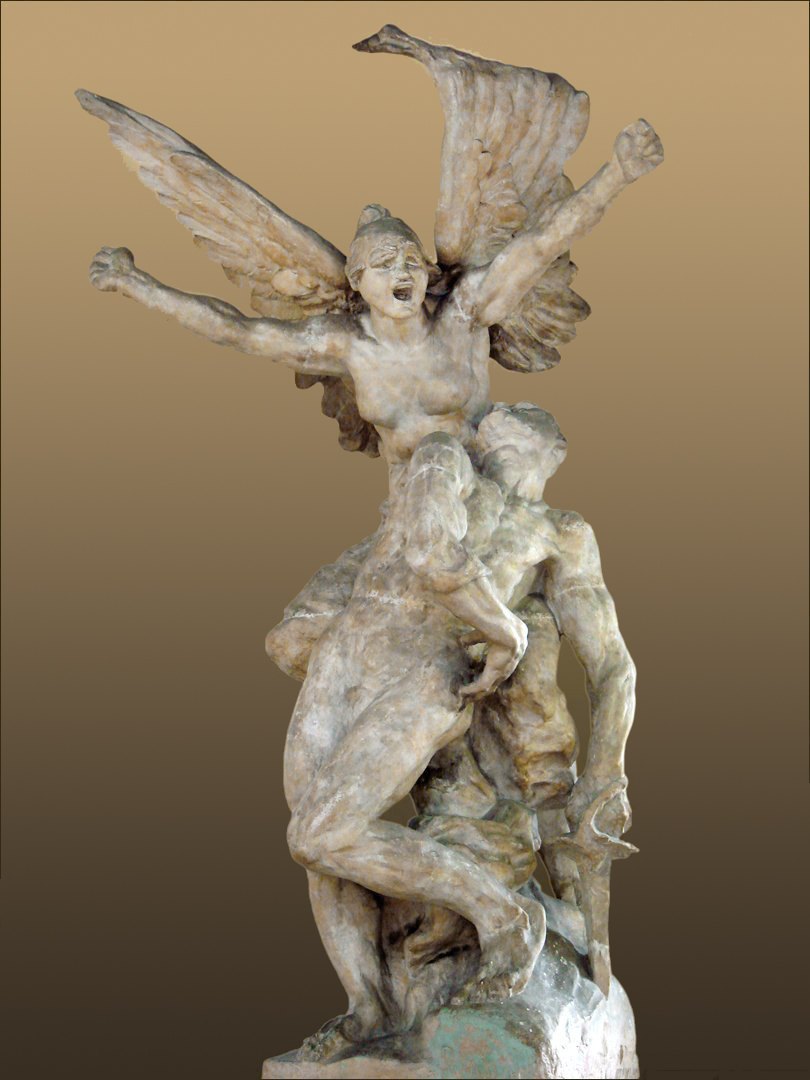
The enlarged plaster shows the grouping at a later scale. It is a separate object from the Verdun bronze. Photograph by Jean-Pierre Dalbéra, Wikimedia Commons. Image source. CC BY 2.0. Resized for the web.
The foundry plaster at Meudon stands just over four and a half metres high. The museum notes traces of the release agent on the plaster, evidence of its use in the casting process. This object can be distinguished from the bronze installed as a memorial. It preserves the large proportions and details of the workshop stage, while the bronze at Verdun has its own setting and history. At the plaster’s scale, even the interval between the two faces is substantial. The viewer has to look up and across the group to compare the different directions taken by the heads. [1] [4]
Identifying a version
The French national collections database records smaller examples, an intermediate model and the large plaster made for the Verdun bronze. It also lists a bust of the winged figure’s head and a separate study of the soldier’s head. The Montreal Museum of Fine Arts documents the role of the founder Léon Perzinka in turning the design into bronze in the years before the Verdun commission. Tokyo’s National Museum of Western Art catalogues an enlarged bronze with its own acquisition history. A close photograph can show the winged figure especially well while leaving out the lower group, base and marks that would help identify which bronze it records. The life of the design is visible in the posture. The size, material and history of a particular object come from its own record. [1] [3] [5] [6]
From a square to a promenade
Verdun’s local record gives two settings for the public bronze. It was first installed at the Place de la Roche near the Saint-Paul gate. It later moved to the Frères Boulhaut promenade. The independent bronze and the foundry plaster can be compared to recover the dimensions and arrangement of the figures. The site record answers another question, since it tells us how the same bronze entered two different public spaces in the city it commemorated. At a gate the monument could be encountered while approaching a threshold. On a promenade a viewer can encounter it in the course of moving along the route, with the outline of the wing and raised arm changing as the distance closes. [1] [4]
That change of setting came after an earlier shift in the purpose of the composition. The competition required a group for Courbevoie to commemorate the defence of Paris. The enlarged bronze addressed Verdun after a later siege and with a different commission behind it. Its physical move within Verdun is part of the history of the installed object, alongside the changes of scale and destination that had preceded it. [1] [4]
Rodin artworks directory
Discussion
Look again at the images and ideas explored in La Defense (The Call to Arms). These editorial prompts invite your observations.
Reader Insights
After reading “The soldier and the winged figure”, what detail would you look for in the object or image?
What extra evidence would help you distinguish the artist’s choices from the effects of material, viewpoint or later display?
Join the Conversation
Share a detail, comparison or question about La Defense (The Call to Arms) below.
References
- Musée Rodin, Meudon. The Defense or The Call to Arms, large model. View source.
- Musée Rodin. La Défense ou l’Appel aux armes, grand modèle. View source.
- National Museum of Western Art, Tokyo. The Defense (The Call to Arms) (Enlarged), S.1959-0013. View source.
- Tourisme Verdun. Rodin’s Defence at Verdun. View source.
- French Ministry of Culture. La Défense, grandissement. Joconde. View source.
- Montreal Museum of Fine Arts. The Defence or The Call to Arms. View source.

 Auguste Rodin.jpg)





