


 by Tom Gurney
Tom Gurney BSc (Hons) is an art history expert with over 20 years experience
Published on June 19, 2020 / Updated on November 18, 2026
Email: tomgurney1@gmail.com / Phone: +44 7429 011000
Eustache de Saint Pierre
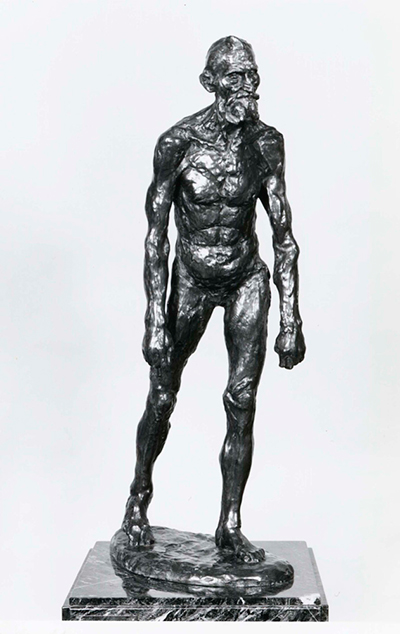
Eustache de Saint-Pierre advances with his arms hanging and his head turned slightly aside in this nude study for Auguste Rodin’s Burghers of Calais. The shoulders sit low and the legs bear the figure’s weight unevenly. These are decisions Rodin could carry into the clothed figure that appears in the monument. The name belongs to several sculptures, including different nude studies, individual casts of robed figures and separate heads. Taken together, they show how Rodin revised his portrayal of the man who volunteered first in the story of the siege of Calais. [1] [2] [3]
What the nude study shows
In the photograph, both feet reach the irregular platform beneath the figure. One stands further forward and gives the lower part of the body a direction, although the head turns away from that line. There is a gentle bend at the knee above the nearer foot. At the other side, the ankle and shin form a longer diagonal. The space between the legs broadens towards the base, where the feet cover different parts of the platform. The shape is easiest to see by following the strip of pale background from the thighs down to the support. It opens a view between the legs and helps show where the body is gathering its weight. [1] [2]
The arms fall at different angles. One stays close to the thigh, while the other gives a narrow view of the pale space behind it. There is enough separation to distinguish that hand even in silhouette. Each shoulder turns out into its own line of descent, and the neck rises slightly off the centre of the chest. Light breaks across the ribs and the upper part of the abdomen. The changing directions of the reflections make the sculpted surface look taut in some places and thin and uneven in others. Near the face, smaller areas of light pick out the forehead, cheek and beard. [1] [2]
Those details contribute to the impression of a man taking a difficult step. The feet are separated as if to move forward, but the weight of the shoulders and arms draws attention back down towards the ground. The posture makes one part of the body seem ahead of another. In the robed figure the surface of the torso is covered for much of its length. The forward inclination and the weight carried down through the arms remain visible, especially when the clothed figure is viewed on its own or in profile. [1] [4]
From the first model to the second
The medieval chronicler Jean Froissart tells how Edward III demanded that six citizens surrender themselves after the siege of Calais. In the account that informed the commission, Eustache put himself forward first. His prominence was clear in Rodin’s first small model for the monument. He carried the key, held his head erect and lifted his other arm as he advanced. The gesture and the key made it possible to identify him quickly. The larger commission gave Rodin room to reconsider how the first volunteer should relate to the others and what he should look like on the way to surrender. [1] [3] [5]
The Metropolitan Museum of Art’s catalogue traces some of that change through the people who posed for Rodin. The sculptor used the painter Jean-Charles Cazin for the nude that underlay the figure in his second maquette. By that stage Eustache’s arms had dropped, and in the clothed version a rope hung at his neck. The key had passed out of his hands. The municipal committee objected to the bearing of the figure. Rodin went on to develop a further nude with Pignatelli as model. The catalogue relates the change of model to the sculptor’s search for an older, more emaciated figure. [1] [2] [5]
Watch Rodin’s sculpture up close
Five films explore Rodin’s sculpture, from his use of classical models and the figures on his monumental doorway to the work of his studio.
Auguste Rodin – Challenging Beauty
Six sculptures show how Rodin adapted classical models.
Watch on YouTubeStudying the head and clothing
Rodin worked on the head separately, and several states survive. The Musée Rodin’s final-state head records the narrow cheeks and the modelling around the eyes in isolation. Viewed alone, the head offers a way to see how much Rodin achieved by varying the depth of the surfaces around the brow and cheekbones. In the monument those same forms have to be read at a distance, among several other figures turning in different directions. The beard makes a strong contour beneath the face, particularly when the head comes into view from the side. [1] [3] [6]
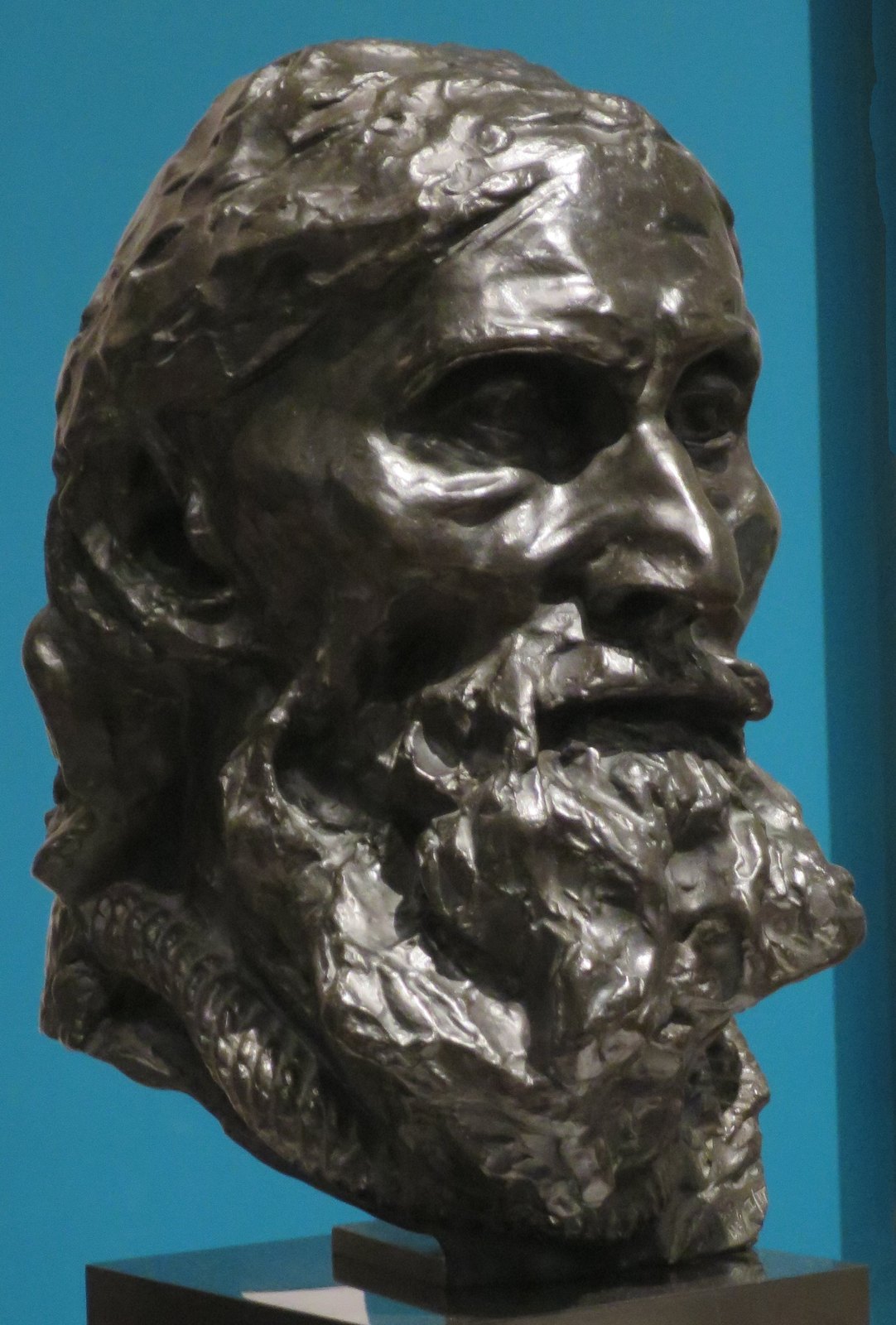
The separately cast head lets the viewer examine Eustache’s expression at close range. Photograph by Hiart, Wikimedia Commons. Image source. CC0 / Public domain. Resized for the web.
The clothing alters the way the body appears to occupy space. In the finished figure it gathers into hanging folds that partly obscure the separation of the legs. The shoulders and arms still provide a framework from which the cloth descends. Eustache can be recognised by his lowered head and the shape of his back, while Jean d’Aire holds the keys in front of him. The group was completed in 1889 and the bronze inaugurated at Calais in 1895. Moving around the finished monument changes which of the burghers is closest and how much of Eustache’s step is visible. The separate figure makes it easier to follow that step from the turn of the head all the way down to the uneven ground under the feet. [1] [3] [4]
The nineteenth-century debate also concerned the height of the monument. The Musée Rodin records that Rodin considered setting it high against the sky or close to the paving. The installation in Calais followed neither proposal. A low position would bring the stooped shoulders and faces closer to a passer-by’s own height. A high one would throw the outlines of the feet, arms and heads into greater relief against the open sky. [3] [5]
Identifying the studies
The Musée Rodin records a 67.4-centimetre nude for the second maquette, modelled in 1885 and cast by Alexis Rudier in 1927. The French national collections catalogue distinguishes it from the later study, about 97 centimetres high. The Met exhibition catalogue illustrates a cast of the latter made in 1965. The Musée d’Orsay, meanwhile, records a 47.3-centimetre statuette of the clothed figure, deposited in Lille. The differences in scale and clothing help to establish which stage of Rodin’s work an object represents. In the photograph, the nude figure, elongated limbs and turned head are consistent with the later study. The photograph gives a good view of the oval platform and the polished rectangular mount below it. Measurements and foundry marks would provide firmer evidence for the individual cast. [1] [2] [7] [8]
The left hand in plaster and bronze
A studio photograph by E. Freuler shows a plaster of Eustache’s left hand suspended on a rig. The Cantor Arts Center identifies the photograph alongside its bronze of the same hand in the final state. The plaster’s suspension leaves open space below the curled fingers. The photograph records how a detached study could be held in space and viewed at an angle before the viewer’s eye related it to a complete body. The bronze is 27.9 centimetres long. In the bronze, the raised veins and the distinctions between the knuckles occupy a surface almost as long as a forearm on a small model of the complete figure. [7] [9]
The Cantor guide points out how a museum mount can alter the apparent weight of the gesture. A hand resting on its mount gives a different impression from the same form hanging free. In the monument, Eustache’s arm supplies the connection between the hand and the figure’s forward movement. Seen independently, the slight curve of the fingers also makes sense as a decision Rodin could revisit without remaking the whole figure. [3] [9]
Rodin artworks directory
Discussion
Look again at the images and ideas explored in Eustache de Saint Pierre. These editorial prompts invite your observations.
Reader Insights
After reading “What the nude study shows”, what detail would you look for in the object or image?
What extra evidence would help you distinguish the artist’s choices from the effects of material, viewpoint or later display?
Join the Conversation
Share a detail, comparison or question about Eustache de Saint Pierre below.
References
- Metropolitan Museum of Art. Rodin: The B. Gerald Cantor Collection, Eustache de Saint-Pierre entries. View source.
- French Ministry of Culture. Eustache de Saint-Pierre, nude for the second maquette, Joconde. View source.
- Musée Rodin, Meudon. Monument aux Bourgeois de Calais. View source.
- Brooklyn Museum. Eustache de Saint-Pierre, Monumental. View source.
- Musée Rodin. Monument aux Bourgeois de Calais, studies and historical texts. View source.
- Musée Rodin. Eustache de Saint-Pierre, head, final state. View source.
- Musée Rodin. Eustache de Saint-Pierre, nude study for the second maquette, S.00387. View source.
- Musée d’Orsay. Eustache de Saint-Pierre, RF 2912. View source.
- Cantor Arts Center, Stanford University. Recasting Rodin, learning guide, figures 8–10. View source.

 Auguste Rodin.jpg)





