


 by Tom Gurney
Tom Gurney BSc (Hons) is an art history expert with over 20 years experience
Published on June 19, 2020 / Updated on November 18, 2026
Email: tomgurney1@gmail.com / Phone: +44 7429 011000
Ovid's Metamorphoses
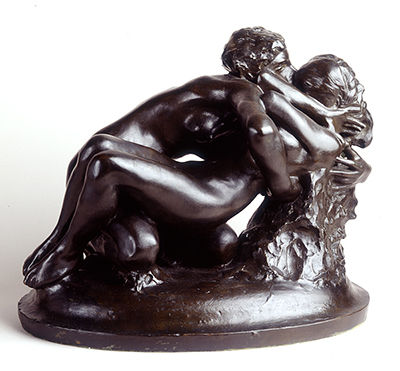
Two women are pressed together in Auguste Rodin’s Ovid’s Metamorphoses. Their heads meet at one end of the sculpture, and their bent legs extend towards the other. The bronze reproduced here sets the embrace close to the ground. One body rises above the other, leaving an opening beneath it, and a rough projection of the base stands behind their heads. Rodin also worked on the composition in an upright form associated with The Gates of Hell. The horizontal arrangement gives the space under the raised torso and the contact of the feet with the base a particular prominence. [1] [2] [3]
Reading the embrace from the side
The bent leg closest to the viewer is an easy place to begin. Its curve takes the eye to the left, where the foot comes down close to the edge of the base. Following the same leg in the other direction leads into the crowded middle of the sculpture. The body above it traces a longer curve towards the heads at the right. The two lines are separated by a small dark interval where one body rises clear of the other. A well-lit view against a plain background makes that interval easier to see than it would be against the surrounding figures of a crowded sculptural relief. [2]
At the right, the arms and heads are hard to pick out individually. One arm seems almost to continue the contour of the adjoining shoulder. With the turn of a wrist or a dip in the surface, the eye can recover the outline of one figure before it joins the other again. The proximity of the faces in particular gives the embrace a point of concentration. Both bodies extend well beyond that point, but the heads occupy a small area, close to the upright part of the base. Its rough texture gives the eye a different surface to follow through this close grouping. [2] [4]
The bronze has a dark surface with lighter passages across the rounded limbs. These are most legible where a projecting knee or shoulder catches the light. The low angle makes the faces less distinct and places greater emphasis on the outlines of the legs and backs. From higher up, a viewer would see more of the upper surfaces and the way the arms meet. From the side, one sees the weight close to the ground at one end and the gathering of limbs and heads at the other. The small opening in the middle helps the eye hold the two figures apart long enough to follow that shift. [2]
The group on The Gates of Hell
The French national collections catalogue records an upright group in the upper right part of the doorway. Set high on The Gates of Hell, the entwined figures have to be read from below and in relation to the adjoining forms. Rodin’s plaster in the Musée d’Orsay measures 42.7 centimetres in height and is dated before 1888. The museum documents traces of reworking with tools. These give a view of the decisions involved in defining parts of the group in plaster, where a change to the surface could clarify the boundary of a limb or mark where it passes into shadow. [1] [3]
The national catalogue also records a horizontal plaster, S 2871, dated before 1886 and measuring 33 centimetres high, 42 wide and 27.6 deep. The different proportions put the long axis of the figures across the base. The figures’ point of contact with the support changes because their shared movement is now set out at a low level. The projection behind the heads feels closer to the ground in this version, and the arc of the nearer leg carries the eye towards the base. Together the catalogues make it possible to discuss the doorway and the independent horizontal version while keeping the measurements and dates attached to the individual objects. [1] [2] [3]
Ovid and the sculpture’s other titles
The reference to Ovid invites a viewer to look for a change taking place. The arrangement supplies an immediate visual reason for doing so. From one point on the outline, a limb belongs clearly to an individual body. At the feet or close to the heads, where the contours meet, it takes a second look to trace it back. The V&A discusses the work in its LGBTQ collection trail and identifies the two figures as women. Its interpretation also treats Ovid as a general influence. The sculpture can be read through the intimacy of the embrace, with the suggestion of transformation arising from what happens to the boundaries between the figures. [2] [4]
The French catalogue lists several names associated with its horizontal plaster, among them Volupté, Les Fleurs du mal and The Death of Sappho. The title Volupté points to sensual experience, while Les Fleurs du mal invokes the title of Baudelaire’s poetry collection. The Death of Sappho offers a specific literary association. Each name directs attention to a different aspect of the same two bodies. The catalogue also tentatively interprets one small feature as a faun’s tail. That detail and the alternative title Satyrs, recorded by the Museo Soumaya for its bronze, give a sense of the range of mythological associations that viewers have brought to the group. [2] [5]
Versions in different materials
The Museo Soumaya dates the conception of its version to 1886–89 and identifies the founder as Alexis Rudier. The Musée Rodin records a plaster associated with the marble in Helsinki. The records show the composition’s circulation in several materials, as well as the importance of distinguishing a model from the specific object reproduced. In a pale plaster the boundary between two limbs may show chiefly as a cast shadow, while the photographed bronze has small areas of reflection that interrupt the dark surfaces. In particular, the window of background below the raised body remains visible even when the finer divisions between overlapping limbs are difficult to see. [1] [2] [5] [6]
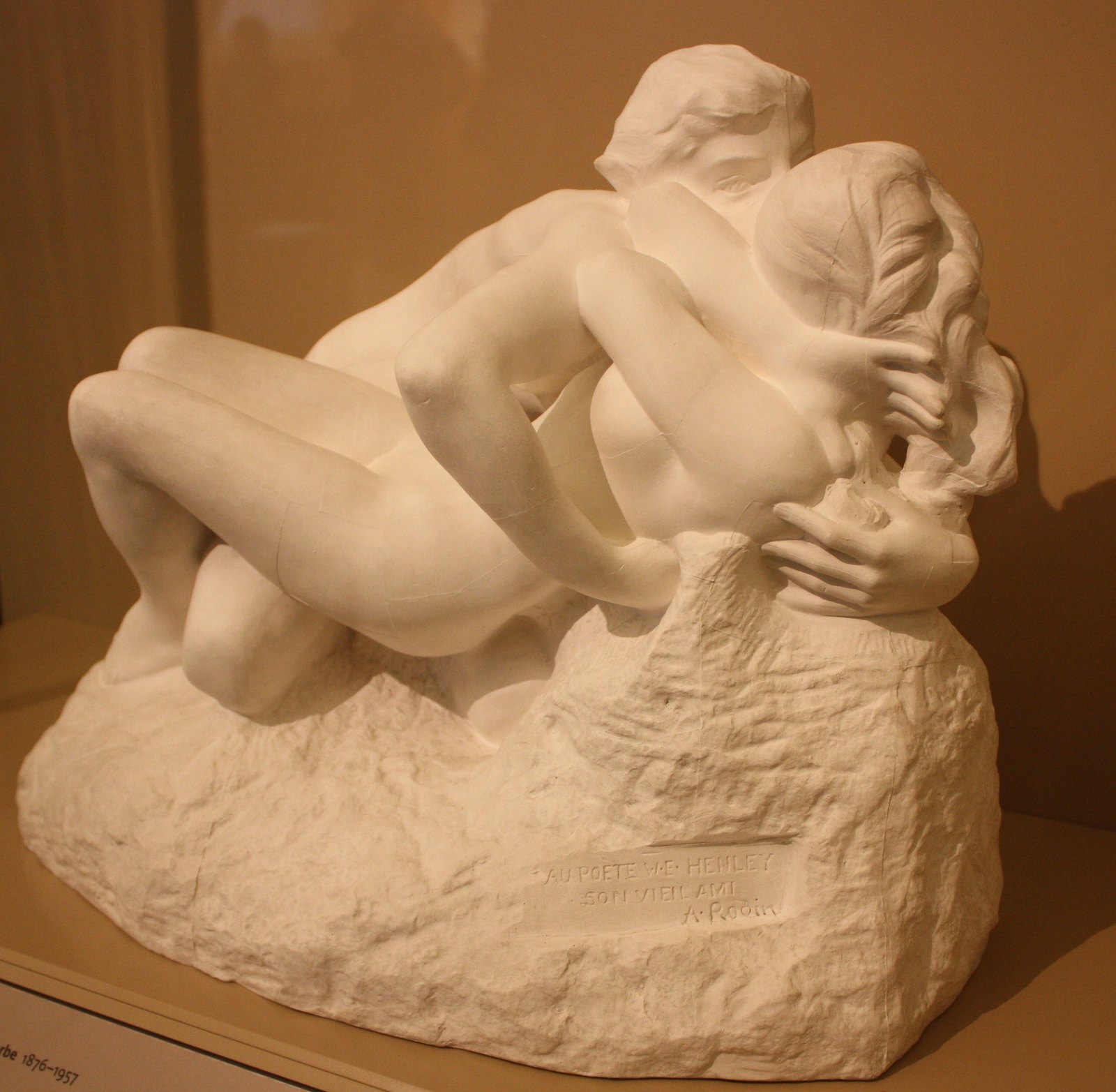
The V&A example is catalogued as A.117-1937. Photograph by Val_McG (va_va_val), Wikipedia Loves Art at the V&A, via Wikimedia Commons. Image source. CC BY-SA 2.5. Resized for the web.
The photograph shows the horizontal composition, and the exact cast remains unidentified. Its viewing angle gives a clear profile of the body arching over the other and of the foot lowering towards the curved edge of the base. The two actions meet in the middle, where the bronze projects farthest from the ground. The heads remain close together at the opposite end. Much of the sculpture’s movement can be read by following these points of contact, from a toe touching the base to the arms and heads closing the space between the figures. [2] [4] [5]
Watch Rodin’s sculpture up close
Five films explore Rodin’s sculpture, from his use of classical models and the figures on his monumental doorway to the work of his studio.
Auguste Rodin – Challenging Beauty
Six sculptures show how Rodin adapted classical models.
Watch on YouTubeReuniting the reclining figure’s legs
The Musée Rodin’s foundry plaster S.02179 preserves the group on a low base. It is 40.7 centimetres wide, and the museum records release agent on its surface. The catalogue relates it to a fragment of the reclining figure’s legs, formerly catalogued under S.02667. The museum reunited that fragment with the plaster in 2009 and retired the separate inventory number. The entry makes it possible to follow a change in the physical object alongside the change in its documentation. A catalogue entry for a pair on a base can represent both the form developed in the studio and the later history of the pieces that survive. [7]
The plaster also provides a comparison with S.02870, cast from the marble in Helsinki and used for pointing. Both entries record marks on the front of the base, including A465 and a V. The two works have different dimensions and functions despite the shared marks. On S.02179 the reunited legs give the reclining figure a continuous outline across the plaster’s lower field. On S.02870 the graphite and metal nails belong to a technical record of the version’s use for transferring measurements. The inventory numbers keep those histories distinct. [6] [7]
Theodor Oppermann faced a related catalogue question in Copenhagen. In 1910 he wrote to Rodin asking about the carving sequence of the Glyptotek’s marbles. He specifically said that he did not know which carving of Ovid’s Metamorphoses the museum owned. That letter documents an uncertainty at the time. The Helsinki and Copenhagen references are valuable precisely because they attach the shared title to different objects and different questions about their making. [6] [8]
A plaster records a marble
One Musée Rodin catalogue entry identifies its work as a plaster moulded from marble and links it with the version in the Ateneum in Helsinki. The dimensions of the Paris plaster are 33.5 by 43.7 by 28.6 centimetres. Its catalogue classification is material evidence of the movement between objects. The term for the moulding gives the direction of the relationship, from a carved surface to a plaster record of that surface. The plaster gives a point of comparison for the way the limbs meet and for the profile of the base. Its recorded relationship to one marble also limits how much it can tell us about the other carvings. [9]
That chronology matters when the same title appears in several forms. The Musée d’Orsay’s upright plaster can be compared with the horizontal version catalogued in Joconde. For those two objects, the terms that identify orientation explain a change in how the same bodies address a viewer. For the plaster moulded from marble, the medium instead tells us about how its model was obtained. The shape, support and surface can therefore answer different questions. Even a plaster with a familiar pose may belong to a later stage of the work’s circulation than a finished-looking version in stone. [9] [1] [2]
Reading the title beside the bodies
The Victoria and Albert Museum’s collection trail describes the figures as two women and discusses the work in the context of desire between women. That attribution gives the museum’s discussion a starting point in the sculpture’s visible relationship. The broad title Ovid’s Metamorphoses names a book of many transformations without naming the women or a single episode. A reader looking for a particular story should first ask what the object supplies: two interdependent poses, with enough of the faces and limbs visible to hold attention on the encounter. [4]
The change between an upright and reclining placement brings another aspect of the title into view. On a horizontal base one body can appear to receive the weight of the other. Turn the group upright and a similar line can look like a reach or a pull. That change can be compared directly in the versions without treating it as proof of which story Rodin meant. The catalogue can document the change of orientation with precision. The interpretation of what happens between the bodies remains a question to bring to the sculpture each time it is seen. [1] [2] [4]
The piece of the portal that survives around the figures
The Musée Rodin holds a plaster relief, S.05778, identified as a portion of the entablature from the upper right corner of The Gates of Hell with the Metamorphoses group. It is almost ninety centimetres high, 69.3 centimetres wide, and weighs 61.5 kilograms. The object record describes a portion of the architecture, so its measurements include more than the figures. Those dimensions explain what can be lost when an isolated photograph shows little of the field around the group. The entwined bodies share the relief with the structure of the doorway. [10]
On the separate reclining sculpture, the stone or bronze at the bottom supplies a reference for where the bodies rest. On the portal, the reference can come from the mouldings around the group. Looking up from below brings the edge of the frame into the same view as the moving bodies. The plaster relief lets this relation be studied without having to locate the figures within the whole door each time. Its inventory and recorded location establish which part of the door it preserves, even as the catalogue lists more than one approximate date in its creation field. [10]
Rodin artworks directory
Discussion
Look again at the images and ideas explored in Ovid's Metamorphoses. These editorial prompts invite your observations.
Reader Insights
After reading “Reading the embrace from the side”, what detail would you look for in the object or image?
What extra evidence would help you distinguish the artist’s choices from the effects of material, viewpoint or later display?
Join the Conversation
Share a detail, comparison or question about Ovid's Metamorphoses below.
References
- Musée d’Orsay. Les Métamorphoses d’Ovide, S 03099. View source.
- French Ministry of Culture, Joconde. Les Métamorphoses d’Ovide, S 2871. View source.
- French Ministry of Culture, Joconde. Catalogue record for the upright group. View source.
- Victoria and Albert Museum. Out on Display collection trail. View source.
- Museo Soumaya. Las metamorfosis de Ovidio. View source.
- Musée Rodin. Les Métamorphoses d’Ovide. View source.
- Musée Rodin. Les Métamorphoses d’Ovide, foundry plaster S.02179. View source.
- Carl Jacobsen’s Correspondence Archive. Oppermann to Rodin, 21 March 1910. View source.
- Musée Rodin. Les Métamorphoses d’Ovide, plaster moulded from the Helsinki marble. View source.
- Musée Rodin. Élément de la Porte avec les Métamorphoses d’Ovide, S.05778. View source.

 Auguste Rodin.jpg)





