


 by Tom Gurney
Tom Gurney BSc (Hons) is an art history expert with over 20 years experience
Published on June 19, 2020 / Updated on November 18, 2026
Email: tomgurney1@gmail.com / Phone: +44 7429 011000
Hand
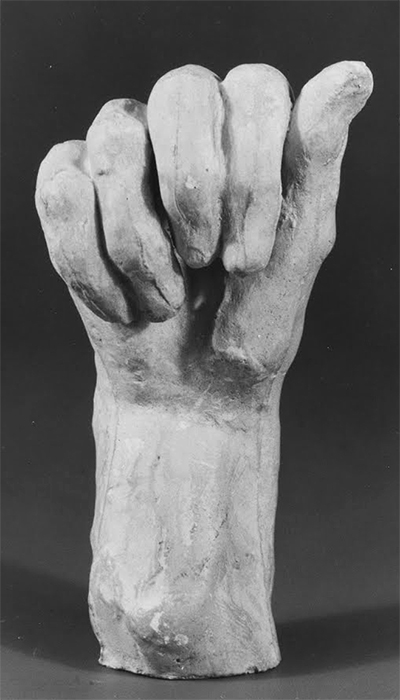
Four fingers curl towards the palm in Auguste Rodin’s small plaster Hand. The thumb remains apart, leaving an opening at the centre of the gesture. Below the fingers a length of wrist rises from a roughly level cut, which makes the fragment look self-supporting in the photograph. The image matches the Metropolitan Museum of Art’s plaster Hand, accession 66.247.4. The museum dates the modelling tentatively to around 1886–89 and suggests a possible connection with Jean d’Aire, the burgher holding the keys in Rodin’s monument to the citizens of Calais. The sculpture is only 7.9 centimetres long. [1] [2]
The shape of a grip
The fingers turn by different amounts. The two at the centre project farther forward and descend close together. The fingers at the left roll inwards at a greater angle. Their lower edges reach across part of the palm and almost touch one another in this view. The thumb extends up on the right, where its outline remains clear against the background. Its tip curves away from the nearer fingers. A slim wedge of darkness separates it from the next finger near the top and broadens closer to the middle of the hand. This variation in spacing gives the grip its particular shape. [1]
At the base of the fingers the plaster is darker. Here the shapes of the fingertips can be followed back into the palm, where the contours start to overlap. A viewer looking from a more oblique angle would see further into the interval between the thumb and the fingers. The opening might then look more like room for something to pass through it. The model gives that concealed area a definite width, even though the fingers would make it difficult to see any object placed inside the grip. In the photograph an empty interval has to do the work of suggesting what the hand could hold. [1]
The wrist also gives the pose a direction. Its length accounts for much of the height, and from this angle the fingers seem to turn down even as the palm points upwards. Light falls across the rounded forward surfaces and catches shallow lines running along the wrist. Lower down, the surface becomes rougher and the edge meets the ground at a slight slope. That edge is visible in the museum photograph. In a full figure, the wrist would lead the viewer towards the elbow and shoulder. The end of this plaster lets one see how Rodin defined the action within a small part of the body. [1] [3]
The surface also records subtle differences at the ends of the fingers. One tip appears rounded and almost smooth, while the smaller forms to its left show shallow depressions. The alternation helps distinguish the individual fingers where their silhouettes overlap and where little of the palm is exposed. [1]
A possible connection to Jean d’Aire
Rodin modelled six citizens for The Burghers of Calais. Jean d’Aire holds the keys to the city in the finished monument. His hands are visible at the front of his body, where the keys give the grip a practical purpose and connect the figure with the city’s surrender. The Met suggests that the small plaster could have been made in connection with a version of Jean d’Aire. Several stages of the monument survive, including independent figures and preparatory studies. A grasping hand would have allowed Rodin to explore how the fingers might respond to the weight and shape of an object before that gesture was placed in a larger composition. [1] [2] [4]
Looking at the hand by itself changes what can be inferred from it. There is no key visible in its palm. Its size and shape can be compared with known studies and versions of the monument, but the association with Jean d’Aire remains tentative in the collection record. The photograph also shows it upright, a position that emphasises the rise of the thumb and draws attention to the curve of each finger. In the monument the relationship of the hands to the keys and to the man’s shoulders helps determine how the same kind of grip is read. [1] [2] [4]
The small plaster in Rodin’s studio practice
The Musée Rodin explains that Rodin called his collection of separately modelled body parts abattis. He had clay models cast in plaster, building up a stock of forms available for comparisons and new combinations. A hand might make the direction of a figure’s movement legible, or be brought close to a face to give its expression a different emphasis. The Musée Rodin’s study of his hands discusses examples that were kept separately as well as others that were combined with heads or additional limbs. The opportunities for reuse depended partly on the ability to look at a form closely and judge what would happen if it were placed at a different angle. [3] [5]
There is also a difference between a hand made at the scale of a monument and a plaster small enough to fit inside the hand of its viewer. The Met’s Study of a Hand, accession 12.12.8, measures 34.3 centimetres and was cast from a full-scale study for the Calais group. Rodin gave it to the museum in 1912. That length allows a spectator to follow individual changes in the contour over a considerable distance. In the small plaster, the changing spaces between the fingers and the thumb are concentrated in a much shorter area. Museum photographs can make either piece fill a screen, so the measurements are important to understanding the difference. [1] [6]
The small plaster has a separate history. Rodin presented it to his pupil, the American sculptor Malvina Hoffman, and it reached the Met through her bequest in 1966. The museum’s history of its Rodin collection records other examples of the small hands she left to it. That provenance distinguishes the pictured plaster from the larger study given by Rodin himself. It also gives the surviving fragment an identity independent of its possible connection to Jean d’Aire. The sharply lit photograph emphasises something a model of this size lets a sculptor assess quickly. The fingers almost close the hand, but the extended thumb leaves just enough room for the shape of its grip to remain visible. [1] [6] [7]
Watch Rodin’s sculpture up close
Five films explore Rodin’s sculpture, from his use of classical models and the figures on his monumental doorway to the work of his studio.
Auguste Rodin – Challenging Beauty
Six sculptures show how Rodin adapted classical models.
Watch on YouTubeReading scale in a group of hand studies
Two other plasters from Rodin’s 1912 gift to the Met are catalogued as Study of a Hand. One, 12.12.16, is 10.8 centimetres along its longest recorded dimension. The other, 12.12.18, measures just 5.1 centimetres in length. The study related to The Burghers of Calais, 12.12.8, is 34.3 centimetres long. Putting those measurements beside the images reveals a spread that a row of equally sized photographs would conceal. In the smallest plaster, a slight change in the angle of a finger occupies a large part of the whole object. On the full-scale study, the eye can travel from the thumb towards the wrist without having to take in the entire silhouette at once. [6] [8] [9]
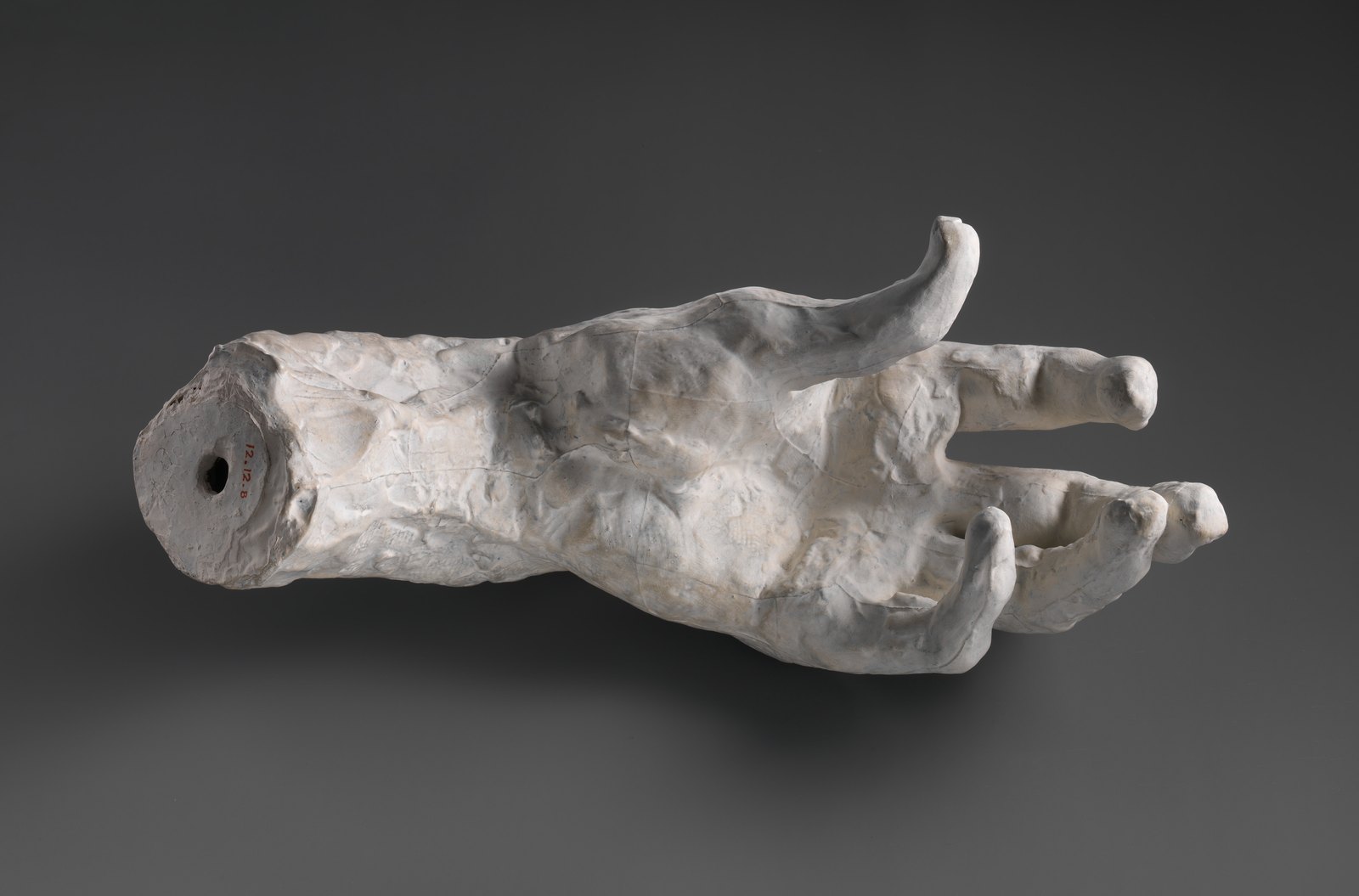
The Met study shows how an isolated hand could be kept as a separate studio model. The Metropolitan Museum of Art, Gift of Auguste Rodin, 1912, 12.12.8. Image source. CC0 / Public domain.
The shared gift date lets us say these plasters reached the Met through the same donation. Their records give different degrees of precision about when the models were made. Only the record for 12.12.8 links its hand to a full-scale study for the Calais monument. The small works can be compared as examples of separate modelling decisions without assigning them to that commission. For the hand on this page, the possible connection to Jean d’Aire still depends on the Met’s description of that particular object. [1] [6] [8] [9]
A different hand named in the Met’s catalogue
The Met catalogues another object as The Clenched Left Hand (Study for Hand of Pierre de Wiessant). Its bronze, cast by Georges Rudier in 1974 from a model dated about 1885, is 46.4 centimetres high. The museum records a weight of 10.5 kilograms. That combination of scale and weight changes the experience of the motif. The fingers have much more room to be read independently than they do in the little plaster illustrated on this page. The large bronze can impose a clear shadow of the curled fingers even when a viewer stands farther away. [1] [10]
The Met identifies the large hand as a study for Pierre de Wiessant, whereas it treats the small plaster’s connection with Jean d’Aire as possible. The comparison is most useful if those two levels of identification stay visible. A similar inward turn of the fingers tells the viewer something about the formal problem Rodin was exploring. Linking a particular hand to a named figure asks for evidence from the larger figure, the studio record, or the museum’s account of the model. In either case, the way the wrist ends makes it possible to direct attention to the hand without being led back up the arm. [1] [10]
A hand becomes the whole subject of a photograph
The Met also holds a gelatin silver print by Eugène Druet that it dates before 1898. The photograph presents Rodin’s clenched hand as a subject on its own. It precedes the Met’s 1974 bronze and offers evidence of how the form could be studied and presented at an earlier date. The print’s date belongs to the photographer’s encounter with a version of the work. It cannot establish a date for the later cast, even where details of the subject agree. [10] [11]
Druet’s framing gives the hand a single orientation. Casting the sculpted form in the round gives a visitor the option of moving to see parts of the knuckles and wrist withheld by that orientation. Look at the hand first as a profile of closed fingers, then imagine seeing it more from the back. This is a way to make the difference between the two kinds of record concrete. The photograph preserves the visual argument made from one position, while the sculpture leaves that position for the viewer to choose. [10] [11]
Two hands from one burgher take different roles
The Musée Rodin links the wide left hand in its assemblage of Camille Claudel’s mask to Pierre de Wissant. It distinguishes that hand from the right one Rodin used in The Hand of God. The works give the two hands different tasks. In the assemblage the fingers are almost as commanding as the face. Their size and their proximity to the eyes can make the relationship feel uncertain. In the other sculpture, the hand supports a group of small figures set within a piece of stone. Once a hand is removed from the body for which it was studied, changing the object beside it can give its already modelled shape a new direction. [12]
Rodin also used photographs to test the gesture of a detached hand. The Musée Rodin’s study of the workshop documents a photograph by Freuler of a clay left hand suspended by a thread. It associates the hand with Pierre and Jacques de Wissant. Suspension let Rodin examine the downward inclination without the mass of an entire figure around it. The same study describes later photographs by Albert Rudomine in which hands are arranged upright. One record preserves an experiment in the direction of a gesture. The later arrangement turns the fingers towards the light and enables another kind of inspection. Neither record resolves the identification of the small Met plaster with Jean d’Aire. [1] [13]
Rodin artworks directory
Discussion
Look again at the images and ideas explored in Hand. These editorial prompts invite your observations.
Reader Insights
After reading “The shape of a grip”, what detail would you look for in the object or image?
What extra evidence would help you distinguish the artist’s choices from the effects of material, viewpoint or later display?
Join the Conversation
Share a detail, comparison or question about Hand below.
References
- Metropolitan Museum of Art. Hand, 66.247.4. View source.
- Metropolitan Museum of Art. The Burghers of Calais. View source.
- Musée Rodin. Abattis. View source.
- Musée Rodin, Meudon. Monument aux Bourgeois de Calais. View source.
- Musée Rodin. Rodin, la main révèle l’homme. View source.
- Metropolitan Museum of Art. Study of a Hand, 12.12.8. View source.
- Metropolitan Museum of Art. Rodin at The Metropolitan Museum of Art. View source.
- Metropolitan Museum of Art. Study of a Hand, 12.12.16. View source.
- Metropolitan Museum of Art. Study of a Hand, 12.12.18. View source.
- Metropolitan Museum of Art. The Clenched Left Hand (Study for Hand of Pierre de Wiessant). View source.
- Metropolitan Museum of Art. Eugène Druet, Auguste Rodin’s The Clenched Hand. View source.
- Musée Rodin. Assemblage: Mask of Camille Claudel and left hand of Pierre de Wissant. View source.
- Musée Rodin. Rodin, le laboratoire de la création, discussion of Freuler and Rudomine. View source.

 Auguste Rodin.jpg)





