


 by Tom Gurney
Tom Gurney BSc (Hons) is an art history expert with over 20 years experience
Published on June 19, 2020 / Updated on November 18, 2026
Email: tomgurney1@gmail.com / Phone: +44 7429 011000
Pierre de Wiessant
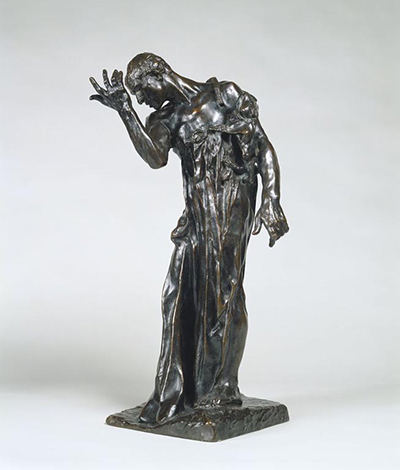
Pierre de Wissant raises his open right hand as he bows his head in Auguste Rodin’s bronze. His body twists between that lifted hand and the arm hanging on the other side. The figure was developed for The Burghers of Calais, a monument to six citizens who offered themselves to the English king during the siege of their city. Rodin also issued the figures independently. The separate bronze gives a viewer time to follow the turn through Pierre’s neck, hips and feet, and to see how the folds of his garment connect those parts of the body. The Metropolitan Museum of Art uses the spelling Pierre de Wiessant for its reduced bronze. [1] [2] [3]
The raised hand and the turn of the body
The arm rises from a bent elbow and ends in an open hand alongside the lowered face. From the angle of the photograph, the spread fingers are visible against a pale background. Their tips make a broken line, quite different from the long edge of the garment below. A slight gap between the hand and the head makes it possible to read both outlines. Even when the face slips into shadow, the viewer can still tell how far the head has turned by following the slope of the neck back towards the shoulders. The hand can suggest both an effort to shield the face and a gesture addressed beyond it. [1] [2]
The other arm drops from the shoulder almost to the level of the hip. Its fingers bend down and project a little beyond the clothes, so the outline at that side is interrupted just as it is at the top of the raised arm. A difference in height gives these two gestures their force. The higher hand stands out clearly in the open space to one side, while the lower one remains close to the body. The chest emerges between them, catching patches of light where the neck turns into the upper shoulder. Below that point the bronze darkens through a long series of folds. [1] [2]
The lower part of the figure is easier to read by looking at the feet first. One foot draws out a little beyond the drop of the garment while the other remains closer to the central mass. In the Met’s interpretation, one side of the figure proceeds towards the English camp while the right side twists back and a foot trails. The roughly modelled surface of the base makes a short interruption between the smooth curve of the toes and the straight lower edge of the sculpture. That small distance gives a viewer somewhere to look for the direction of the step, even when the shadows of the fabric hide much of the legs. [1]
A figure worked out in stages
Rodin first studied the bodies of the burghers nude, developing the movement beneath the clothing before working with the draped figures. The Metropolitan Museum dates its nude study of Pierre to 1885. Its catalogue on the Cantor collection compares the figure in the first model for the monument with the nude prepared for the second. The earlier boyish figure raises an arm with a gesture that seems directed at himself. The subsequent figure angles his head down and turns the arm into a shield. The changed pose permits a different reading of the same character, in which the attention seems to turn inwards as the body strains away from its direction of travel. [4] [5]
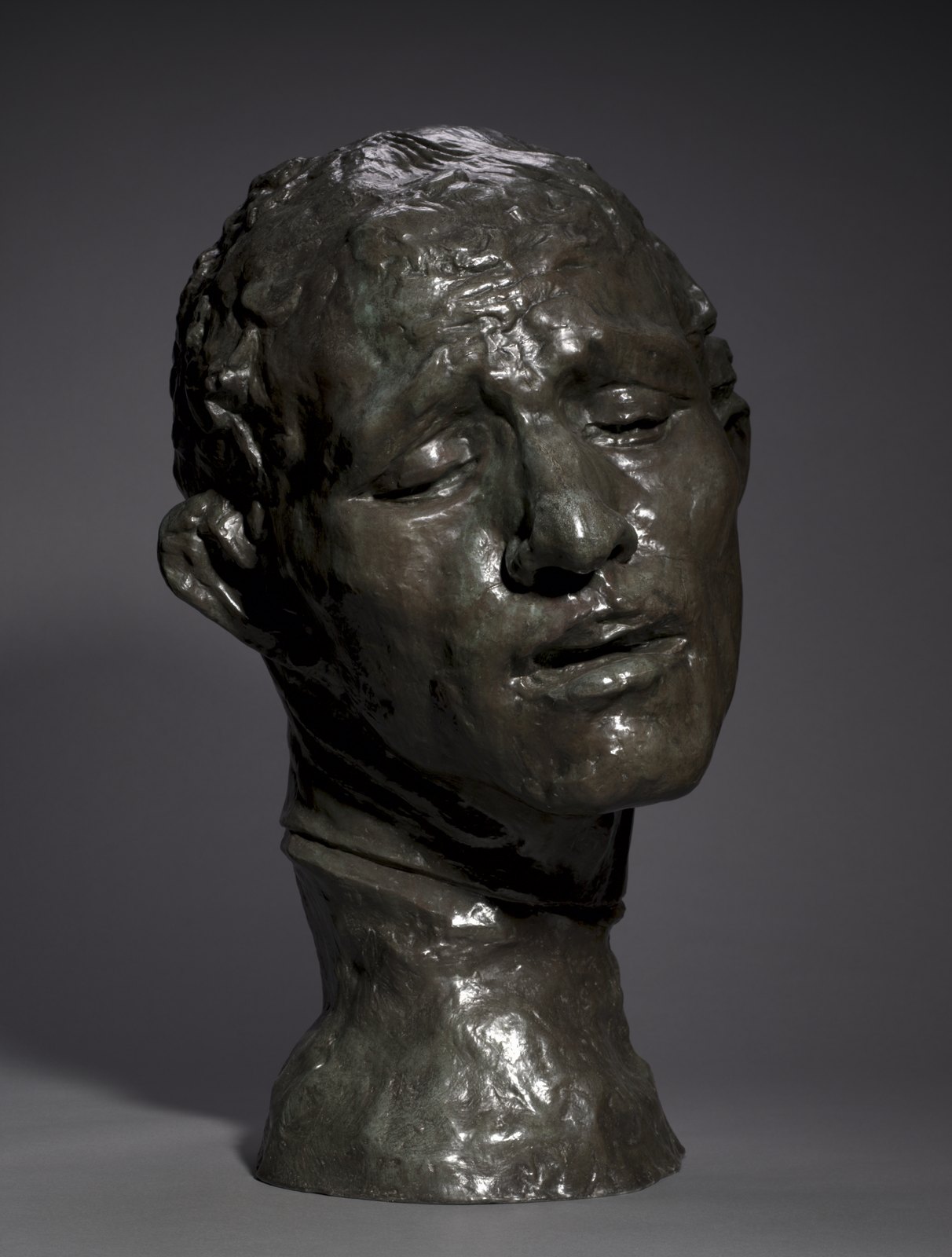
Rodin developed Pierre’s head as a separate study for the Calais monument. The Cleveland Museum of Art, The Norweb Collection, 1920.120. Image source. CC0 / Public domain.
The Musée Rodin gives a further example of how closely the gesture was worked out. In its monumental nude S.00626 the elbow is closer to the torso, while in the final version the palm is turned more towards the sky. With the elbow drawn in, the curve from shoulder to hand follows a compact path close to the head. The outward movement in the draped bronze increases the visible space alongside the face. The catalogue records studies at different scales for the head and hands as well as reductions of the whole figure. The expression was worked on both at the level of the entire body and through the angle of the wrist or the shape of the mouth. [2] [5] [6]
Watch Rodin’s sculpture up close
Five films explore Rodin’s sculpture, from his use of classical models and the figures on his monumental doorway to the work of his studio.
Auguste Rodin – Challenging Beauty
Six sculptures show how Rodin adapted classical models.
Watch on YouTubePierre among the burghers
The story commemorated by the monument takes place during the siege of Calais in 1347. Six citizens put themselves at the mercy of Edward III of England to spare the city. Pierre and his brother Jacques were two of the six. Rodin’s ensemble gives its figures different bearings within a common situation. Jean d’Aire carries the keys, while Pierre’s bowed head and raised hand turn attention towards the decision of an individual within the group. The others provide points of reference for the direction of his movement. The space between their bodies also allows his splayed hand to register as part of a sequence of gestures across the monument. [3] [5]
Taken away from the group, Pierre still seems to be in the process of moving. A spectator approaching the bronze from the side would first see the height of the hand relative to the face, then the offset between the hips and shoulders. From the front, the long lines of cloth bring the eye down to the base and to the figure’s uneven footing. These vantage points give different weight to the parts of a single action. A detached version also makes the figure’s scale relative to the spectator different, particularly if it is a reduction set at eye level. [1] [2]
Independent bronze versions
The Met’s reduced Pierre de Wiessant stands 45.1 centimetres high. The museum dates its modelling to 1885 and its casting by Alexis Rudier to around 1900–07. The Musée Rodin’s monumental draped bronze S.06139 stands 214 centimetres high. The museum dates the conception of that version to 1887 and records the Coubertin foundry’s casting in 1988. A similar posture in the two photographs therefore encompasses works of very different size and casting history. The reduced bronze can be seen in a single glance from the raised fingertips to the base. In the monumental version, a spectator standing close to it has to look up to see the hand alongside the face. The legacy image shows the draped composition with the same arrangement of the hands, deep vertical folds and low square base as in the Met’s reduced bronze. The exact cast in that photograph remains unconfirmed. [1] [2]
A nude at the Pavillon de l’Alma
The Musée Rodin identifies a nude study of Pierre without a head or hands as one of the works that greeted visitors to Rodin’s own exhibition at the Pavillon de l’Alma in 1900. The French national inventory records the same fragmentary type as a nude for the monument. Its appearance near the beginning of a public exhibition put a studio study before an audience in its own right. The missing parts include the features that most clearly distinguish Pierre in the clothed group, leaving the twist through the torso and the disposition of the legs to carry the movement. [7] [8]
The hands also led separate lives. The Musée Rodin identifies Pierre’s left hand in the assemblage with Rodin’s mask of Camille Claudel and the right hand in The Hand of God. In the first assemblage the left hand is large against the face. Against another body on a monument its scale would be read in relation to a forearm and shoulders, while here it stretches across the space of a portrait. The surviving mould seams on Claudel’s mask make the two elements legible as pieces that Rodin brought together. [9] [10]
Rodin artworks directory
Discussion
Look again at the images and ideas explored in Pierre de Wiessant. These editorial prompts invite your observations.
Reader Insights
After reading “The raised hand and the turn of the body”, what detail would you look for in the object or image?
What extra evidence would help you distinguish the artist’s choices from the effects of material, viewpoint or later display?
Join the Conversation
Share a detail, comparison or question about Pierre de Wiessant below.
References
- Metropolitan Museum of Art. Pierre de Wiessant, 67.155.12. View source.
- Musée Rodin. Pierre de Wissant, Monumental, S.06139. View source.
- Musée Rodin. Monument to the Burghers of Calais. View source.
- Metropolitan Museum of Art. Pierre de Wiessant, Nude Study, 1984.364.11. View source.
- Metropolitan Museum of Art. Rodin, the B. Gerald Cantor Collection, discussion of Pierre de Wiessant. View source.
- French Ministry of Culture, Joconde. Pierre de Wissant catalogue record and related studies. View source.
- Musée Rodin. Rodin, la lumière de l’antique, exhibition dossier. View source.
- French Ministry of Culture. Pierre de Wissant, nude for the monument without head or hands. View source.
- Musée Rodin. Mask of Camille Claudel and left hand of Pierre de Wissant. View source.
- Musée Rodin. Assemblage, collection record. View source.

 Auguste Rodin.jpg)





