


 by Tom Gurney
Tom Gurney BSc (Hons) is an art history expert with over 20 years experience
Published on June 19, 2020 / Updated on November 18, 2026
Email: tomgurney1@gmail.com / Phone: +44 7429 011000
Monument to Victor Hugo
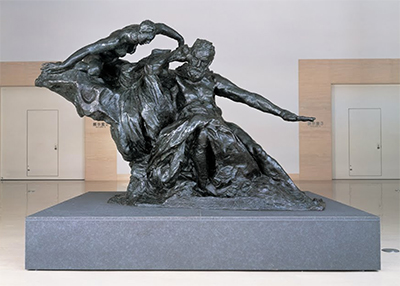
Victor Hugo sits on a mass of rock, one arm stretching into the air. His beard and bowed head bring the eye back to the figure as the arm takes it outward. A portrait bust might have given Auguste Rodin room for the turn of the head and the shadow beneath the brow. The monument gave him a hillside’s worth of stone and an interval of open air in which to make the gesture count. In some of his studies, figures gather around the poet and offer a way of reading the space above and behind him. The marble installed in the Palais-Royal in 1909 concentrates attention on Hugo himself. [1] [2] [3]
A monument for the Panthéon
The French state commissioned Rodin to commemorate Hugo in 1889, four years after the writer’s death. Its intended site was the Paris Panthéon. The choice of building put a particular demand on a sculptor. Hugo’s work as novelist and poet was part of the reason he was being honoured, but so was his public and political life. An official monument had to address viewers who already knew his face and who might approach the statue from across an architectural space. Rodin’s first design placed the poet seated among rocks, with other figures drawn into the composition. [1] [4]
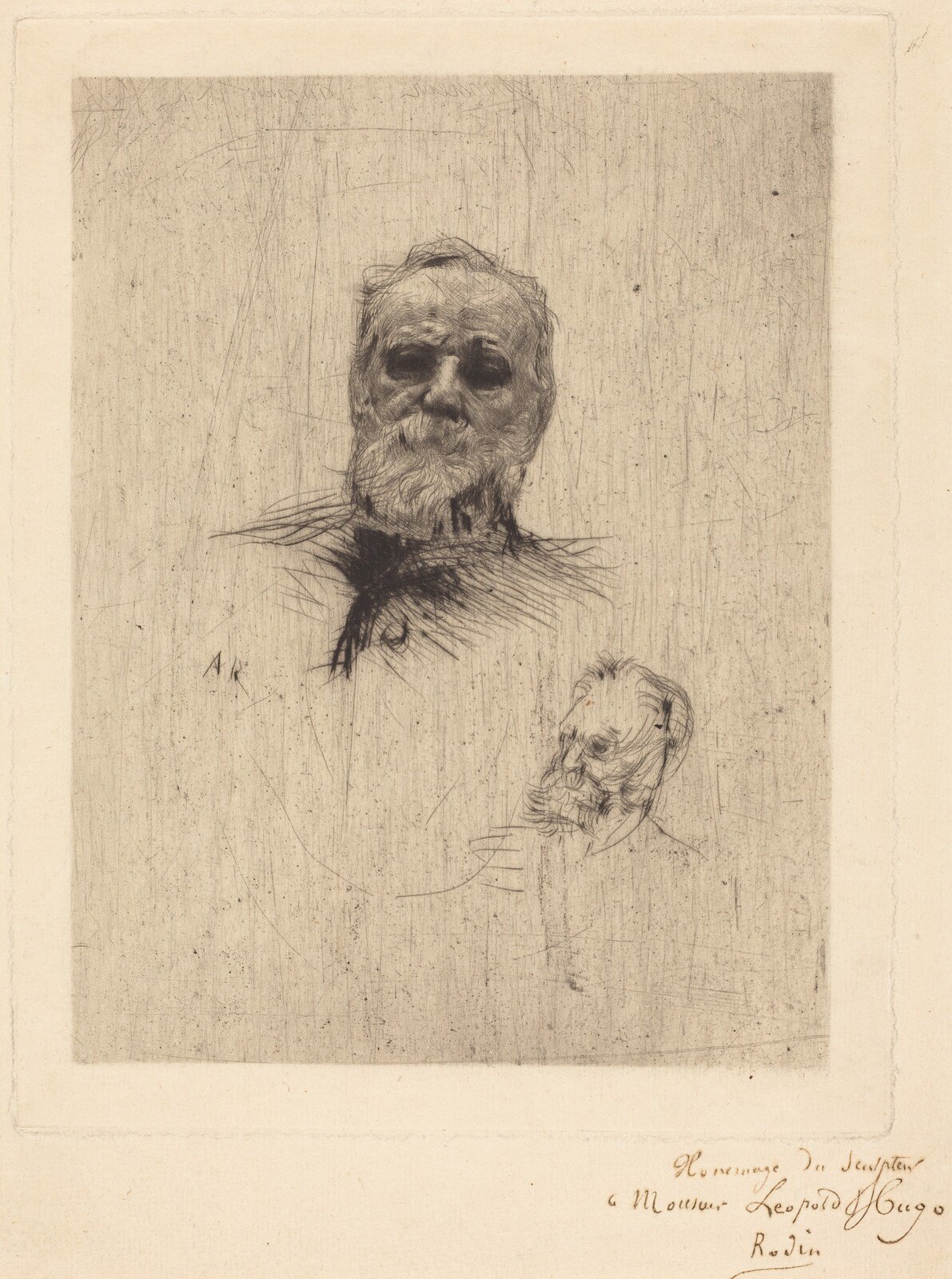
Rodin also portrayed Hugo in drypoint. This frontal print focuses on the face, which would later be read as part of a larger sculptural group. National Gallery of Art, Washington, Rosenwald Collection, 1943.3.7406. Image source. CC0 / Public domain.
The rocky setting recalls Hugo’s exile in the Channel Islands. It gives the action of the extended arm a larger field. One can imagine the hand being raised against the wind or the figure addressing something beyond the rock. The Musée Rodin relates the gesture to Hugo’s public resolve and his defence of republican liberties. The gesture can carry that meaning while the bent head and the supporting hand direct attention back to a solitary individual. Hugo is presented as both someone with an inward life and someone whose words and decisions mattered in public. [2] [3]
The seated proposal did not satisfy those responsible for the Panthéon project. Rodin continued to develop it and pursued a standing Hugo for the Panthéon as a separate line of work. In studies and accounts of the commission, it is useful to keep those two lines in view. A figure moving upwards through the space of an interior monument presents a different problem from a man seated on rock in a garden. A date attached to the original commission does not identify which design a later study or bronze records. [1] [3] [4]
The poet and the muses
The Musée Rodin’s Model for the Monument to Victor Hugo, with Meditation and the Tragic Muse gives two companion figures a place beside and behind the writer. Their presence changes the direction of his listening gesture. The hand near the head and the reach of the other arm can be read as part of an exchange. Seen from another angle, each added figure also alters the silhouette. The monument becomes a composition that extends upward as well as outward, concentrating more of its activity around the poet’s shoulder and head. [1] [3]
Rodin revised those relations repeatedly. A muse could acquire a significance of her own as her posture and position changed. The vertical figure changes what can be seen around Hugo’s head, sometimes putting it in shadow or narrowing the open area beyond the face. Move a figure away and the same expression becomes more immediately legible. The Musée Rodin’s account of the plaster exhibited in the Pavillon de l’Alma in 1900 identifies a version in which the Tragic Muse was retained above the poet on a support. To someone seeing that arrangement, the figure in the air would have been part of the way the whole image worked. [2] [3]
The working photographs provide a different sort of evidence. In Dornac’s studio portrait from around July 1898, Rodin sits near a plaster for the first Hugo project at the Dépôt des marbres. The photograph can help a viewer see how much room there was around the work before it went into a public garden. It belongs to the history of work on the commission, while the monument eventually seen outdoors belongs to the history of its installation. A closely cropped reproduction of the photograph gives a particularly different impression if it makes the scene primarily a portrait of Rodin. [5]
How a muse fitted beside the poet
The bowed figure known as Meditation existed before she took her place beside Hugo. The Musée Rodin traces her to the tympanum of The Gates of Hell. For the monument Rodin removed the arms and shortened the legs so that she could fit with the other forms. The narrowing at the shoulders and the lower ends of the legs have a different effect when seen beside Hugo. His raised head makes the inclination of hers easier to see, while her torso follows a much tighter curve than his extended arm. One body can reach into the space around the rock because the other turns inward beside it. [12]
The studio modification survived when the figure took on an independent life. The Musée Rodin dates its enlarged plaster S.01125 to 1896 and records a height of 147 centimetres. It notes that the figure was exhibited without the limbs in Dresden and Stockholm the following year. On her own, the shape that had helped her fit into a larger group needed to be read as the whole sculpture. Start with her inclination at the neck and trace it down through her ribs. Those turns continue below the places where the missing limbs might ordinarily direct a viewer’s attention. The museum records that the unfinished appearance gave early audiences difficulty. [12]
The two uses of the figure give different weight to the same changes. Beside Hugo, a reduction of the limbs allowed Rodin to bring the muse close enough for her face and body to register as a presence near the poet. Enlarged and shown alone, she had room around the entire contour. Rodin could keep the decisions he had made for the group while exposing them to a new view. The museum’s account identifies the figure as an inspiration for Hugo. The fragment by itself also leaves room to consider meditation as something expressed through the turn of one body. [12] [4]
The marble at the Palais-Royal
The state ordered the seated version for the Palais-Royal, where the marble was installed in 1909. The finished composition has Hugo alone. The substantial rock beneath him carries a good part of the sculpture’s physical weight and changes the way the eye approaches his figure. The passage from the irregular mass below to the free reach of the arm can be read from well back. Up close, the hand and face become much more important, while the rougher stone offers a visible connection with the place imagined for Hugo during exile. A large base in a garden brings with it shifting viewpoints and the play of outdoor light. [1] [3] [6]
The marble subsequently went to the Musée Rodin. Institutional accounts differ over the precise dating of its transfer from the Palais-Royal in the 1930s. The city’s account places its removal in 1935. The Metropolitan Museum of Art’s essay gives 1933 for its move. The public installation in 1909 and the eventual museum location are consistent across those accounts. Keeping the respective dates attached to their sources allows the story of the marble to remain distinct from that of a later bronze at another Paris site. [6] [8]
Watch Rodin’s sculpture up close
Five films explore Rodin’s sculpture, from his use of classical models and the figures on his monumental doorway to the work of his studio.
Auguste Rodin – Challenging Beauty
Six sculptures show how Rodin adapted classical models.
Watch on YouTubeA different monument in bronze
The bronze installed in the twentieth century near the junction of the avenues Victor-Hugo and Henri-Martin returns to the design with the muses. The Musée d’Orsay’s monument archive records the city’s willingness to support the project in 1959 and authorisation of the bronze in 1963. The city’s account relates this decision to the loss of the earlier Hugo monument by Alexandre Falguière, whose bronze figures were melted down under the Vichy regime. This later Rodin casting answers a public need that arose decades after his death and draws on a composition that had remained available in plaster. [6] [7]
The marble of the lone poet and the bronze with companions therefore make different use of the air around Hugo. In one, the extended arm carries the eye towards a space the viewer can fill with the thought of the sea or the wind. In the other, the presence of the muses gives weight and volume to a second set of gestures above and around him. Both take shape from Rodin’s long engagement with a single commission. Looking at their differences brings you close to the questions he kept asking about where to place a figure, what to give it for company and how a change in setting might alter what the figure could say. [1] [6] [7]
The standing Hugo in Philadelphia
Philadelphia’s bronze Apotheosis of Victor Hugo preserves the second proposal for the Panthéon. The museum dates the model to 1890–91 and the cast to 1926. Hugo stands above a tall, pillar-like support, with allegorical figures around it and a muse above his head. The support fixes a vertical route for the eye. In the seated proposal the rock and extended arm carry attention outwards, but in the Apotheosis a viewer can begin with the figures around the base and end with the crowning gesture. These are two ways Rodin explored giving Hugo a place in an interior already designed to commemorate public figures. The bronze was made after his death and preserves a proposal the state never installed in the Panthéon. [1] [9]
Two photographs of the monument in public
The Musée Rodin preserves a photograph by Eugène Druet of the marble at the Salon of the Société Nationale des Beaux-Arts. Its documentary account identifies that exhibition as the Salon of 1901 and dates completion of the marble to 1906. The sculpture could thus be presented publicly in stone before work on it was finished and before it had a permanent outdoor setting. The absence of the muses in that phase of the work changes the view above Hugo’s shoulder. The head and extended arm can be seen against the open air or a gallery wall, where an earlier model gives them a more crowded surround. [3] [10]
Another photograph in the archive shows Rodin beside the marble after its inauguration in the Palais-Royal garden on 30 September 1909. Compare it with Dornac’s earlier photograph of the sculptor beside the plaster. Both give the eye a human measure of the monument’s size. In the studio portrait that measure belongs to an object being worked on. In the garden photograph it belongs to an installed sculpture with a public setting. The photographer can use the likeness of Rodin to draw attention to either stage. The material and location in the records let a reader distinguish the two even if both images are reproduced under the same title. [5] [11]
What the 1999 exhibition put back together
At the Metropolitan Museum of Art, the exhibition that opened in October 1999 placed a full-scale bronze cast from the finished plaster of 1897 at its centre. The Cantor Foundation identifies the bronze as the second cast. Its itinerary included Los Angeles and Portland before the Met. The display brought small studies, portraits, paper works and photographs into the same exhibition as a finished-scale example. A viewer could see the decisions gathered into the monument and then return to objects that preserve them individually. [4] [13]
That arrangement gave small-scale sculpture a specific job. A small sketch lets you see the reach of the arm and the placement of other bodies almost together. A full-scale monument makes you walk some distance before the same relationships become clear. Photographs, in turn, let you judge how the group looked before or during installation from a position that the photographer selected. Bringing those materials together helped show why the monument’s history has to be reconstructed from the models and records of a commission whose versions went in different directions. The New York exhibition gave the viewers a way to make that reconstruction in front of the objects. [4] [13]
The Tragic Muse as a marble and as a head
The Musée Rodin dates the execution of its large Tragic Muse in marble to 1904. At 146.5 centimetres wide and 92 centimetres high, the marble preserves a form that extends sideways even when viewed apart from the poet. In the monument the muse occupies space in relation to Hugo’s head. As a separate sculpture the viewer can follow the shape of her own body across the stone and judge how much of its movement is carried by the turn of the torso and the reach into the space beside it. [14]
The museum also catalogues a 31-centimetre sand-cast bronze of the muse’s head, with a separate entry for the base’s dimensions. Its casting date is given only as before 1952. The head gives a different way into the figure: the viewer can approach the expression without having to locate it high in a group or follow the whole body. These survivals preserve successive areas of attention, from the place the muse takes beside Hugo to the posture of the independent figure and the modelling of the face. The date of the bronze head records a cast, distinct from the work of developing the muse for the monument. [14] [15]
Rodin artworks directory
Discussion
Look again at the images and ideas explored in Monument to Victor Hugo. These editorial prompts invite your observations.
Reader Insights
After reading “A monument for the Panthéon”, what detail would you look for in the object or image?
What extra evidence would help you distinguish the artist’s choices from the effects of material, viewpoint or later display?
Join the Conversation
Share a detail, comparison or question about Monument to Victor Hugo below.
References
- Musée Rodin. Model for the Monument to Victor Hugo, with Meditation and the Tragic Muse. View source.
- Musée Rodin. Victor Hugo. View source.
- Musée Rodin. Rodin, le laboratoire de la création. View source.
- The Metropolitan Museum of Art. Rodin’s Monument to Victor Hugo. View source.
- Musée Rodin. Rodin assis dans son atelier devant le Monument à Victor Hugo, Ph.00179. View source.
- Ville de Paris. Paris, un musée à ciel ouvert: les écrivains. View source.
- Musée d’Orsay. Monument à Victor Hugo. À nos Grands Hommes. View source.
- The Metropolitan Museum of Art. Auguste Rodin (1840–1917). View source.
- Philadelphia Museum of Art. Apotheosis of Victor Hugo. View source.
- Musée Rodin. Eugène Druet, Monument à Victor Hugo (marble) at the Salon. View source.
- Musée Rodin. Rodin beside the newly inaugurated marble. View source.
- Musée Rodin. Meditation or The Inner Voice, plaster S.01125. View source.
- Iris & B. Gerald Cantor Foundation. Rodin’s Monument to Victor Hugo, works and venue itinerary. View source.
- Musée Rodin. La Muse tragique, grand modèle, 1904 marble. View source.
- Musée Rodin. Tête de la Muse tragique, bronze. View source.

 Auguste Rodin.jpg)





