


 Auguste Rodin.jpg)
 by Tom Gurney
Tom Gurney BSc (Hons) is an art history expert with over 20 years experience
Published on June 19, 2020 / Updated on November 18, 2026
Email: tomgurney1@gmail.com / Phone: +44 7429 011000
The Kiss (Tate)
The marble of The Kiss in Tate’s collection weighs 3,180 kilograms. That is an unlikely weight for something that looks as if it might have happened in a moment. The woman’s arm curves around the man’s neck, and his hand rests on her thigh, with the fingers barely seeming to press. At their feet and behind their legs the rock keeps the pair firmly in place. The closeness of those small gestures and the size of the stone are part of the history of this particular version. Edward Perry Warren ordered it for his home in Lewes, Sussex. Moving it, housing it and making it available to others proved to be consequential decisions. [1] [2]
Warren’s commission
Warren was an American collector who made his home at Lewes House. He and John Marshall formed part of a circle that collected and studied antiquities. Their interest in the ancient world helps explain the commission. Warren wanted a marble of a contemporary sculpture, and his correspondence with Rodin shows that he was thinking about how a nude should be rendered. The classical precedent gave him a way to make a particular request about the treatment of the male figure. He wanted its genitals shown without concealment. This was an instruction about the making of this version, and has a different status from the interpretations it acquired when shown in public. [2] [3]
Tate’s catalogue identifies the work as N06228 and dates the marble to 1901–04. It is carved in Pentelican marble and measures 182.2 centimetres high, 121.9 wide and 153 deep. The dates place it after the state-commissioned marble now at the Musée Rodin, which was exhibited in 1898. Carl Jacobsen’s commission for Copenhagen also belongs to the period around 1900. Each patron ordered a substantial version of a composition Rodin had developed much earlier, when he was planning figures for The Gates of Hell. The three marble objects are linked by the model and distinguished by their respective histories of ordering, carving, transport and ownership. [1] [4] [5]
The lovers in the marble
The composition derives from Paolo and Francesca, whose story appears in Dante’s Inferno. They read together about Lancelot and Guinevere and were moved to kiss. Paolo’s book survives in the sculpture, although it can be surprisingly hard to notice from the front. Following the arms is one way to find it. One arm has become part of the embrace, while the hand with the book carries something of what the pair had been doing before they turned towards each other. You can read this object as a small indication of subject or as a pause in the movement of the whole group. [4] [6]
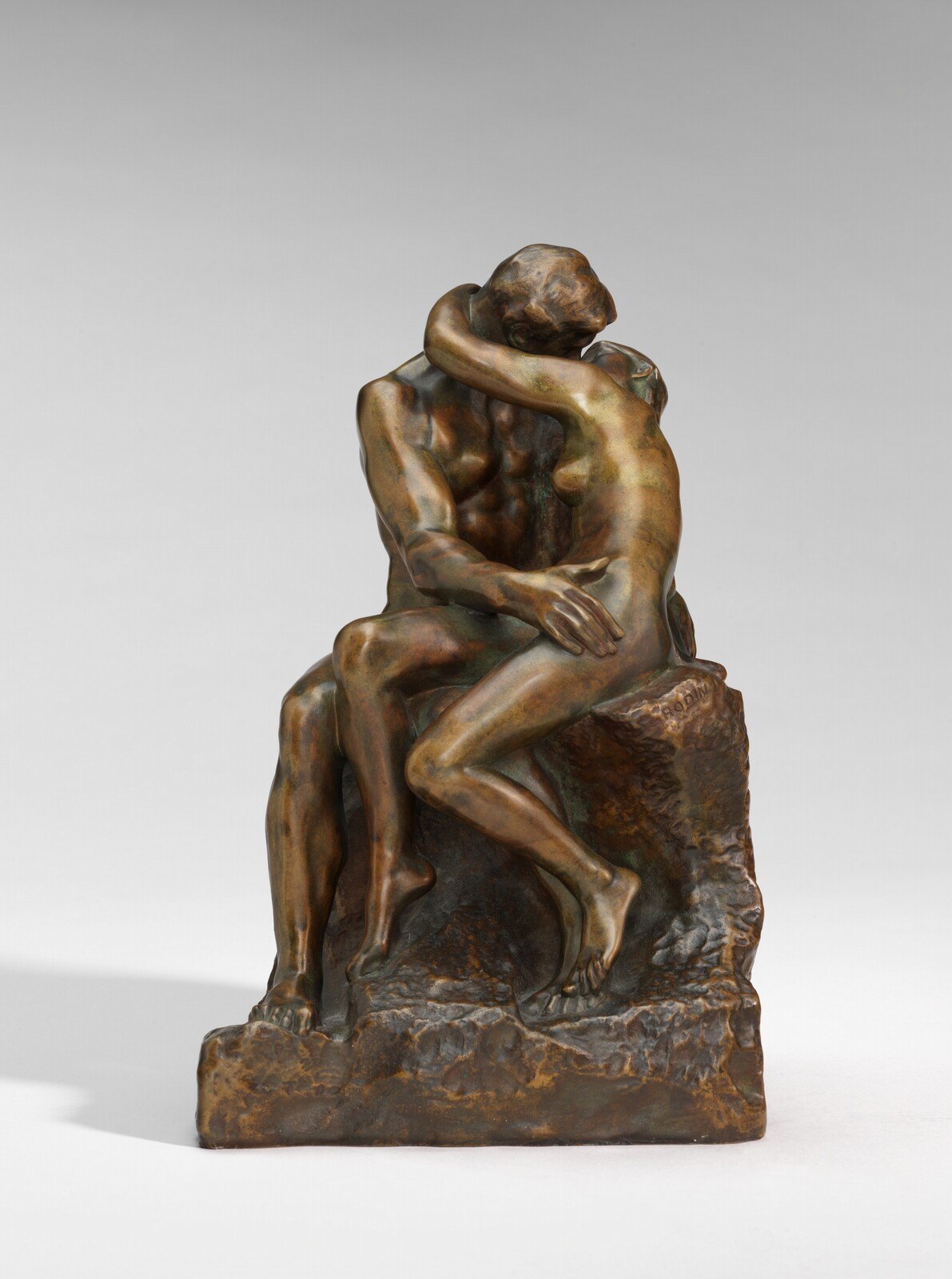
The Simpson bronze is a reduced cast of the shared composition. Its scale and bronze surface offer a comparison with Warren’s marble. National Gallery of Art, Washington, Gift of Mrs. John W. Simpson, 1942.5.15. Image source. CC0 / Public domain.
The size of the marble lets you see changes at the scale of a wrist, a knee or a hand. From a broad view, the woman’s torso seems to rise out of the turn of one hip. Move around the work and the relation between the two backs becomes clearer, with open space at some points and body against body at others. The same movement can look more settled if your eye is drawn to the stone seat. Its heavier and more roughly worked forms give the polished limbs a place to rest. The experience changes as you follow the bodies around the rock, since no single angle gives equal access to the book, the hands and the faces. [1] [4]
The earlier history of the design helps explain its independent success. As a group on a portal, the lovers would have been encountered among other figures whose poses carried different forms of suffering or desire. Rodin took the pair out of that setting. The individual marble gives the viewer time to see what the embrace alone can communicate. The literary subject remains available to someone who notices the book or knows the story. Other viewers can start from the narrow points where the bodies meet, and gradually recognise how much of the sculpture is organised around anticipation. [4] [6]
From Lewes House to public display
The marble was dispatched to England in 1904. Its size shaped what Warren could do with it on arrival. At Lewes House it was kept in the stables, a domestic setting quite different from an open museum gallery. In 1914 Warren lent the sculpture for display in Lewes Town Hall. Once it moved into that civic building, people who had no connection with his household could encounter a work made to his specifications. The change of audience brought with it objections to its display. The episode shows how a collector’s understanding of the work and the conditions for exhibiting it in a public building could diverge. [2] [3]
The reception in Lewes forms part of the work’s provenance, but it is also a matter of how the sculpture was seen. People in a town hall can come upon an artwork while attending to other business, and a large marble at the centre of a room is hard to pass without noticing. In a collector’s stable or a museum gallery, a visitor may have come expressly to look at it. The sculpture’s physical candour, which Warren had asked for and which he could connect to the tradition of the nude, meant something different in the company of an audience deciding what belonged in a civic interior. [2] [3]
Watch Rodin’s sculpture up close
Five films explore Rodin’s sculpture, from his use of classical models and the figures on his monumental doorway to the work of his studio.
Auguste Rodin – Challenging Beauty
Six sculptures show how Rodin adapted classical models.
Watch on YouTubeThe auction and the years in Cheltenham
The marble’s move from Lewes House to a national collection took more than two decades after Warren’s death. His heir, H. Asa Thomas, offered it at an auction of the Lewes House contents in October 1929. The advertisement made Rodin’s group the principal attraction, identifying it by its French title. Christopher Skelton-Foord’s study of Warren’s papers reports an unsuccessful bid on behalf of the French government. The price fell short of the reserve and the lot was withdrawn. The fact that a French public buyer was interested helps explain how contingent the marble’s eventual place in a British collection was. Warren had ordered it from France, and the auction put the possibility of its return into play. [2]
Thomas was prepared to lend the sculpture to a provincial gallery that would cover transport and insurance. Daniel Herdman, Cheltenham’s librarian and curator, persuaded the local committee to accept it. The marble was displayed there from 1933 until it moved to Tate at the end of February 1939. That move took place fourteen years before the acquisition recorded by Tate. The two dates tell different parts of the object's history. The first marks a change of venue. The second identifies its entry into the collection. [2] [10] [1]
Herdman could also connect the loan with Rodin’s own visit to Cheltenham in 1914. The local study, drawing on the contemporary press, records a brief 1934 display of a blue beret Rodin left behind. The beret and the marble offered quite different connections with him. The marble had been made for Warren, and reached Cheltenham through Thomas’s offer. The beret gave the museum a way to recall Rodin as a visitor to the town. Displaying them together attached a local story to a sculpture whose commission and previous exhibition belonged elsewhere. [10]
The acquisition by Tate
Tate’s collection data records the purchase in 1953 with assistance from the Art Fund and public contributions. That line distinguishes the acquisition from the carving dates and from the earlier display in Lewes. It also gives the Tate marble another kind of public history. The commission depended on one collector who wanted a particular work for his own surroundings. Its place in the collection depended in part on people choosing to contribute towards acquiring it. When the work is described simply as a version of The Kiss, those two decisions can disappear from sight. [1] [2]
The marble now offers a way to follow the composition into a setting far removed from the portal on which it was first imagined. Look for the book and the points where the bodies turn into one another, then step back far enough to take in the block that holds them. The object at Tate has a weight, a size and a history of movement of its own. Those facts explain why Warren’s marble makes a particularly useful comparison with the versions in Paris and Copenhagen. [1] [4] [5]
Two public decisions about a private commission
Thomas’s daughter Pamela Tremlett was the seller when the work was acquired in 1953. The New College study traces that final transaction through the family, and Tate’s accession record identifies the assistance of the Art Fund and public contributions. Taken together, the records explain how an individually specified commission entered a public collection. The successful acquisition also gave the marble a permanent accession number, N06228. That identifier is the most direct way to follow this particular sculpture through later loans and displays when records use only the common title The Kiss. [2] [1]
Installing the marble again
Tate’s photographic archive records the work being reinstalled for the opening of the gallery extension in May 1979. The contact sheet and its fourteen negatives sit alongside records of staff preparing the new rooms and rehanging the modern collection in the older galleries. Most photographs of the sculpture begin when that work is over. The archive entry gives the installation a place in the object’s history, alongside the better-known movements to Lewes and to Tate. It also gives a sense of the choices involved in a new display. With a work of this depth, even the distance between the marble and the walls determines which of its views the public can reach. [7]
As part of the Tate Triennial in 2003, Cornelia Parker wrapped the marble with a mile of string for an intervention titled The Distance (A Kiss with String Attached). The stone figures stayed in their embrace while the string changed what could be seen of it. A spectator following the strands around the bodies could still make out their collective shape, while small details such as the book and the contact between hand and thigh became harder to trace. The work gave the Tate marble another episode in which the way it was presented shaped what viewers could make of the figures. [8] [9]
Rodin artworks directory
Discussion
Look again at the images and ideas explored in The Kiss (Tate). These editorial prompts invite your observations.
Reader Insights
After reading “Warren’s commission”, what detail would you look for in the object or image?
What extra evidence would help you distinguish the artist’s choices from the effects of material, viewpoint or later display?
Join the Conversation
Share a detail, comparison or question about The Kiss (Tate) below.
References
- Tate. Tate Collection open data, The Kiss, N06228. View source.
- Christopher Skelton-Foord. Ned Warren’s ‘Jack in the Pulpit’: New College MS 380 and Textual Transmission. New College Notes, 2022. View source.
- Sussex Gardens Trust. Lewes House. View source.
- Musée Rodin. The Kiss. View source.
- Musée Rodin. Rodin and modernism. View source.
- Musée Rodin, Meudon. The Kiss, large model. View source.
- Tate Archive. Tate Gallery Buildings and Fabric, photographic collection list no. 8, p. 8. View source.
- Drawing Room. Cornelia Parker in conversation and panel discussion. View source.
- Frith Street Gallery. Cornelia Parker, The Distance (A Kiss With a String Attached), 2003. View source.
- Cheltenham Local History Society. Journal 26, 2010, account of Rodin and the Cheltenham loan. View source.
 in Detail Auguste Rodin.jpg)






