


 by Tom Gurney
Tom Gurney BSc (Hons) is an art history expert with over 20 years experience
Published on June 19, 2020 / Updated on November 18, 2026
Email: tomgurney1@gmail.com / Phone: +44 7429 011000
Watercolour Paintings
A small Belgian landscape in the Musée Rodin combines oil paint and pastel on paper card. Its size is closer to a sheet you could hold in your hands than to a painting that would dominate a room. It dates from the years when Auguste Rodin was working as a sculptor in Belgium. Paintings like this can come as a surprise to someone who has met him through the large bronzes. He also made many drawings to which he added watercolour, and collected paintings by other artists. Each of these activities brought him into contact with colour in a different way. The objects help show what he did with it. [1] [2] [3]
Painting before the famous sculpture
The Musée Rodin’s research on its holdings identifies early academic studies and copies among Rodin’s paintings. Copying gave a student a way to see how an artist had distributed light across a face, arranged a shoulder within the edge of the picture or carried a colour from one part of a composition to another. The museum’s catalogue lists Rodin’s copy after Rubens’s portrait of Adrienne Perez as P.07245. Its entry is filed among paintings by Rodin. The name of the older painter identifies the source of the copy, while the author field identifies who made the object. That distinction becomes important in a museum with works both made and owned by the sculptor. [2] [3]
The time he spent in Belgium gives his painting a more recognisable setting. In Brussels and its surroundings he worked on architectural sculpture and had opportunities to look at nearby landscapes. The present catalogue groups several paintings by the places they show, including Boitsfort and the Forest of Soignes. Titles referring to a farm, orchard or small settlement locate the painting in inhabited countryside. The forms that matter there can be the edge of a wall, a patch of trees or the distance between a roof and an area of open ground. These are subjects in which colour and the arrangement of the whole stretch of paper have more to do than the modelling of a single body. [3] [4] [5]
Paintings and works on paper
Three ways of using a support
The record for Paysage de Belgique, P.07253, gives a date range of 1871–77, dimensions of 29 by 38.7 centimetres and a support of paper card. It identifies both oil and pastel. That combination puts two kinds of mark in the same work. A patch laid in oil can establish a broader area, while the pastel can sit on the surface with the character of a drawn mark. The records do not give a running account of the order in which he used them. They let you look for the way different marks occupy the same picture and consider what he gained from having both available. [1]
Another landscape with the same general title has oil on the front and graphite on the reverse. Compare the two catalogue entries and the differences begin before you even see the images. The artist made use of both sides of that support and worked in different media on each. A photograph of the oil in a book might give no indication of the drawing on the back. Turning the support over also changes the scale of the comparison. Here the two surfaces belong to a single object, and the graphite marks can be studied separately from the painted view. The two works also make the limits of a generic title clear. Date range, inventory number, measurements and the relationship of paint to its support can help identify which landscape is being described. [1] [6]
The catalogue of farms at the edge of the forest offers a further kind of comparison. The farm with a pink wall and the farm in an orchard near Groenendael are separately catalogued oil paintings. One title draws attention to a plane of colour and the other to the setting of the building among trees. The way each work is named gives you a place to begin, but a comparison is worth making from the edges inward. Look at which forms the painter puts close to the boundary of the picture and which have room around them. The different positions of a building or a tree can make similar subjects occupy the whole sheet differently. [5] [7]
A copy after Rubens
Among the paintings from Rodin’s Belgian years is a copy of Rubens’s portrait of Adriana Perez, whom the Musée Rodin names as Adrienne Perez in its catalogue. The museum dates the oil on canvas to 1871–77 and measures it at 72.5 by 39 centimetres before the frame. The portrait in Rubens’s Incredulity of Saint Thomas occupies the right wing of the triptych in Antwerp. Perez and her husband Nicolaas Rockox commissioned the work as a memorial. In Rodin’s canvas, her figure occupies a surface of its own. The narrow format carries the upright shape of the donor portrait into an independent study, with the other panels absent from the viewer’s field. [11] [12] [13]
The Brussels heritage inventory describes another copy in Saint-Gilles, attributed to a follower of Rubens. Its comparison identifies one difference that can be checked by looking at the hands. Rodin kept the rosary held by Perez in the triptych, while the Saint-Gilles copy omits it. The rosary ties the gesture to the devotional setting of Rubens’s commission. In the separate canvas it still gives the fingers something specific to hold and keeps a detail of the figure’s original role. That comparison shows the kind of choice a copy preserves. Even where the sitter and the general arrangement agree, an object held in the hands can tell you which version you are looking at. [11] [12]
Watch Rodin’s sculpture up close
Five films explore Rodin’s sculpture, from his use of classical models and the figures on his monumental doorway to the work of his studio.
Auguste Rodin – Challenging Beauty
Six sculptures show how Rodin adapted classical models.
Watch on YouTubeWatercolour and the drawn figure
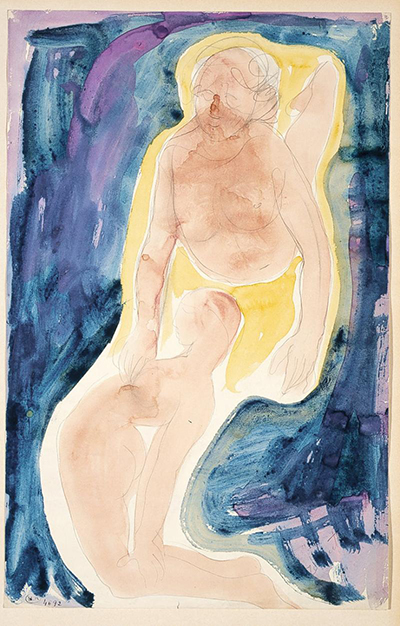
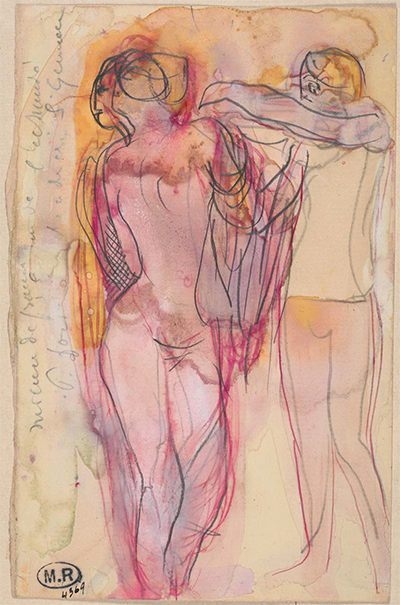
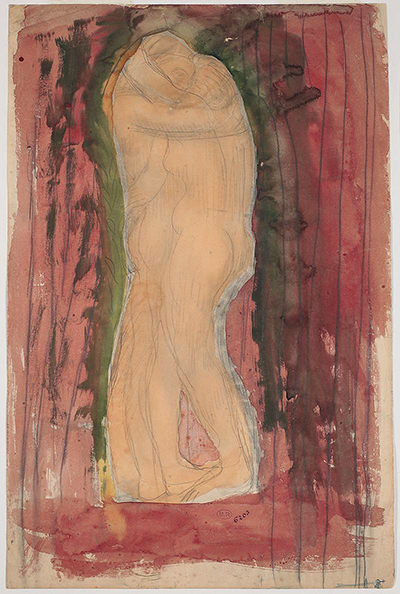
In a late figure study, colour can be much less continuous. The Musée Rodin describes Rodin’s use of washes on drawings made from living models. In a sheet such as the frontal Cambodian dancer, D.04437, graphite and watercolour share a light ground. The graphite can establish the direction of an arm or the position of a foot. The wash gives a garment or a part of the body an area of colour broad enough to hold together several lines. It can leave parts of the paper untouched and carry a change of tone across an edge that the drawing approaches quite differently. The sheet remains a drawing in the catalogue, with watercolour among its techniques. [8] [9]
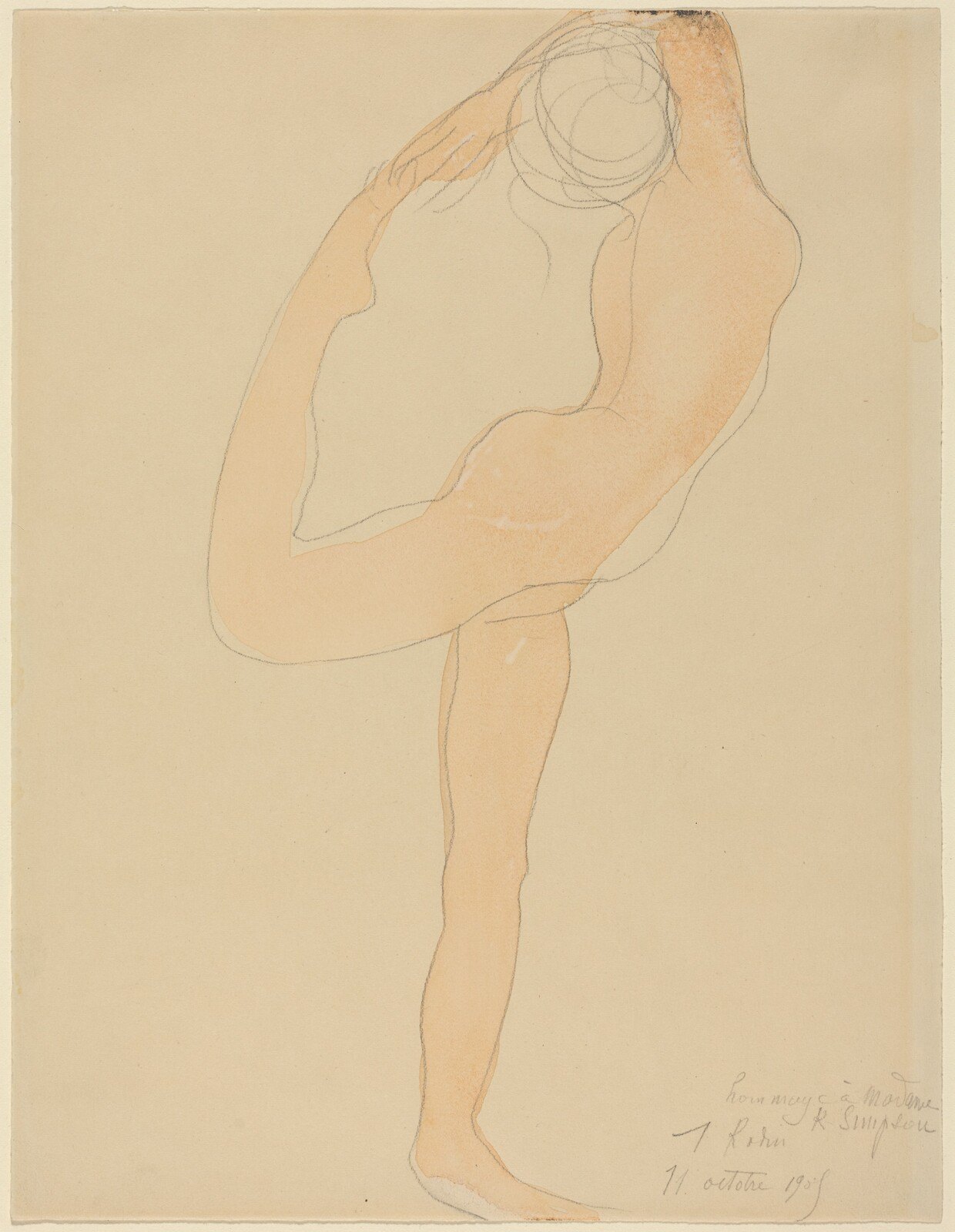
This sheet shows how Rodin used wash to carry color within an outline that remains visible. National Gallery of Art, Washington, Gift of Mrs. John W. Simpson, 1942.5.36. Image source. CC0 / Public domain.
Comparing that sheet with an oil landscape helps explain why paintings and watercolours belong alongside the drawings and still merit their own discussion. The Belgian landscape can turn on where a body of colour is placed within a view. In the watercolour there can be so little background that a patch of colour mainly tells you how to group the markings of a gesture. The oil and pastel landscape shows another possible relation between colour and drawing, since more than one type of mark appears on the same face of the support. [1] [8] [9]
Painting and collecting
Rodin also acquired paintings from other artists. His 1888 exchange with Claude Monet brought one of Monet’s Belle-Île paintings into his collection. The Musée Rodin documents the exchange and the painting’s later presence at the Villa des Brillants. It records what Rodin chose to live with and tells something about the exchange between the two artists. Authorship remains with Monet. For anyone exploring paintings in the Musée Rodin, that distinction is a useful first step. From there the studio copy, the small Belgian landscape, the coloured figure study and the picture acquired from a colleague can each be read in relation to the part it played in Rodin’s life. [2] [3] [10]
Which paintings belong to Rodin’s own output?
The Musée Rodin’s painting catalogue project describes a collection of more than two hundred works, with about eighty painted by Rodin. Those works include early copies, nude studies and Belgian landscapes. Other paintings arrived through his own purchases, gifts and exchanges, through the Hôtel Biron or through museum acquisitions. A search for paintings in the museum can therefore bring up objects that answer several different questions. The artist field identifies whose brushwork is being described. The provenance shows how a work came to be available for Rodin to examine or how it reached the museum after his death. [2]
The catalogue project also records an interest in works that are now missing, some of which Rodin sold. Even a complete inventory of the museum’s holdings would represent only the paintings that came into the collection and stayed there. Copies can be useful when thinking about that broader output. A copy may have little in common with the organisation of one of the Belgian landscapes, yet preserve evidence of something Rodin deliberately tried to repeat from another artist. The difference between the two groups points to a productive way to read the corpus. Ask what problem was available to Rodin in each: arranging an existing portrait through paint, recording the relation of a building to its surroundings, or fixing the shape of a posed body. [2]
A collector’s picture with prints behind the sitter
Van Gogh’s portrait Père Tanguy makes the distinction between Rodin’s collections and his own painting especially clear. Rodin purchased it in 1894. Van Gogh had painted three portraits of the paint supplier, but this is the one the Musée Rodin describes Tanguy as keeping. It places him frontally with clasped hands against a field of Japanese prints. The print imagery extends across most of the space beyond the sitter and leaves little of the kind of depth we find behind the buildings in the Belgian landscapes. The flat space is one of the features that attracted the museum’s attention in describing Van Gogh’s handling of colour. [14]
The museum also notes that Rodin collected Japanese prints and acquired two other Van Gogh paintings. It raises a possible connection between Rodin’s collecting and the prints pictured behind Tanguy. The documented purchase is enough to establish that Rodin had the painting. The prints explain one feature he and Van Gogh could have found interesting in common. A visitor can test their effect by first following the edges of the seated body, then letting one of the bright areas of the background take over. The shift between figure and print makes the warmth and directness of the portrait depend partly on the things arranged around Tanguy. Rodin’s ownership gives such a picture a place in his life as a collector. [2] [14]
Getting closer to Monet’s painting of Belle-Île
The Musée Rodin catalogue dates Monet’s Belle-Ile-en mer to 1886 and records his signature and the year at the lower left. The signed date puts the painting before the exchange that brought it into Rodin’s collection. It also places the work in the period when the two artists already moved among some of the same painters, critics and collectors. The museum’s account connects Monet’s return from Belle-Île with the dinners of the Bons Cosaques, which Rodin also attended. Both artists exhibited in group shows at the Galerie Georges Petit before their joint exhibition there in 1889. The painting’s date, its later exchange and the joint exhibition each supply a different piece of evidence for how their work came into contact. [15] [16]
Look at the coast in Monet’s painting before comparing it with one of Rodin’s Belgian landscapes. In the Belgian studies a building can supply a firmer edge, something against which the viewer can judge the spread of surrounding foliage or land. Monet’s coastal subject gives the boundary between rock and water a greater share of the work. The comparison brings out what each artist asks a painted edge to do. The documented exchange explains the presence of a Monet in Rodin’s collection and gives the two works a historical reason to be studied together. [2] [15] [16]
Rodin artworks directory
Discussion
Look again at the images and ideas explored in Watercolour Paintings. These editorial prompts invite your observations.
Reader Insights
After reading “Painting before the famous sculpture”, what detail would you look for in the object or image?
What extra evidence would help you distinguish the artist’s choices from the effects of material, viewpoint or later display?
Join the Conversation
Share a detail, comparison or question about Watercolour Paintings below.
References
- Musée Rodin. Paysage de Belgique, P.07253. View source.
- Musée Rodin. A catalogue of the paintings at the Musée Rodin. View source.
- Musée Rodin. Peintures, collection catalogue. View source.
- Musée Rodin. Sculpture and architecture. View source.
- Musée Rodin. Ferme au mur rose à l’entrée de la forêt de Soignes. View source.
- Musée Rodin. Paysage de Belgique, oil recto and graphite verso. View source.
- Musée Rodin. Ferme dans son verger vers Groenendael à l’entrée de la forêt de Soignes. View source.
- Musée Rodin. Dessins. View source.
- Musée Rodin. Danseuse cambodgienne de face, D.04437. View source.
- Musée Rodin. Rodin and Monet. View source.
- Musée Rodin. Copy after Rubens’s portrait of Adriana Perez, P.07245. View source.
- Brussels Capital Region. Portrait of Adriana Perez, Saint-Gilles movable heritage inventory. View source.
- Snijders&Rockox House. Visitor guide, Adriana Perez and the Rockox memorial. View source.
- Musée Rodin. Vincent Van Gogh, Père Tanguy. View source.
- Musée Rodin. Claude Monet, Belle-Ile-en mer. View source.
- Musée Rodin. Claude Monet, account of the Galerie Georges Petit exhibitions. View source.

 Auguste Rodin.jpg)





