


 by Tom Gurney
Tom Gurney BSc (Hons) is an art history expert with over 20 years experience
Published on June 19, 2020 / Updated on November 18, 2026
Email: tomgurney1@gmail.com / Phone: +44 7429 011000
The Athlete
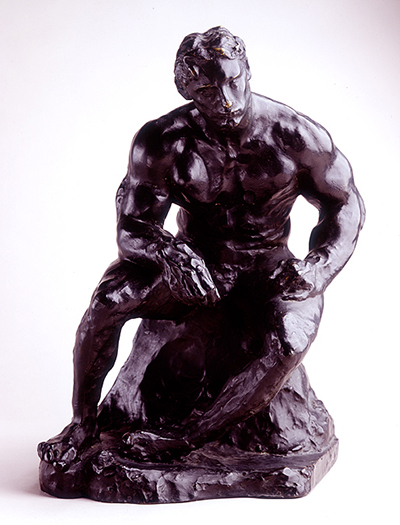
Auguste Rodin’s The Athlete shows Samuel Stockton White III seated on a rough support, one foot set out to the side and the other drawn towards the middle of the base. His shoulders spread wide above his legs, but his body inclines to one side. The distance between his feet and the differing angles of his arms make that inclination look sustainable, as though he could remain in place for some time. White was an American gymnast and bodybuilder who sat for Rodin in Paris in 1901 and again in 1904. The encounters resulted in several treatments of the figure, which museums catalogue under both The Athlete and The American Athlete. [1] [2] [3]
Choosing a pose
White studied at Princeton and Cambridge and was already known for his athletic development when he visited Rodin. The Philadelphia Museum of Art describes the sculptor’s preference for a position that would come naturally to the sitter. White remembered settling on a bench with an arm resting on his leg. A seated position had the practical advantage of being possible to maintain during a long session. It also gave Rodin a way to compare the weight carried by the legs, the seat and the resting arm. The result provides plenty of opportunity to study White’s physique even though the figure is at rest. [1] [3]
In the bronze that Philadelphia dates to 1904, the shoulders and arms take a strong light. There are shadows under the upper arms and across the middle of the torso. The recess where the body folds over the legs is particularly deep, and below it the two feet spread out over the base. Notice how the hand towards the middle of the figure hangs from a much thicker forearm. The fingers give the eye a scale for the muscles above them, and their downward direction continues the line of the arm towards the knee. The other arm forms a more open angle at the elbow and helps define the outer contour. [1]
From a position in front of the figure, the knees and shoulders form two broad spans. Move towards the side and the forward inclination of the body becomes more apparent. That movement changes the spaces you can see through and the apparent weight of the bent arms. The figure’s strength registers partly through the places where it is possible to see between the limbs. In Philadelphia’s photographs, the opening near the outer arm is particularly useful. It separates the silhouette of the elbow from the mass of the torso and helps the viewer trace the line of the arm back towards the waist. [1]
Two bronzes in Philadelphia
The Philadelphia Museum of Art catalogues one bronze as The American Athlete, modelled from 1901 to 1904 and cast in 1904. The museum identifies it as the first bronze cast of that version and records that Rodin gave it to White when he asked to buy a cast. The head dips towards the front. The same institution holds another bronze titled The Athlete, modelled in 1901 and cast in 1925. In its catalogue view the face is directed more emphatically to the side. Start comparing the two at the neckline. The different turn changes the relation of the jaw to the shoulder, even while the seated arrangement of the limbs remains familiar. [1] [2]
The Musée Rodin also records a first version, modelled in 1901, in a bronze cast in 1927 by Alexis Rudier. Its entry gives the position of the foundry mark at the back, along with the location of Rodin’s signature. Another record describes a plaster dated 1901–1904 as a second version. These entries illustrate two separate decisions a museum makes when it labels a bronze. It identifies the form that was reproduced and describes the particular physical object that resulted. A change in the head or the modelling can distinguish forms, while a foundry mark and an execution date can help identify a particular cast. The main title alone cannot supply that information. [4] [5]
The Kreeger Museum dates its cast to 1959. Its account of White’s sittings describes work in clay and plaster as well as the production of different versions in bronze. In a photograph, colour and gloss can make bronze surfaces look quite different under a change of lighting. The position of the head, the meeting of the feet and the base, and the contour of the supporting mass offer more specific points of comparison. To put a date or a collection name to a pictured bronze, it helps to start with those features and then check the object record. [1] [2] [3] [4]
Watch Rodin’s sculpture up close
Five films explore Rodin’s sculpture, from his use of classical models and the figures on his monumental doorway to the work of his studio.
Auguste Rodin – Challenging Beauty
Six sculptures show how Rodin adapted classical models.
Watch on YouTubeThe sitter after the studio
Philadelphia’s museum notes a resemblance to The Thinker. Both men are seated and lean into the space above their legs. In The Thinker the raised hand takes the weight of the lowered chin and gives thought an unusually physical expression. White’s forearm and hand are much lower, leaving the head free. The difference changes the way the space above the lap reads. In the athlete, the eye can move from the chest towards the hands without following an arm back up towards the face. The resemblance helps locate a familiar problem in Rodin’s work. A seated figure can convey effort through the way the parts accommodate one another, even when the action itself is slight. [1] [6]
White’s connection to the sculpture continued after the sittings. The Philadelphia museum records that the athlete became an art collector and that his wife, Vera McEntire, was a painter. The couple’s collection later went to the Philadelphia Museum of Art. Museum material also connects White to Jules Mastbaum, whose collection formed the basis of Philadelphia’s Rodin Museum. The sculpture’s presence in the city thus has a history that begins with a Philadelphian sitting in Paris and continues with a collector participating in the artistic life of his own city. The gift of the 1904 bronze from Rodin to White is the earliest part of that history recorded in its object entry. [1] [7]
An older photograph in the Musée Rodin collection supplies another way to see the work. The museum catalogues an image of a bronze of the athlete by Eugène Druet, who photographed Rodin’s sculpture. The catalogue identifies the photographer separately from the sculptor. When comparing an archival print with a modern museum photograph, look for where each places the strongest light. A highlight across the shoulder can emphasise the span of the torso, while a brightly lit edge along the wrist can bring the sitter’s resting gesture into view. The bronze has both features available at once. A photograph makes one particular relationship between them visible. [1] [8]
The seated figure and the torso
The Smithsonian’s National Portrait Gallery holds a plaster catalogued as American Athlete and another called Torso of the American Athlete. Both identify White as the sitter. Together they give a different way of studying the work from comparing bronze editions. In the seated figure the bent legs and the contact between the arm and the knee help establish how the weight is carried. The torso puts the mass of the ribcage and the turn of the trunk closer to the centre of attention. It also preserves White’s identity in a study where the face is absent. The two plaster records add evidence of how Rodin treated part of the sitter’s body as a work in its own right. [9] [10]
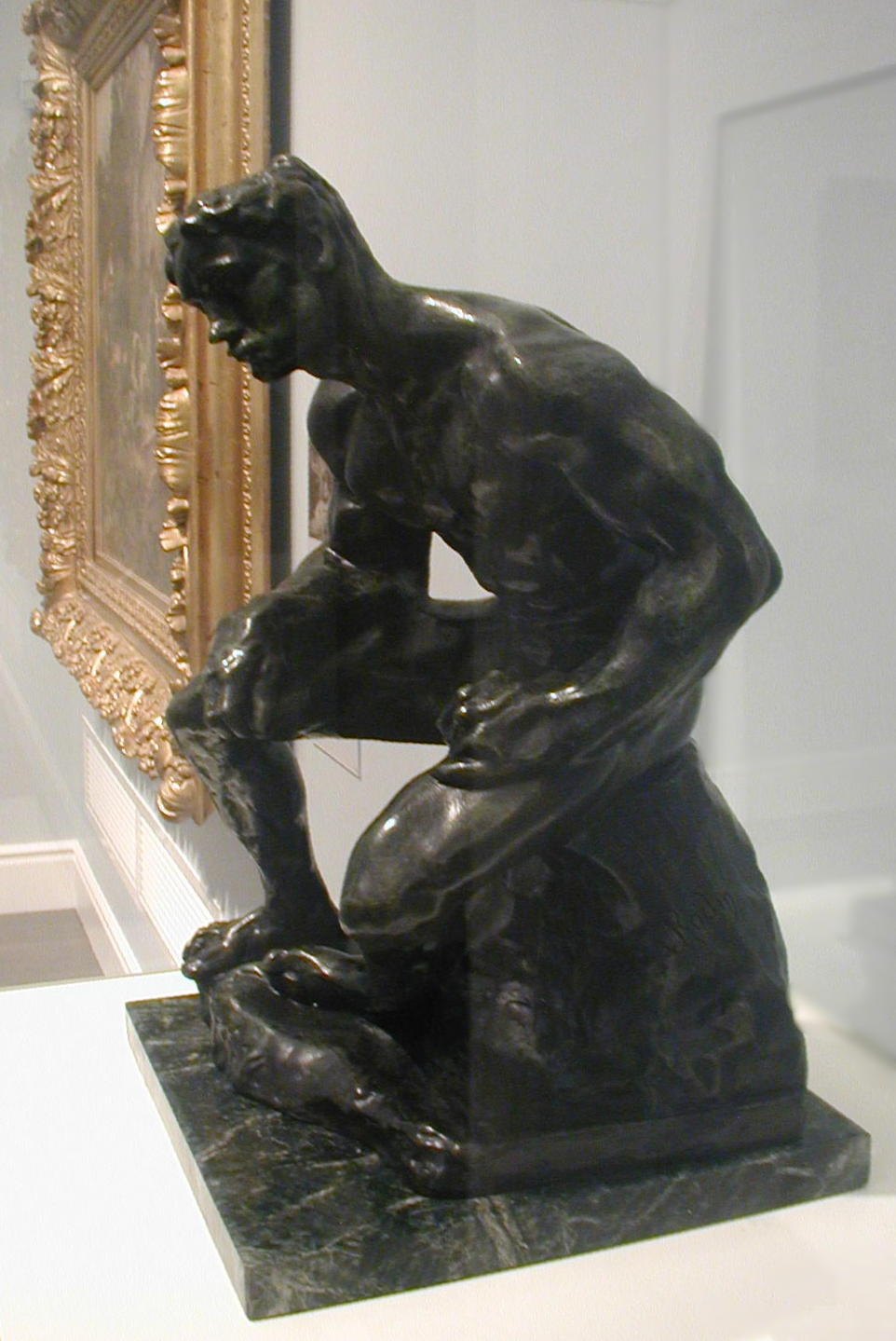
The Haggin Museum example shows the forward lean and the relation of the arms to the legs. Photograph by Stevensaylor, Wikimedia Commons. Image source. CC BY-SA 4.0. Resized for the web.
Rodin artworks directory
Discussion
Look again at the images and ideas explored in The Athlete. These editorial prompts invite your observations.
Reader Insights
After reading “Choosing a pose”, what detail would you look for in the object or image?
What extra evidence would help you distinguish the artist’s choices from the effects of material, viewpoint or later display?
Join the Conversation
Share a detail, comparison or question about The Athlete below.
References
- Philadelphia Museum of Art. The American Athlete, modelled 1901–1904 and cast 1904. View source.
- Philadelphia Museum of Art. The Athlete, modelled 1901 and cast 1925. View source.
- The Kreeger Museum. The Athlete, bronze cast 1959. View source.
- Musée Rodin. L’Athlète américain, première version, S.01100. View source.
- Musée Rodin. L’Athlète américain, plaster S.02159. View source.
- Philadelphia Museum of Art. The Thinker. View source.
- Philadelphia Museum of Art. Who’s Who at the Rodin Museum. View source.
- Musée Rodin. Eugène Druet, Athlète américain (bronze). View source.
- Smithsonian National Portrait Gallery. American Athlete, S3413. View source.
- Smithsonian National Portrait Gallery. Torso of the American Athlete, S3426. View source.

 Auguste Rodin.jpg)





