


 by Tom Gurney
Tom Gurney BSc (Hons) is an art history expert with over 20 years experience
Published on June 19, 2020 / Updated on November 18, 2026
Email: tomgurney1@gmail.com / Phone: +44 7429 011000
The Cry
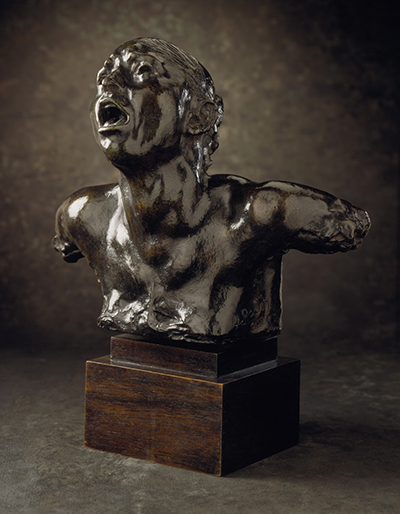
A head rises sharply from a roughly cut torso in Auguste Rodin’s The Cry. The mouth is open, the chin lifts, and the shoulders spread into two short projections. From the front, those shoulders make the head look small and exposed. From the side, the movement becomes easier to trace from the breastbone through the throat and into the lower jaw. The Los Angeles County Museum of Art dates the first modelling to around 1886 with a question mark and identifies its bronze as a cast made in 1964. The Musée Rodin records another bronze and connects the half-bust to the better-known marble composition The Tempest. [1] [2] [3]
How the cry takes shape
Start at the lower lip. It catches the light around an opening that remains dark in photographs taken from several directions. The chin projects below it and gives the mouth a sense of depth. Above, the cheeks rise unevenly from the nose towards the edges of the face. These movements are visible across surprisingly little space. They keep the upturned face active even in a view where the brows almost merge into shadow. Seen at an oblique angle, the mouth is partly a profile and partly a hollow. The change from one to the other gives the impression that the jaw has opened as far as the position will allow. [1] [2]
The neck contributes as much as the open mouth. Its modelling runs up from the chest in a series of ridges and depressions. In the frontal photograph, the strongest reflections make some of those lines appear almost continuous with the lower edge of the chin. In a side view the space under the jaw is much easier to judge. The neck leans at an angle that makes the head seem to move away from the shoulders. Look for the place where that angle meets the upper chest. A small change of light there can turn the throat into a separate bright plane or let it recede within the mass of the bust. [1] [2] [4]
The arms stop near the shoulders. Their irregular ends and the uneven lower edge bring the head into relation with a visibly incomplete body. The surfaces of the chest and neck are readily recognisable, while those ends are harder to read as parts of any complete gesture. That uncertainty keeps attention close to the face. The bust gives the cry a body through the distance across the shoulders and the tension through the neck, even though it provides little indication of what the arms would be doing beyond the surviving form. The support below gives a steady horizontal edge against which the lift of the head looks all the stronger. [1] [2] [4]
The Cry and The Tempest
The Musée Rodin treats The Tempest as a variation on the plaster half-bust of The Cry. It describes the marble shown at the Galerie Georges Petit in 1886 as a woman screaming in terror. The Metropolitan Museum’s collection history likewise compares the two designs and suggests that the bronze composition has its origin in a study for the marble. The connection is easiest to see at the mouth and throat. In the marble, the figure is bound into a larger mass, and the hair takes on a more elaborate shape. In the bronze, the free silhouette at the neck and shoulders makes the bodily effort easier to follow. [2] [3] [5]
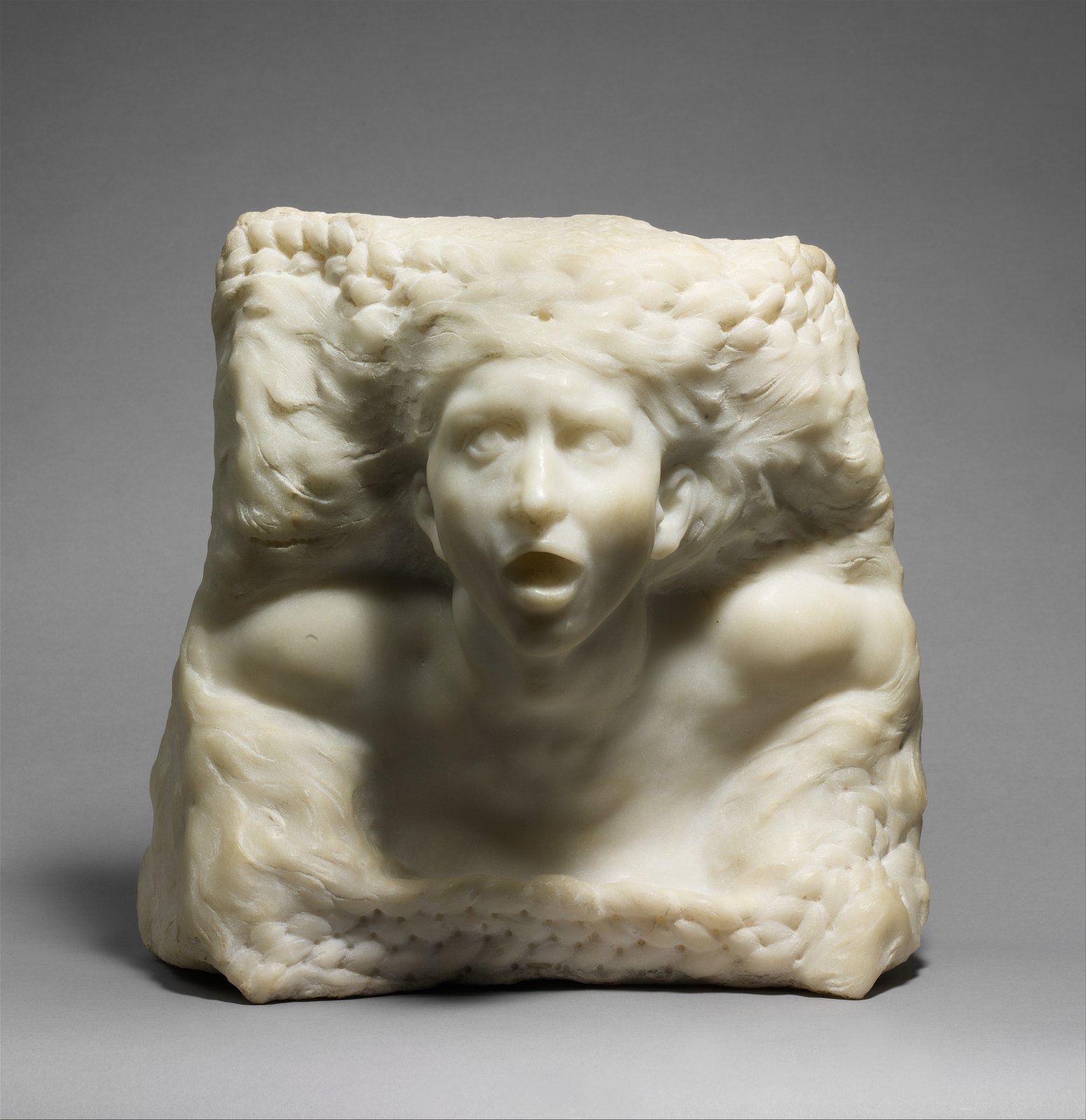
The Met’s marble The Tempest shows how Rodin varied the head and surrounding forms of The Cry. The Metropolitan Museum of Art, Gift of Thomas F. Ryan, 1910, 11.173.7. Image source. CC0 / Public domain. Resized for the web.
The related works also illustrate how a viewer’s interpretation can change with a title. The Cry calls attention to the action of the mouth. The Tempest invites an imagined setting and a cause for the motion. The Musée Rodin connects the screaming face with the academic practice of the expressive head, through which artists studied how emotions changed the face. In these works the opening of the jaw also changes the whole shape of the neck. Compare the mouth with the raised shoulder before deciding what the face expresses. Much of the effect comes from the relation between those parts and the material around them. [1] [3] [4]
The museum discusses other expressions of grief or terror in Rodin’s work, including the later Head of Sorrow. A title may point to a related emotion even when the arrangement of the figure differs substantially. In this bust the spread of the shoulders gives a strong point of reference for the angle of the face. The brevity of the torso brings the lower edge into the same field of view as the open mouth. To compare it with a head on its own, look at what happens to that reference as the shoulder or chest disappears. The same movement of the mouth can feel more detached when the body that supports it is absent. [1] [3] [4]
Watch Rodin’s sculpture up close
Five films explore Rodin’s sculpture, from his use of classical models and the figures on his monumental doorway to the work of his studio.
Auguste Rodin – Challenging Beauty
Six sculptures show how Rodin adapted classical models.
Watch on YouTubeDates and casts
The Musée Rodin catalogues its bronze S.01126 with a model date before 1886 and a casting date of 1961. It records Georges Rudier as the founder and identifies the cast by a number below the signature. LACMA identifies its 1964 bronze as number 12 of 12. These records locate distinct examples in the history of a model made decades earlier. The French museum also holds a plaster whose fabrication it dates to 1993. Its date belongs to that particular object. The separate records are helpful when the same title appears beside materials and dates that would otherwise be hard to reconcile. [1] [2] [6]
The LACMA photographs include frontal, profile and rear views. The different angles make it possible to see how close the neck comes to the outline of the shoulder and how the torso ends above the wooden support. The colour of the bronze changes with the position of the light, while the broad contours and the rough interruptions remain available for comparison. The photograph on this page shows the head from a position to one side, which gives the mouth and chin a stronger profile than the museum’s frontal view. A view from each side places that upward movement within the full depth of the bust. The profile also shows the slight projection behind the crown, just above the nape, a detail easily lost when the forehead and the open mouth occupy the centre of the image. [1] [2]
From a pointing model to a marble
The Musée Rodin catalogues a plaster of The Cry as a pointing model. It links that record to the plaster The Tempest, S.01092, identifying the latter as a model used in transferring the form into marble. Pointing gives the carver a series of positions and depths to work from. Between those positions, the stone still has to be shaped into the continuous surfaces around the lips, jaw and neck. The catalogue links preserve evidence of workshop use alongside the resemblance that can be seen in the two works. [3] [7]
The bronze S.01126 records a separate way the image reached another material. Cast by Georges Rudier for the museum in 1961, it bears a cast number below the signature and a foundry mark on the back. The museum gives the height of its pedestal separately from the bust. In a close photograph that leaves out the pedestal and rear marks, the eye can follow the strain around the open mouth more easily than it can determine where the example was made. The foundry and pointing records recover different stages of manufacture behind that shared expression. [2] [7]
Rodin artworks directory
Discussion
Look again at the images and ideas explored in The Cry. These editorial prompts invite your observations.
Reader Insights
After reading “How the cry takes shape”, what detail would you look for in the object or image?
What extra evidence would help you distinguish the artist’s choices from the effects of material, viewpoint or later display?
Join the Conversation
Share a detail, comparison or question about The Cry below.
References
- Los Angeles County Museum of Art. The Cry, M.73.108.14. View source.
- Musée Rodin. Le Cri, bronze S.01126. View source.
- Musée Rodin. The Tempest, The Terror-Stricken or The Marathon Runner. View source.
- Musée Rodin. The depths of despair. View source.
- Metropolitan Museum of Art. Rodin at The Metropolitan Museum of Art: A History of the Collection, p. 15. View source.
- Musée Rodin. Le Cri, plaster S.06653.(E). View source.
- Musée Rodin. Le Cri, pointing model and related plaster of La Tempête. View source.

 Auguste Rodin.jpg)





