


 by Tom Gurney
Tom Gurney BSc (Hons) is an art history expert with over 20 years experience
Published on June 19, 2020 / Updated on November 18, 2026
Email: tomgurney1@gmail.com / Phone: +44 7429 011000
The Hand of God
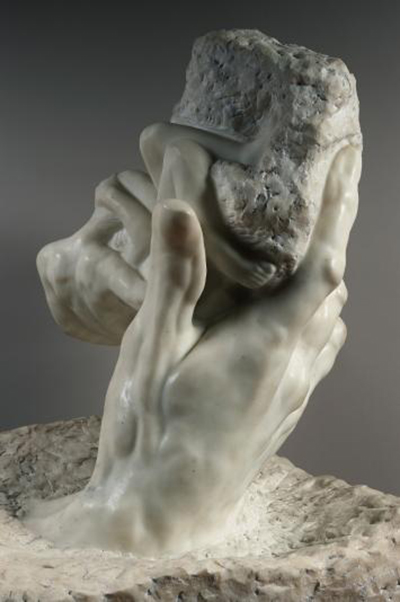
A hand rises from a rough block and holds two small bodies in Auguste Rodin’s The Hand of God. The fingers curl around a piece of stone in which the bodies are still partly embedded. In the photographed view, the thumb stands out in front, giving the eye a familiar measure for the much smaller figures beyond it. The group is also known as The Creation. Adam and Eve are the usual identification of the figures, and Rodin gives the biblical subject a form closely tied to the work of carving. The same stone serves as the ground, the substance of the bodies and the material from which the hand itself emerges. [1] [2] [3]
Reading the hand and the figures
The wrist in the photograph begins broad and low. On the left a pale ridge carries the eye upwards towards the thumb. On the right the outer contour rises from the base, then bends inwards as the fingers curl towards the mass they support. Along the palm, the highlights are broad enough to reveal a change of plane without making a hard line across the surface. The thumb has a darker edge where it overlaps the figure behind it. This makes its projection especially clear, even in a photograph that gives little sense of the distance from the palm to the far side of the stone. [1] [2]
One of the smaller bodies folds inward above the palm. To follow it, look for the rounded planes at the left of the stone and then for the narrower forms that turn back towards the centre. A second body is less accessible in this angle. Parts of it are obscured where the fingers meet the stone. From the other side, the relation of the figures is easier to make out. Their limbs occupy parts of the same small volume, and the bends of knees, arms and backs make the pair look compressed inside the hand. The open sweep of the palm helps the passer-by understand that compression at a glance. [1] [2]
The upper piece of stone has small pits and ridges across its face. It stands irregularly above the rounded forms around it. There is a comparable change of surface near the wrist, where an area of smooth modelling meets the coarse base. The two transitions happen at different scales. At the bottom a whole hand seems to rise from a solid mass. Further up the fingers give a frame to the smaller surfaces that are becoming recognisable as bodies. The repeated movement from rough to smooth lets the eye trace the act of emergence from base to summit. [1] [3]
Creation and the marks of carving
The Metropolitan Museum of Art connects the group with the unfinished sculptures Rodin saw on his trip to Italy in 1876, especially works by Michelangelo in which figures are only partly released from the stone. In The Hand of God the visible stages of finish create the sense that something is coming into being. The brightest areas are on the hand and bodies. Rough stone stays prominent behind and below them, and a spectator can follow the boundary where it meets a more defined form. Where that boundary is gradual, it may take a change of viewpoint to see quite how far a figure has been opened out of the block. [1] [3]
The title The Creation can refer both to the biblical scene and to the sculptor’s work. The Philadelphia Museum of Art points out that the creative hand comes up from the earth in Rodin’s composition. Its direction sets the bodies above the ground while keeping them connected to it. The Met’s account also draws attention to the parallel between the maker of the bodies and the artist shaping a piece of stone. The hand has a different role in each reading, but the visible details remain the same. The curve of the fingers supports the bodies and also leads the eye straight to the places where marble becomes recognisable as flesh. [1] [2]
Watch Rodin’s sculpture up close
Five films explore Rodin’s sculpture, from his use of classical models and the figures on his monumental doorway to the work of his studio.
Auguste Rodin – Challenging Beauty
Six sculptures show how Rodin adapted classical models.
Watch on YouTubeA hand borrowed from the Burghers
The Musée Rodin identifies the model for the large hand as the right hand of Pierre de Wissant, a figure Rodin developed for The Burghers of Calais. On the monument a hand can be read together with the head, shoulders and posture of the man it belongs to. In this composition its scale and its relation to the bodies give it an entirely different task. The museum compares it with another assemblage in which Rodin brought Pierre’s left hand together with a mask of Camille Claudel. There, the hand towers over a face. Here the distance between the wrist and thumb helps establish the disproportion between the hand and the two bodies it holds. [3] [4]
Versions in marble and plaster
The Met dates the original model before 1895 and the carving of its marble to about 1907. The marble measures 73.7 centimetres high and entered the museum in 1908 as a gift from Edward D. Adams. The Met’s collection history also mentions a larger marble sold to Albert Kahn around the time of the New York commission. The French national collections database credits Séraphin Soudbinine as carver on its record for La Main de Dieu, also titled La Création. Those records describe separate stages and examples of the sculpture. The wider shape of the original block, the treatment of its base and the account of the commission are useful evidence for distinguishing different marbles. [1] [5] [6]
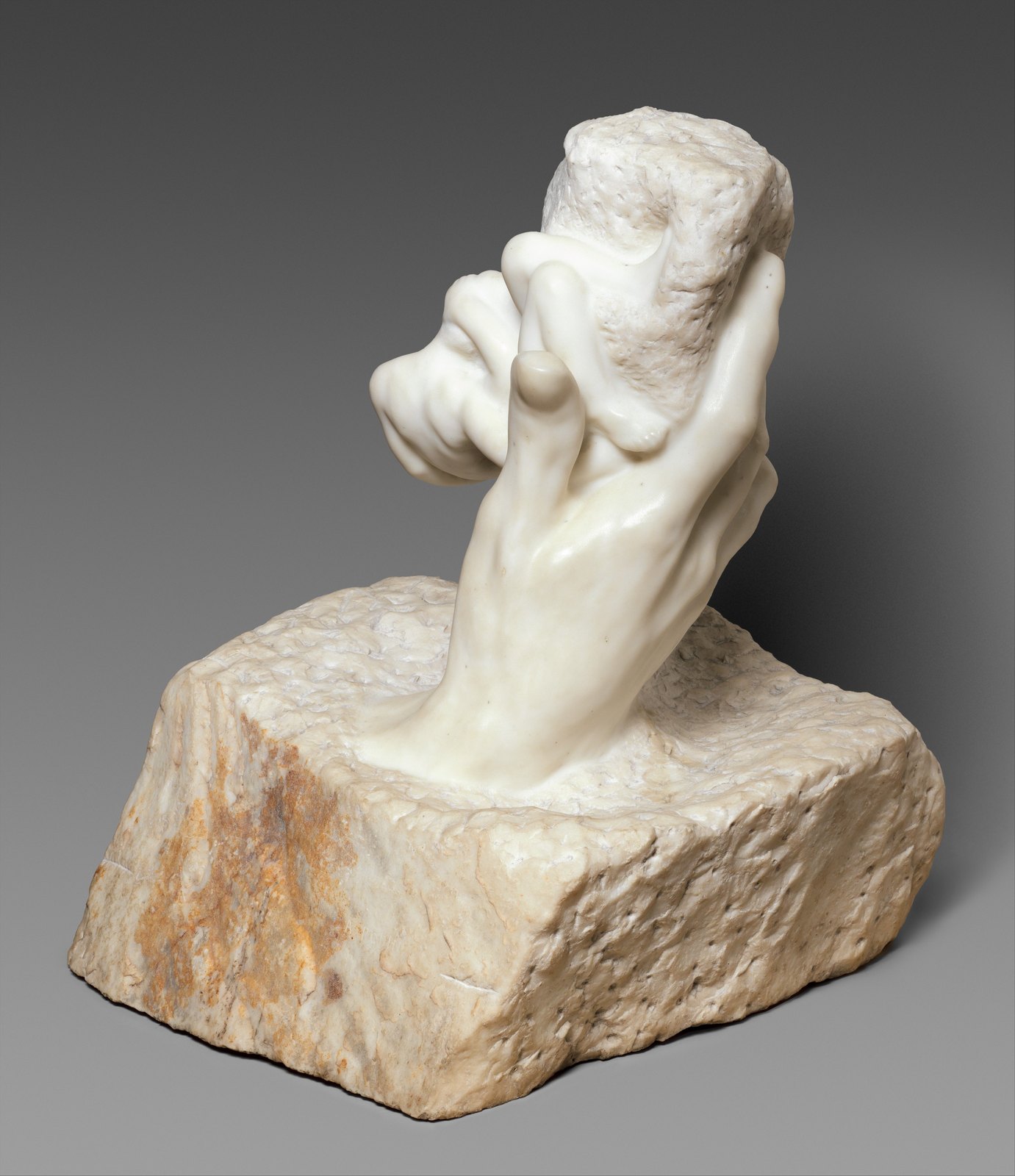
The Met marble shows the fingers and figures emerging from the rougher block. The Metropolitan Museum of Art, Gift of Edward D. Adams, 1908, 08.210. Image source. CC0 / Public domain.
A large plaster also appears in the Met’s Cantor exhibition catalogue. The existence of a plaster model makes it possible to compare which parts of the design were already defined before it was worked out in stone. In the marble, colour and light depend on how the carved surface is finished. The photograph is especially good at showing that difference in the central passage, from the pitted stone at the top to the thumb right in front of it. Along the lower edge of the photograph, one section of the base catches more light than the rest and makes the steep rise of the wrist easier to gauge. The narrow frame leaves less of the base available for comparison. The parts most clearly shown are the overlapping fingers and the gradual opening of the figures among them. [1] [3] [7]
How a second marble could be made
The Met identifies Victor Frisch as the practitioner who carved its marble and records a larger marble sold to Albert Kahn around the time of the American commission. The Musée Rodin preserves a large plaster after Kahn’s marble and catalogues another plaster after that carving as a pointing model. This distinction matters because a plaster can be taken from a finished marble and used to carry measurements into another block. It is evidence of how the workshop preserved a design while keeping the finished carvings separate. The two museum records place Kahn and the Met in the history of related works without establishing that either of the surviving Paris plasters was Frisch’s model for the Met carving. [3] [5] [8] [9]
A photograph in the Musée Rodin archive records Rodin beside a marble Hand of God at the Dépôt des marbres. It allows a comparison between the scale of a person and the scale of the carved hand. A tightly cropped object photograph can instead make the hand fill the frame, so that the curled figures alone supply a clue to its size. The Met records its marble at about 74 centimetres high and 230 kilograms. The weight shows how much stone could remain in a work whose hand appears to rise freely out of its base. The archive photograph and the catalogue measurements describe different aspects of the encounter with the carving. [1] [10]
Rodin artworks directory
Discussion
Look again at the images and ideas explored in The Hand of God. These editorial prompts invite your observations.
Reader Insights
After reading “Reading the hand and the figures”, what detail would you look for in the object or image?
What extra evidence would help you distinguish the artist’s choices from the effects of material, viewpoint or later display?
Join the Conversation
Share a detail, comparison or question about The Hand of God below.
References
- Metropolitan Museum of Art. The Hand of God, 08.210. View source.
- Philadelphia Museum of Art. Rodin’s Hands. View source.
- Musée Rodin. Rodin et le marbre. View source.
- Musée Rodin. Assemblage: Mask of Camille Claudel and left hand of Pierre de Wissant. View source.
- Metropolitan Museum of Art. Rodin at The Metropolitan Museum of Art. View source.
- French Ministry of Culture. La Main de Dieu, La Création, Joconde. View source.
- Metropolitan Museum of Art. Rodin: The B. Gerald Cantor Collection. View source.
- Musée Rodin. La Main de Dieu, large plaster after the Kahn marble. View source.
- Musée Rodin. La Main de Dieu, pointing model after the Kahn marble. View source.
- Musée Rodin. Rodin at the Dépôt des marbres beside The Hand of God. View source.

 Auguste Rodin.jpg)





