


 by Tom Gurney
Tom Gurney BSc (Hons) is an art history expert with over 20 years experience
Published on June 19, 2020 / Updated on November 18, 2026
Email: tomgurney1@gmail.com / Phone: +44 7429 011000
Head of Saint John the Baptist
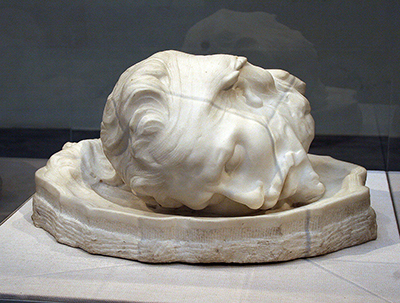
In Auguste Rodin’s Head of Saint John the Baptist, the face rests sideways within the low rim of a platter. The forehead and cheek catch the light, and a length of carved hair curves around the back of the head. The position of the face is as important to the subject as its features. It refers to the account of John’s death, in which his head is brought out on a dish. The composition belongs to a family of works that includes the standing Saint John the Baptist Preaching, separate upright heads and busts, and versions of the severed head made in marble, plaster and bronze. [1] [2] [3] [4]
A head lying on its side
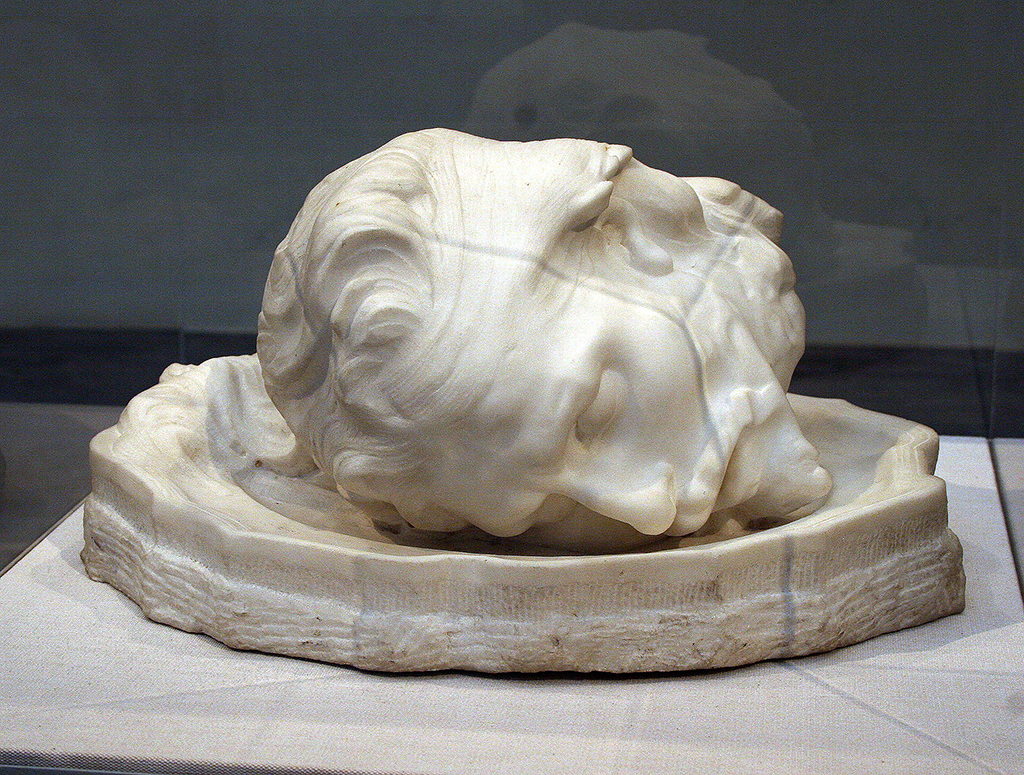
The photograph gives the face an unusual orientation. In an upright portrait one might begin with the eyes and then move along the nose to the mouth. Here the lines of those features run diagonally across the image. The nose projects close to the front rim, and the mouth and beard are farther round towards the right. At the left, the curve of the hair makes the back of the skull easy to distinguish. Together these details let the viewer reconstruct the shape of the head despite the way it has turned on its own axis. [1] [3]
The eyelids form narrow ridges under the brow. Their shadows are slight compared with the deeper space below the cheek, where the head meets the interior of the vessel. The side of the face looks broadly lit in the photograph. Following the outline downwards brings the eye to the point where that light gives way to the dark gap between the flesh and platter. From a higher position, more of the inner surface would become visible. The low view makes the head seem to occupy nearly all the space within the raised edge. [1] [3]
The support has two quite different surfaces. Its upper edge is fairly smooth and passes under the head in a long, shallow curve. The outer face has irregular horizontal lines and a less even finish. These extend almost the full width of the photograph. In the enlarged reproduction, the rim rises slightly behind the beard and behind the hair, leaving the front edge low enough for the nose to remain visible. A close view brings out how the lower texture changes towards the corners, while the comparatively smooth rim continues to separate the head from the surface beneath it. The platter is wide enough to give the composition a strong horizontal direction, which makes the slight angle of the face more conspicuous. [1] [3]
The story and the separate bust
In the Gospel of Mark, Herod has John imprisoned after John condemns his marriage to Herodias. At the banquet, Herod promises a reward to Herodias’s daughter for dancing. At her mother’s prompting she asks for the head of John the Baptist, and it is brought to her on a platter. Rodin’s sculpture concentrates on what is delivered. There is no accompanying banquet scene, and the person carrying the platter is outside the picture. In this arrangement the dish identifies the moment, while the close presentation of the features holds attention on John. [1] [5]
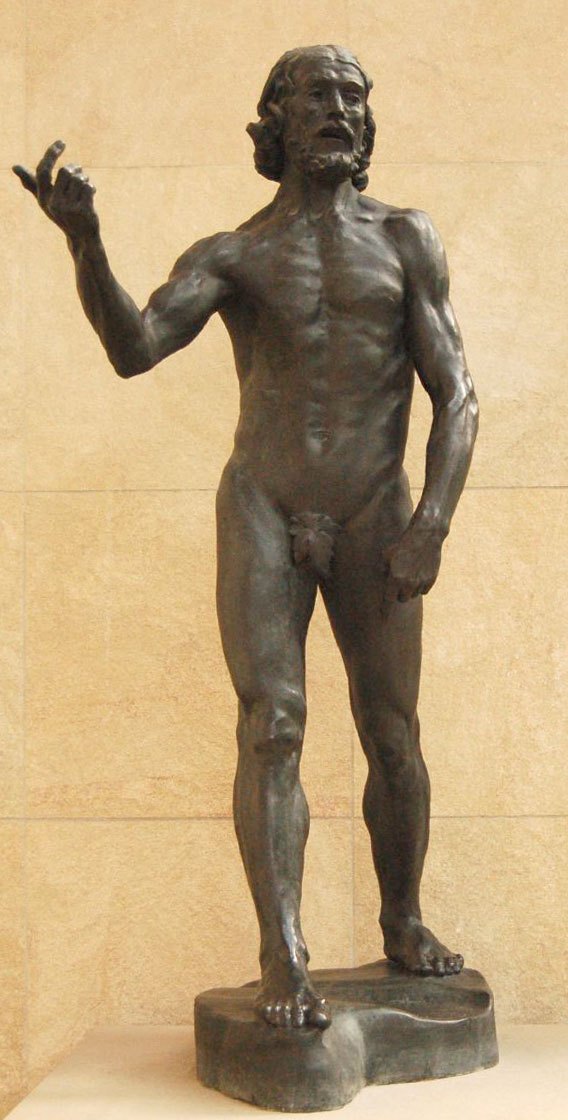
The full-length Saint John gives a comparison for the head when it forms part of the preacher’s striding pose. Photograph by Maarten, Wikimedia Commons. Image source. CC BY 2.0. Resized for the web.
The earlier Saint John the Baptist Preaching presents an active figure. The Met describes its separate bronze bust as deriving from Rodin’s over-life-size standing figure of 1878 and records that an independent painted plaster bust appeared at the 1879 Salon. The bust includes enough of the chest and shoulders to give the head its upright bearing. The hair, beard and deep-set face are readily comparable with the head on a platter. The manner of support changes the sense of the same subject. A viewer standing in front of a bust can meet the face at its own height, while the platter encourages the eye to move down and across the face. [2] [3]
Rodin also worked a head of the Baptist into The Gates of Hell. The Musée Rodin identifies the subject in its doorway catalogue. In the doorway a head can be seen in relation to neighbouring parts of the architecture and other figures. In a separate work the space around it can be kept low and open so that its position on the dish becomes the principal point of reference. This is one way to see how a form developed for a figure or a larger composition could take on a more specific narrative effect when shown on its own. [3] [6]
Watch Rodin’s sculpture up close
Five films explore Rodin’s sculpture, from his use of classical models and the figures on his monumental doorway to the work of his studio.
Auguste Rodin – Challenging Beauty
Six sculptures show how Rodin adapted classical models.
Watch on YouTubeMarble, plaster and bronze versions
The National Museum of Western Art in Tokyo holds a marble version of Head of Saint John the Baptist from the Matsukata Collection. The Los Angeles County Museum of Art dates its marble Severed Head of Saint John the Baptist broadly to about 1887–1907. Its published view shows a head much more closely surrounded by rough stone. The difference is important. In the illustrated view, the curve of the upper rim can be followed around much of the head. Where stone rises closer to the face, it is harder to see the edge as a continuous line and the eye spends more time on the surfaces immediately around the features. [1] [4]
The Musée Rodin catalogues a plaster dated 1887, with a dedication to the Queen of the Belgians along the edge below the face. It also records a bronze made after a marble from the Lhermitte collection. Its bronze was cast by François Rudier on 31 January 1901, with 1893 recorded for the design. These objects offer a more specific history than the general title can convey. The material, inscriptions and shape of the platter help identify a version, especially when different objects share the same pose. [7] [8]
The legacy view shows a pale head inside a clearly defined shallow rim. Museo Soumaya also documents a marble version under the title Cabeza de san Juan Bautista, and the Washington National Gallery of Art records a much smaller work in plaster. Measurements and a set of views that include the reverse or inscription would make it easier to assign a precise object record to the pictured head. The oblique view is especially good at showing the sideward tilt of the face and the place where it comes to rest just inside the rim. [1] [4] [9] [10]
Two Rudier casts with different sources
The Musée Rodin catalogues two dish versions whose bronze measurements are close. The cast from the Lhermitte marble, S.00519, is 38 centimetres across and was sand-cast by François Rudier on 31 January 1901. S.00771 is 39 centimetres across. The museum credits that cast to Alexis Rudier and relates it to a marble from a private collection in Paris. For S.00771 the founder’s mark is at the back of the base, while Rodin’s signature is in the hair near the neck. The two records document distinct links between a bronze and a marble even when size and subject make the bronzes easy to group together. [8] [11]
The museum also preserves a small plaster sketch of the saint’s head, S.00304, dated 1877–78. At 13.8 centimetres high it can be held in mind as a single head, before considering the broad horizontal profile created by a dish. The number on the sketch’s right cheek belongs to its own catalogue history. In the bronze versions, the rim and the way the hair meets the plate occupy much more of the viewer’s field. Looking between the sketch and the two bronze records makes clear how far the framing of the face changes with the addition of the dish. [8] [11] [12]
Rodin artworks directory
Discussion
Look again at the images and ideas explored in Head of Saint John the Baptist. These editorial prompts invite your observations.
Reader Insights
After reading “A head lying on its side”, what detail would you look for in the object or image?
What extra evidence would help you distinguish the artist’s choices from the effects of material, viewpoint or later display?
Join the Conversation
Share a detail, comparison or question about Head of Saint John the Baptist below.
References
- Los Angeles County Museum of Art. Severed Head of Saint John the Baptist. View source.
- Metropolitan Museum of Art. St. John the Baptist, bust. View source.
- Getty Museum. Bust of John the Baptist acquisition. View source.
- National Museum of Western Art, Tokyo. Head of Saint John the Baptist, S.1959-0051. View source.
- Gospel of Mark. Mark 6:17–29. View source.
- Musée Rodin. The Gates of Hell, figure index. View source.
- Musée Rodin. Tête coupée de Saint Jean-Baptiste, S.01922. View source.
- Musée Rodin. Tête coupée de Saint Jean-Baptiste sur un plat, S.00519. View source.
- Museo Soumaya. November 2017 collection publication. View source.
- National Gallery of Art. Head of Saint John the Baptist. View source.
- Musée Rodin. Tête coupée de saint Jean-Baptiste dans un plat, bronze S.00771. View source.
- Musée Rodin. Tête de Saint Jean-Baptiste, plaster sketch S.00304. View source.

 Auguste Rodin.jpg)





