


 by Tom Gurney
Tom Gurney BSc (Hons) is an art history expert with over 20 years experience
Published on June 19, 2020 / Updated on November 18, 2026
Email: tomgurney1@gmail.com / Phone: +44 7429 011000
Fugitive Love
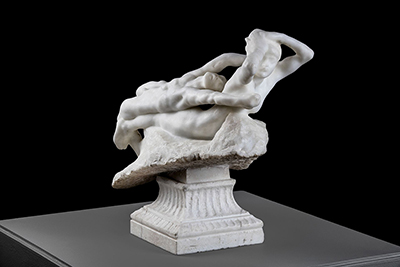
In Auguste Rodin’s Fugitive Love, two bodies overlap in a long group that rises sharply at one end. A torso bends away from the other figure, and a lifted arm curves over the head. The bodies are close enough for their outlines to merge at several points. Their different directions give the group a sense of movement even where it rests on a solid support. Rodin used the composition twice on the right door of The Gates of Hell. He also made it an independent work, known as Fugit Amor, with versions in bronze and marble. [1] [2] [3]
Reading the two bodies
In the photograph, the quickest way into the composition is to start at the raised arm on the right. Its curve leads around the head and into the upper body. The line from the chest to the hip continues down and to the left. It joins a band of overlapping limbs that runs across the middle. Their light surfaces are close in colour, but the nearer forms cast small shadows on the ones below. That makes some of the contacts easier to locate. The lower figure is partly concealed until the eye follows the contour back from the ends of the legs. [1] [4]
The arrangement is easier to understand if you follow its two main directions in turn. The body that lifts at the right draws the eye upward and out of the balanced centre of the group. The other figure continues more nearly along the length of the support. The muscles of the upper body turn even as the legs carry the shape sideways. The figures appear to share part of the same path, while the arch near the raised arm shows one of them already moving away. In the lower left, several silhouettes come together before falling sharply over the edge of the rough slab. [1] [4]
There is a second change of direction beneath the figures. A thin lip of stone juts out above a narrower, moulded pedestal. The front edge of that lip is rough and uneven. The repeated vertical grooves on the pedestal are more regular, and the square foot below gives the eye something stable with which to compare the broad diagonal of the group. In this view the pedestal is visible almost in full. The contrast makes the overhang particularly apparent and draws attention to how far the bodies extend beyond the middle of their support. [4]
A group shown twice on the doorway
The Musée Rodin locates both appearances of the composition on the right door. In one, the group projects toward the spectator in a near-horizontal position. In the other, it seems to recede into the surface. These positions affect where the eye expects the movement to continue. The first brings the overlapping bodies forward, towards the space occupied by a person standing below. The second sends that energy back towards the figures around it. By changing the angle and depth of the same group, Rodin could give one model different relationships with the crowd of bodies on the door. [1] [2] [3]
The museum relates the group to the second circle of Dante’s Inferno. In Canto V a storm sweeps the souls of those condemned for lust through the air. The Musée Rodin’s study of the marbles describes Paolo and Francesca as a probable inspiration for the group. The association provides a way to read the opposing lines of the bodies. The figures seem to be pushed onward by forces beyond their control. On the doorway the nearby figures and surrounding relief contribute to that impression. In an independent version the viewer sees more clearly how much of the force is already present in the bending limbs and the contact between the two bodies. [2] [4]
Watch Rodin’s sculpture up close
Five films explore Rodin’s sculpture, from his use of classical models and the figures on his monumental doorway to the work of his studio.
Auguste Rodin – Challenging Beauty
Six sculptures show how Rodin adapted classical models.
Watch on YouTubeA figure taken out of the pair
The male figure has a history of its own. The Musée Rodin traces his head and torso to one of the sons in Ugolino and His Children. It explains that Rodin used those forms in Fugitive Love and reworked them with different legs for The Prodigal Son. A large bronze of the latter was cast in 1905. In the independent figure the head and torso rise above the bent lower body and the arms stretch into the surrounding space. In the pair, the same backward inclination is drawn into a lateral movement by the position of the second body. A comparison brings out what changes when the torso turns towards open space or comes up against another figure. [3] [5]
From bronze to marble
The Musée d’Orsay’s Fugit Amor is a bronze. The Musée Rodin dates the carving of its marble S.01154 to about 1892–94 and gives its width as 72 centimetres. In the museum’s discussion of this marble, the bodies have fairly distinct outlines and stand away from the block in places. Its later marble, S.01396, was made around 1910 and is about a metre across. The museum describes forms that meet the block more gradually and leave fewer deep openings. The contrast changes the pace at which the eye can follow a limb from its most exposed point to the place where it joins the stone. [1] [4] [6] [7]
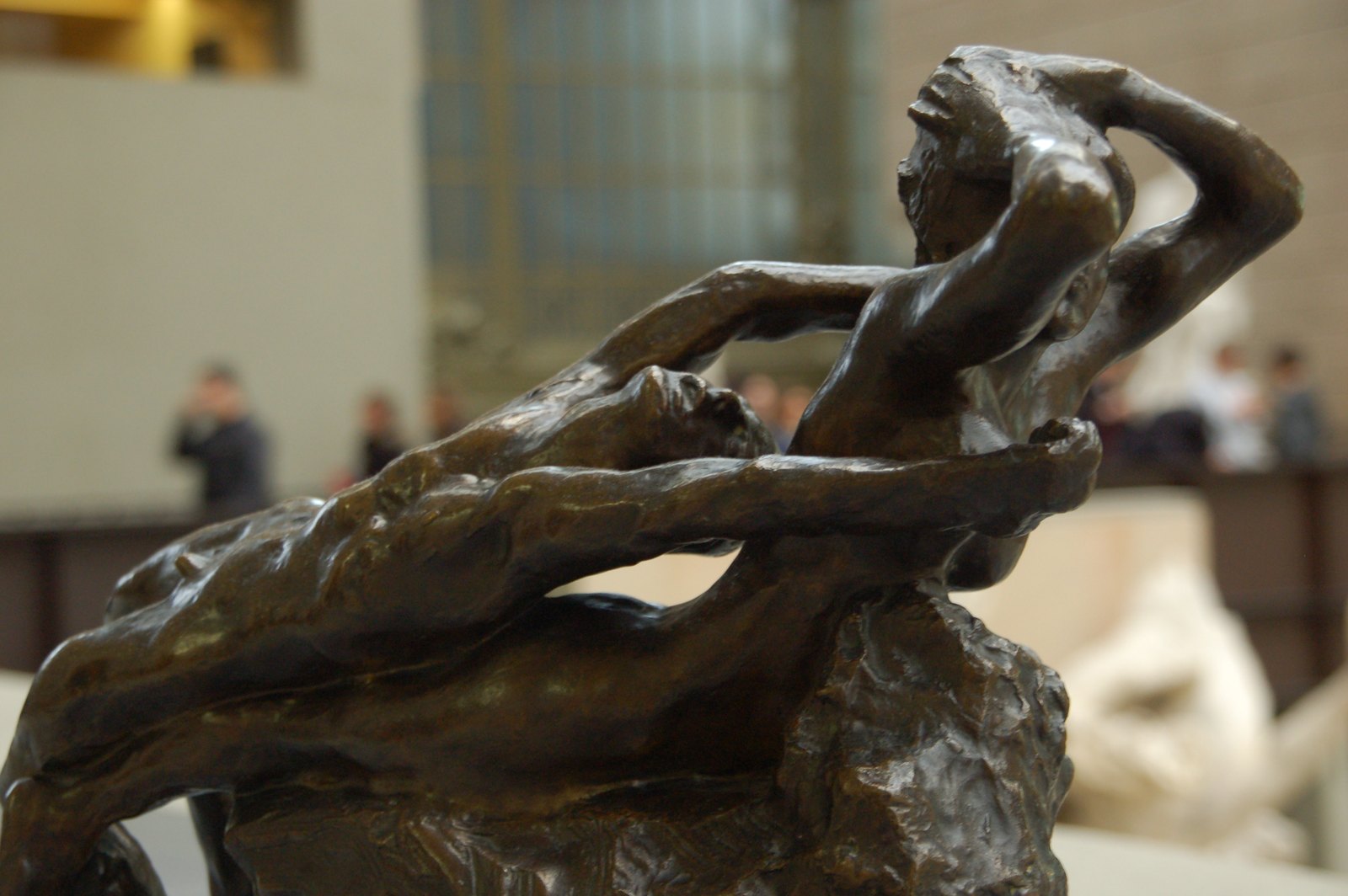
The Musée d’Orsay’s sand-cast bronze, RF 2241, provides a comparison with the marble versions. Photograph by Gautier Poupeau, Wikimedia Commons. Image source. CC BY 2.0. Resized for the web.
That difference is especially apparent if you look beneath the point where the upper torso lifts. There the shadow can give the impression that the body might continue outward, even though its weight is carried down through a substantial mass of stone. In a version with deeper transitions, the shadows divide the bodies into more distinct parts. Where the surfaces meet gradually, the same bend can appear to sink back into the support. The sculptor could therefore revisit the same arrangement and change how quickly the figures seem to pass across the viewer’s field of vision. [4] [6] [7]
The photograph shows a relatively open treatment above a rough slab. The shape of the slab, the openings around the bodies and the form of the pedestal all provide clues for comparing it with documented objects. The photograph alone leaves the exact version open. It does show how Rodin gave what might have been a narrow strip of relief enough depth to become a sculpture that rewards several views. As the angle changes, the turn of one body can hide or expose the contour of the other. [1] [4] [6] [7]
Two objects from the Matsukata collection
Tokyo’s National Museum of Western Art has two examples with almost identical dimensions. The bronze bears the mark of Alexis Rudier on the front of the base. The plaster carries a dedication to Madame and Monsieur Lyn. With a difference of only a centimetre in height, scale says much less about the identity of these objects than the inscriptions do. The dedication also shows that the base carried a personal association at some point before the plaster entered the museum. [8] [9]
Kōjirō Matsukata bought the bronze in 1919 and acquired the plaster separately around December 1923, both through Léonce Bénédite. The two purchases took different paths. The bronze remained in France and entered the Japanese museum after the 1959 transfer from the French government. Matsukata pledged the plaster in 1927 in an effort to rescue his shipbuilding business. It later belonged to a private collection in Japan and was deposited with the museum before being acquired in 2017. The works share their composition, dimensions and a collector, but their separate records explain how they entered the same public collection nearly sixty years apart. [8] [9]
Rodin artworks directory
Discussion
Look again at the images and ideas explored in Fugitive Love. These editorial prompts invite your observations.
Reader Insights
After reading “Reading the two bodies”, what detail would you look for in the object or image?
What extra evidence would help you distinguish the artist’s choices from the effects of material, viewpoint or later display?
Join the Conversation
Share a detail, comparison or question about Fugitive Love below.
References
- Musée d’Orsay. Fugit Amor. View source.
- Musée Rodin. Fugit Amor, La Porte de l’Enfer. View source.
- Musée Rodin. Multiples, fragments, assemblages. View source.
- Musée Rodin. Rodin et le marbre, pp. 8–9. View source.
- Musée Rodin. The Prodigal Son. View source.
- Musée Rodin. Fugit Amor, S.01154. View source.
- Musée Rodin. Fugit Amor, S.01396. View source.
- National Museum of Western Art, Tokyo. Fugitive Love, bronze S.1959-0022. View source.
- National Museum of Western Art, Tokyo. Fugit Amor, plaster S.2017-0003. View source.

 Auguste Rodin.jpg)





