


 by Tom Gurney
Tom Gurney BSc (Hons) is an art history expert with over 20 years experience
Published on June 19, 2020 / Updated on November 18, 2026
Email: tomgurney1@gmail.com / Phone: +44 7429 011000
Bust of Maurice Haquette
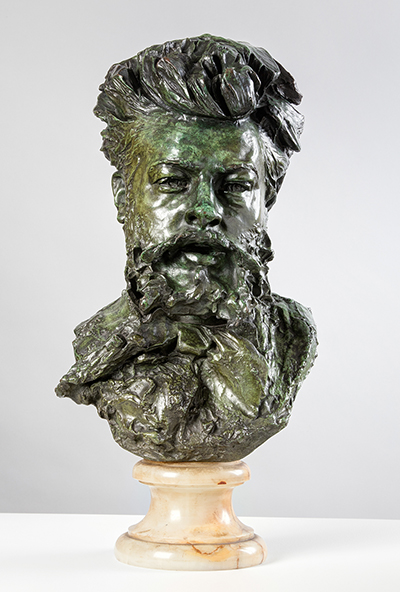
Maurice Haquette’s head rises from a small, densely modelled mass of clothing. A knot sits under the beard, the shoulders end in irregular edges, and the hair rises in thick locks that catch the light. Auguste Rodin modelled the portrait in 1883. By then he knew Haquette through the porcelain manufacture at Sèvres, where both men worked. The Musée Rodin discusses the bust alongside the portrait of Jules Dalou as an example of Rodin’s work in the 1880s. The Museo Soumaya holds a green-patinated bronze with a dedication to Haquette. Its account connects the portrait to the support Haquette gave Rodin during the early part of his career. [1] [2] [3]
The passage from the eyes to the clothes
The eyes sit beneath a brow that runs across a comparatively broad forehead. Look first at the relationship between the eyes and the bridge of the nose. The cheeks offer enough of a continuous surface to carry the light away from that centre. Below them, the ends of the moustache and the raised parts of the beard cast small shadows. It is possible to lose the edge of the mouth in that change of surface, then find it again where light catches the lower lip. Rodin gives these features enough definition to hold their own within a much more irregular passage of modelling. [1] [2]
The hair at the top works differently from the beard. Several large locks sweep back and rise above the forehead, so the outline expands on either side before it closes over the head. The channels between the locks are deep enough to be visible even at reduced scale. The forehead has a calmer surface, with broad patches of light interrupting the smaller markings. These changes make the upper part of the face a strong presence in its own right. The silhouette of the hair tells us where the head ends, and the change of modelling tells us where to look inside it. [1] [2]
At the bottom of the bust the collar and knot have less space to develop. The collar turns outwards and offers several irregular edges where it meets the background. The knot draws the garment in near the centre. Below it the modelling becomes broad and rough again. Light moves rapidly across this section, as it does through the hair, but the folds lead in different directions. In the frontal view the bust therefore has two centres of texture with the face between them. An oblique view makes it easier to judge which edges belong to the garment and which are the exposed outer limits of the bust. [1] [2] [3]
Haquette and Rodin at Sèvres
The Musée Rodin’s index of Rodin’s correspondents identifies Haquette with photography, art dealing, appraisal and administrative work. It records correspondence from 1880 to 1911. The Museo Soumaya situates their acquaintance at the manufacture at Sèvres and describes Haquette as an early supporter of the sculptor. In its account he took Rodin’s side in the controversy over The Age of Bronze, when the sculpture’s treatment of the body led to suspicions that it had been moulded directly from the sitter. A portrait of Haquette consequently has a place in the history of the people with whom Rodin worked and exchanged information as well as in his development as a sculptor. [2] [4] [5]
The Soumaya catalogue also records Haquette’s recommendation of Rodin to Edmond Turquet, the official who commissioned The Gates of Hell in 1880 for a planned museum of decorative arts. An introduction is a small event compared with the decades of work that went into the monument, but it is one of the points at which a personal connection enters the record of a public commission. The Soumaya bronze carries a dedication on the back identifying Haquette as Rodin’s friend. The inscription gives that object a personal address. Visitors seeing only a frontal photograph can study the face, but they need another view or the catalogue to see what Rodin wrote. [2] [5]
Watch Rodin’s sculpture up close
Five films explore Rodin’s sculpture, from his use of classical models and the figures on his monumental doorway to the work of his studio.
Auguste Rodin – Challenging Beauty
Six sculptures show how Rodin adapted classical models.
Watch on YouTubeWhat the two bronze records establish
The Musée Rodin dates the creation of the portrait to 1883 and the casting of its own bronze, S.01309, to 1910. Its record names Alexis Rudier, identifies sand casting and includes onyx among the object’s materials. The Soumaya catalogue describes a green-patinated bronze also bearing the Rudier association, and reproduces the dedication. The years a museum assigns to the model and to an individual cast have different purposes. The first locates the portrait in Rodin’s working life. The second identifies a stage in the history of the object that visitors see. The description of the Soumaya cast should be read with its own catalogue evidence, including the inscription it preserves. [1] [2]
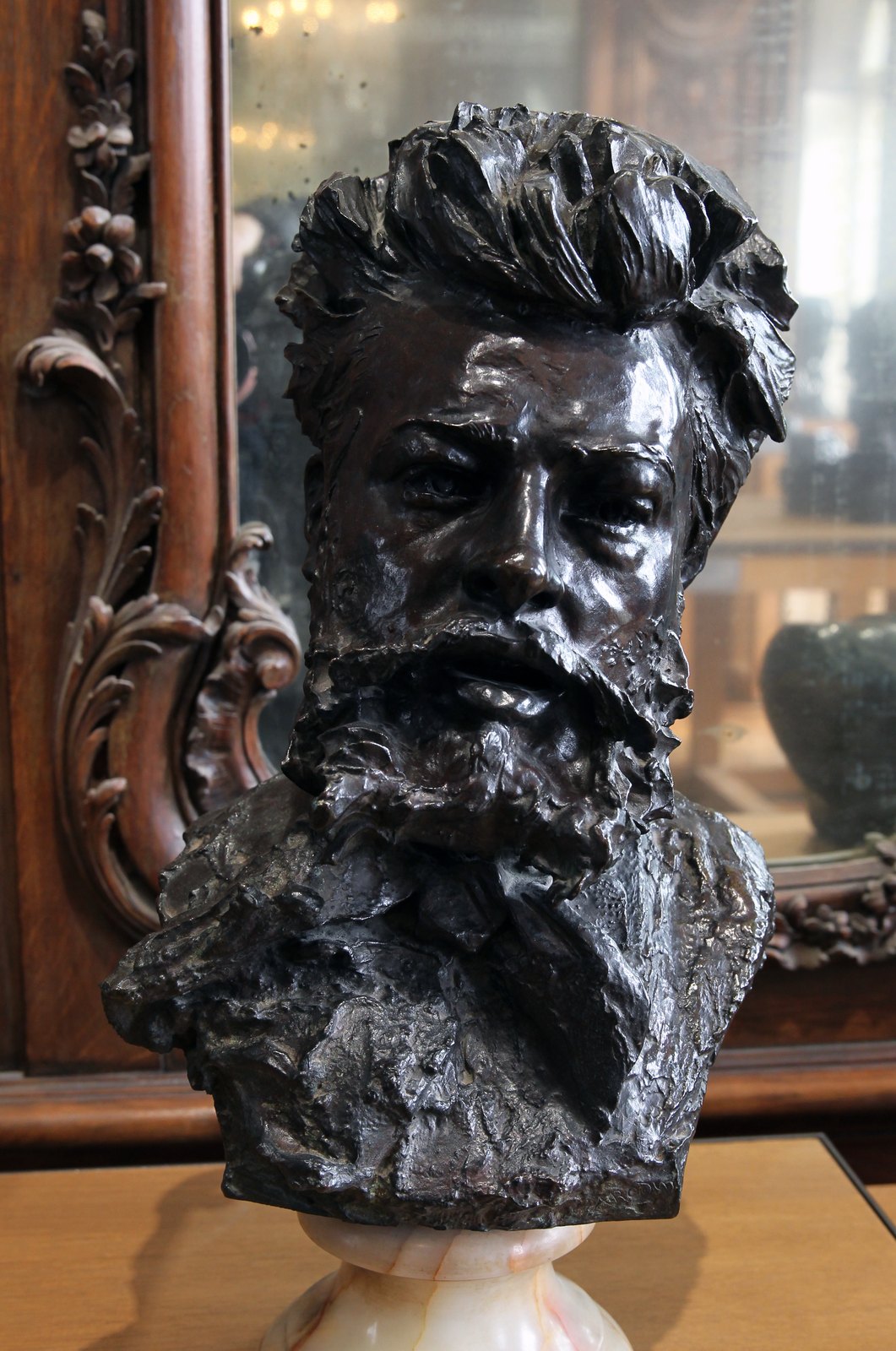
The Musée Rodin’s bronze gives a documented comparison for the handling of the face and clothing. Photograph by Vassil, Wikimedia Commons. Image source. CC0 / Public domain. Resized for the web.
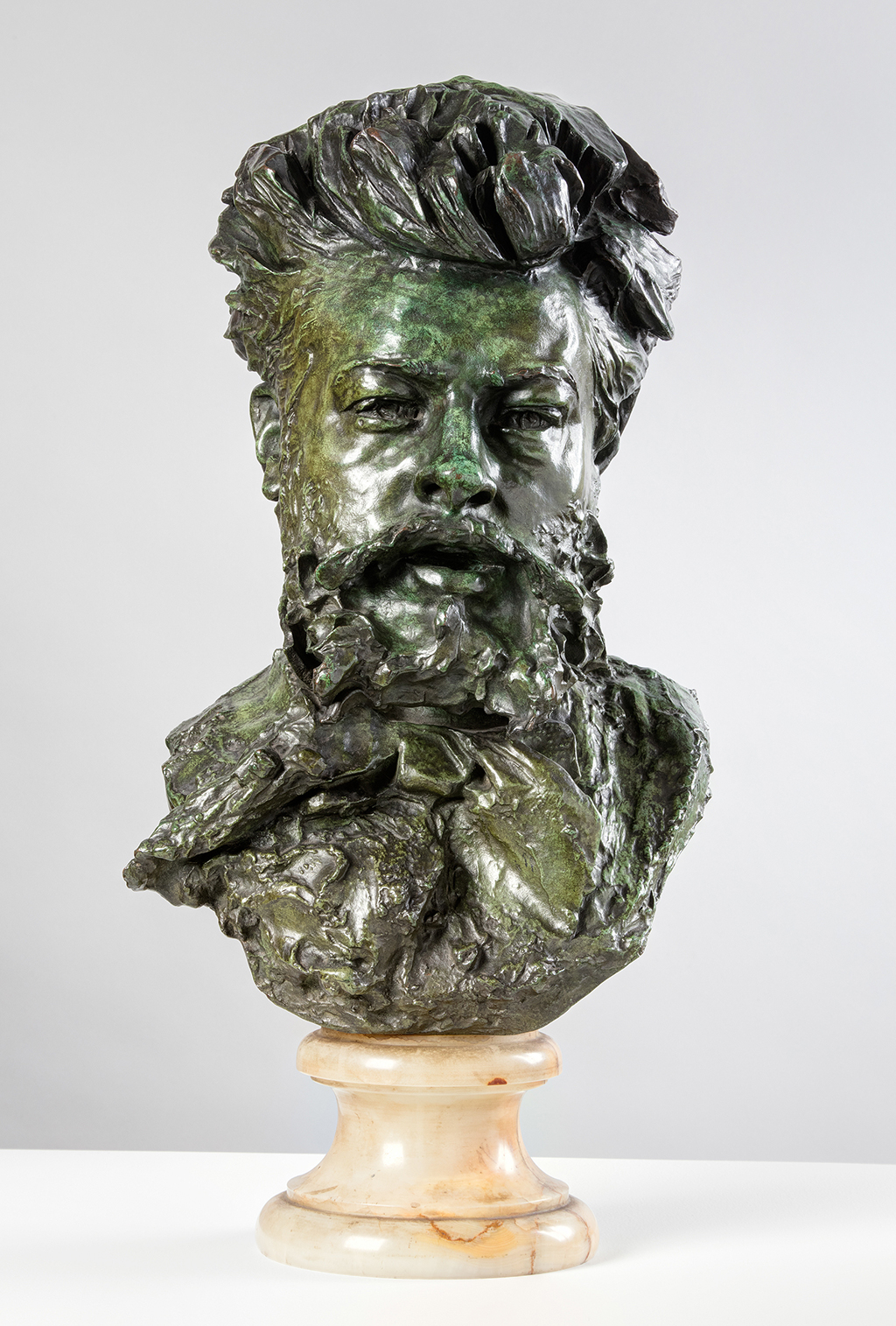
A frontal photograph may bring out the patina and the form of a pale support while leaving identifying inscriptions out of view. Colour is particularly sensitive to how the bronze is lit. In a green-patinated example, bright points around the cheeks can make the surrounding surface look darker, and reflections on the hair may pick out only some of the locks. The most useful way to compare examples is to follow distinctive shapes first and then consult the foundry marks, dedication and dimensions for the individual cast. Those records account for evidence that even a sharply focused photograph shows only on one side. [1] [2]
Rodin’s portraits in the 1880s
The Musée Rodin places Haquette among the portraits in which Rodin had developed particular command of the expressive possibilities of the bust. It connects this period with an interest in concentrating a likeness through modelling. Here the face is close enough to the uneven borders of the beard and clothes for the treatment of one part to affect how we see another. For a final look, start at the eyes and then follow the turn of the collar down to the lower edge. The head retains its prominence throughout that movement. Notice where the shoulders come to an end. Their outer edges sit well inside the widest sweep of the imagined body, so the garment reads as a close frame around the sitter. Viewed from below, the collar and beard would almost overlap. The cropped shoulders and gathered cloth give it a physical setting without competing with the gaze. [1] [2] [3]
What Haquette’s recommendation set in motion
The account of Rodin’s early career in Rodin, published in association with the Musée Rodin, places Haquette’s recommendation to Edmond Turquet beside a second intervention. After visiting Rodin’s studio, a group of artists sent Turquet a letter on 23 February 1880. They cited the range of work they had examined, including Saint John the Baptist, The Creation of Man and The Age of Bronze, and disputed the claim that Rodin had cast the last figure from life. The edition records Turquet’s instruction to attach the letter to the commission file. In May the state approved the acquisition of the plaster and the bronze. [2] [6]
These were separate contributions to the sculptor’s early career. Haquette helped bring Rodin to Turquet’s attention. The visiting artists gave the ministry a written assessment based on the work they saw in the studio. A few years later, Rodin modelled the portrait in which Haquette’s clothes and beard frame his attentive expression. The dedication on the Soumaya bronze gives this institutional history a personal counterpart. It records the sculptor’s address to the man he portrayed. [1] [2] [6]
Rodin artworks directory
Discussion
Look again at the images and ideas explored in Bust of Maurice Haquette. These editorial prompts invite your observations.
Reader Insights
After reading “The passage from the eyes to the clothes”, what detail would you look for in the object or image?
What extra evidence would help you distinguish the artist’s choices from the effects of material, viewpoint or later display?
Join the Conversation
Share a detail, comparison or question about Bust of Maurice Haquette below.
References
- Musée Rodin. Maurice Haquette, S.01309. View source.
- Museo Soumaya and Musée Rodin. La puerta del Infierno, pp. 87–89, figures 68–69. View source.
- Musée Rodin. Portraits sculptés. View source.
- Musée Rodin. Fichier des correspondants de Rodin, HAN.2962. View source.
- Metropolitan Museum of Art. Auguste Rodin, 1840–1917. View source.
- Rodin, chapter on the early commissions and the letter to Edmond Turquet, pp. 36–38. View source.

 Auguste Rodin.jpg)





