


 by Tom Gurney
Tom Gurney BSc (Hons) is an art history expert with over 20 years experience
Published on June 19, 2020 / Updated on November 18, 2026
Email: tomgurney1@gmail.com / Phone: +44 7429 011000
Cambodian Dancer, Front View
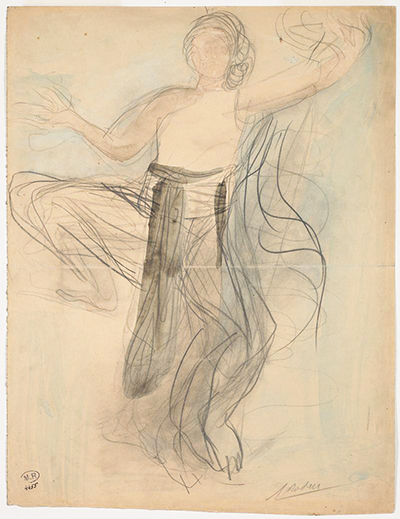
The dancer faces out of the sheet with her arms at different heights and one knee lifted towards the left. Lines gather around her waist and hang down through the folds of the garment. Elsewhere they remain open, especially around the hands and face. A pale blue-green tone sits behind parts of the figure without filling the sheet evenly. Auguste Rodin drew dancers from the Royal Ballet of Cambodia in 1906, and the Musée Rodin catalogues a number of works from July of that year under the title Danseuse cambodgienne de face. The frontal view gives an unusually clear way to see how the lift of the knee and the spread of the arms work together. [1] [2] [3]
A raised knee and two different hands
At the left, the raised knee reaches close to the edge of the paper. Several lines describe the top of the thigh, while a fainter set turns back towards the lower leg. Look for where those marks meet the darker lines of the waistband. That meeting gives the lifted leg a firm connection to the body even where it is difficult to tell an edge of the garment from an exploratory mark. The other leg descends within the longer folds, and its foot appears near the bottom of the drawing. The different treatment of the two legs is part of what makes the pose look momentary. One extends across the sheet, while the other passes through a crowded stretch of hanging cloth. [1] [3] [4]
The arms make a second uneven arrangement above the waist. At the left, the upper arm slopes down to the elbow before the forearm rises towards the hand. On the right, the whole arm lifts on a longer diagonal. The two hands are among the least heavily defined portions of the sheet. Traces around the fingers spread beyond the stronger outlines. Look at the small turn at the end of each wrist. It lets the fingers take a different direction from the arm that carries them. The extent of both gestures is easy to read, even when the smaller marks around each hand leave several possible paths for the eye. [1] [3] [4]
The face is comparatively spare. The hair gives the head a distinct outline, including a compact cluster of curves behind one side. The lines around the head are much darker than the small marks within it. The face can consequently be read as turned towards the viewer without revealing a strong individual expression. That economy makes the way it sits between the arms especially important. Its position is nearly upright while the limbs take widely different directions. It is a small, quiet area above the denser marks that anchor the waistband. [1] [2] [3]
Lines through the garment
The darker part of the garment begins at the waist. Below it, overlapping marks descend or swing to one side. Some appear to describe folds, and others run too far into the surrounding area to remain easy to assign. The parts of the figure left in pale paper have a much more open appearance. It helps to compare the tightly gathered lines immediately below the belt with the longer curves to the right. The first area gives the garment a point of attachment. The second makes it seem to move away from the figure, and the open paper between the marks keeps that movement legible. [1] [2] [4]
Technical research for the Courtauld’s exhibition on Rodin and dance found examples in which he applied paint over pencil. A conservation study can see which material lies on top at a particular crossing. In a reproduction the safest observations concern where the darker lines are visible and where colour spreads beyond them. Here the pale tone around the body connects parts of the sheet that otherwise have little in common. It reaches both towards the arms and around the lower folds, while leaving the stronger drawing of the waist and knee easy to follow. [3] [4]
The paper is visible as a field of its own around the arms. Along the lower edge there is a comparatively quiet margin where the writing and the oval stamp sit apart from the figure. At the sides the space changes from one height to another. The lifted knee nearly meets the left edge, but the lower folds narrow back towards the foot. The margin on that side therefore grows wider as the eye goes down. The shift helps the raised knee register as a gesture even if the pale lines of the shin are difficult to follow. [1] [2]
Watch Rodin’s sculpture up close
Five films explore Rodin’s sculpture, from his use of classical models and the figures on his monumental doorway to the work of his studio.
Auguste Rodin – Challenging Beauty
Six sculptures show how Rodin adapted classical models.
Watch on YouTubeA frontal view among many sheets
The Musée Rodin dates several drawings titled Danseuse cambodgienne de face to July 1906. One, D.04437, is graphite and watercolour on watermarked paper. D.04455 has a different set of dimensions and a wider range of recorded materials, including gouache. D.04493 is on tracing paper. The shared title describes the artist’s position relative to the dancer, leaving significant differences in pose, handling and support to be established from each object. In the illustrated sheet, the mark at the lower left and the writing at the lower right are worth consulting alongside the pose. Small details of that kind can distinguish sheets whose titles and overall formats are similar. [1] [2] [5]
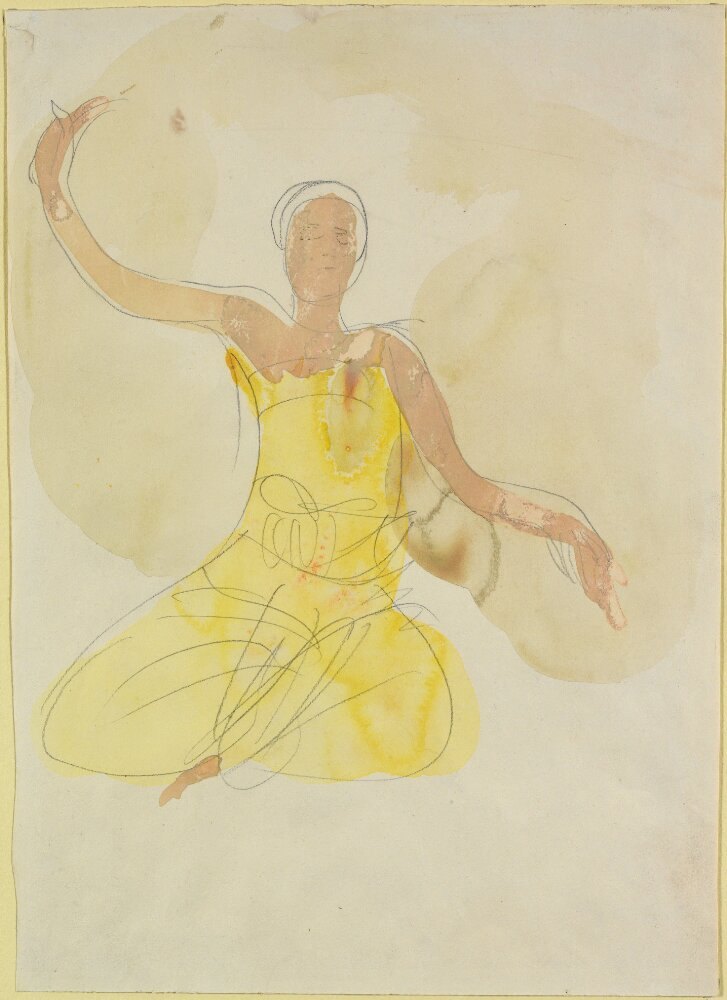
A separate sheet in Stockholm shows another way Rodin recorded a single dancer from the troupe. Nationalmuseum, Stockholm, via Wikimedia Commons. Image source. Public domain. Resized for the web.
Rodin encountered the troupe during King Sisowath’s official visit to France and followed the dancers to Marseille. Cambodia’s Ministry of Culture and Fine Arts describes the role of trained gesture in the ballet, where movement conveys meaning within a performance also involving song. A drawing allows closer inspection of one position than the audience could have during a dance. It offers much less of the succession that gives a gesture its place. The raised wrist, bent fingers and lifted knee can be studied as parts of the same posture while the dancer’s role or the passage being performed remains open. [3] [6]
A side view would give more information about how far the raised knee projects. The frontal view shows plainly how much of the page the limbs span at once and how the torso stays between them. Notice where the knees, elbows and wrists interrupt the longer curves. Those changes of direction carry the pose across the sheet and help the viewer imagine how one gesture might follow another. [1] [3] [4]
A frontal figure with a drawing on the reverse
Another frontal sheet in the Musée Rodin, D.04459, is known as Victoire. The catalogue records a signature and an inscription of homage to Madame Berte Elisseieff on the front. On the reverse is a sketch of an arm, and the catalogue also records a watermark in the paper. At 32 by 24.4 centimetres, the sheet holds a more developed study on one side and an isolated limb on the other. The arm sketch has its own place in the inventory description and can be examined without assuming that it is a preparatory study for the figure on the front. [7]
The verso helps explain why a shared title is often only the start of a comparison. One sheet can be distinguished by the exact relation of its hands and knee, another by the writing on the front and the marks visible when the paper is turned over. In the image on this page, the change between the two hands belongs to the pose. The arm on the back of Victoire makes a useful comparison because it isolates precisely the kind of detail that a finished frontal study brings into relation with the rest of the body. [1] [7]
Rodin artworks directory
Discussion
Look again at the images and ideas explored in Cambodian Dancer, Front View. These editorial prompts invite your observations.
Reader Insights
After reading “A raised knee and two different hands”, what detail would you look for in the object or image?
What extra evidence would help you distinguish the artist’s choices from the effects of material, viewpoint or later display?
Join the Conversation
Share a detail, comparison or question about Cambodian Dancer, Front View below.
References
- Musée Rodin. Danseuse cambodgienne de face, D.04455. View source.
- Musée Rodin. Danseuse cambodgienne de face, D.04437. View source.
- Musée Rodin. Rodin and the Cambodian Dancers. View source.
- The Courtauld. The Body in Motion, interview on materials and conservation. View source.
- Musée Rodin. Danseuse cambodgienne de face, D.04493. View source.
- Ministry of Culture and Fine Arts, Cambodia. Royal Ballet of Cambodia. View source.
- Musée Rodin. Danseuse cambodgienne de face dite Victoire and sketch of an arm, D.04459. View source.

 Auguste Rodin.jpg)





