


 by Tom Gurney
Tom Gurney BSc (Hons) is an art history expert with over 20 years experience
Published on June 19, 2020 / Updated on November 18, 2026
Email: tomgurney1@gmail.com / Phone: +44 7429 011000
Andromeda
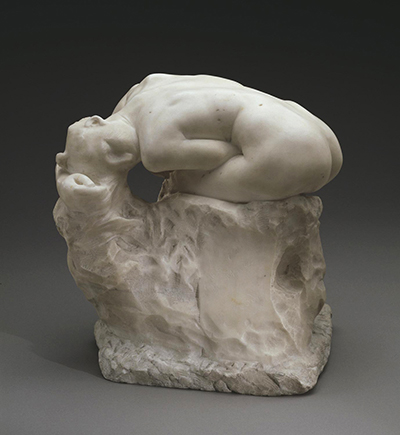
In Auguste Rodin’s Andromeda, a woman doubles over a block of marble with her head tipped back and her face turned upwards. The curve of her back runs almost without interruption into the bend of her legs. Below that closely gathered shape, the stone has the rough, irregular face of a rock. The version at the Rodin Museum in Philadelphia was modelled in 1885 and carved in 1886 for the French art critic Roger Marx. The museum identifies it as the first marble of the subject. One of the striking things about it is how much of a story about a woman exposed on a rock can be told through the way her body rests upon it. [1]
The space beneath the body
From the side, the figure appears to fold around an opening between her upper body and the rock. The opening is small, but it matters to the whole composition. It puts a shadow and a momentary break between two large passages of the same pale material. Follow its edge upwards and it takes you towards the shoulder and the underside of the head. Follow it down and you are back among the irregularities of the rock. The separation lets the figure seem poised above the block even as the head and legs appear to bear against it. [1]
The folds of the pose are particularly clear in profile. A knee comes up close to the torso and an arm is held close to the centre of the body. The chin rises while most of the figure remains drawn inwards. That angle of the head is worth spending time on. If you follow the movement from the back of the hips towards the shoulder, you might expect the figure to be looking down into the shelter of the rock. The head turns away from that expectation and gives a sense of exposure to an otherwise protective posture. [1]
The stone beneath her is as carefully placed as the figure above it. In the Philadelphia marble the broadest broken surfaces face outwards, where their unevenness shows beside the smoother course of the body. Look for the edge below the legs, where contact is easy to read, then for the less distinct transition around the head. There is enough variation along that boundary to make some areas seem to carry weight and others seem almost to merge with the figure. The change in finish also affects how much of the shape you can see at once. The long sweep of the back is easy to follow in light that leaves the block broken into bright ridges and darker hollows. [1]
A woman mistaken for a statue
In Book IV of Ovid’s Metamorphoses, Andromeda is bound to a rock as a sacrifice to a sea monster. Perseus happens upon her and takes her for a marble statue until he notices a breeze disturbing her hair and tears running from her eyes. Those minute signs of movement distinguish a living figure from stone in the story. The episode is especially apt for a work carved in marble. The woman’s stillness belongs both to the position in which she has been left and to the material through which Rodin depicts her. Her lifted face gives the pose an uneasy life even when the sculpture is seen without its title. [1] [2]
Ovid goes on to tell how Perseus saves her. The Philadelphia marble keeps the woman and the rock alone within the composition. The figure’s predicament has to be understood through her place on the stone, with the spectator left to imagine the surrounding shore and whatever lies beyond it. The upward turn of the face can suggest attention to something outside the group, but it gives few clues as to what she sees. This makes the position in front of the sculpture quite different from the one offered to a reader of Ovid, who first encounters Andromeda through Perseus’s arrival. [1] [2]
Watch Rodin’s sculpture up close
Five films explore Rodin’s sculpture, from his use of classical models and the figures on his monumental doorway to the work of his studio.
Auguste Rodin – Challenging Beauty
Six sculptures show how Rodin adapted classical models.
Watch on YouTubeThe figure in other settings
The Museo Nacional de Bellas Artes in Buenos Aires discusses Andromeda alongside the figures Rodin developed for The Gates of Hell. The monumental doorway gathered bodies into a crowded architectural setting. A form contemplated against that larger work can acquire meaning through the figures around it and the direction in which they move. In a marble like the one in Philadelphia, the relation of flesh to rock is much easier to examine on its own. A turn around the base takes the viewer from the long profile of the body to more compressed angles in which the legs and torso appear closely interlocked. The exhibition setting makes that movement possible at the scale of a single figure. [1] [3] [4]
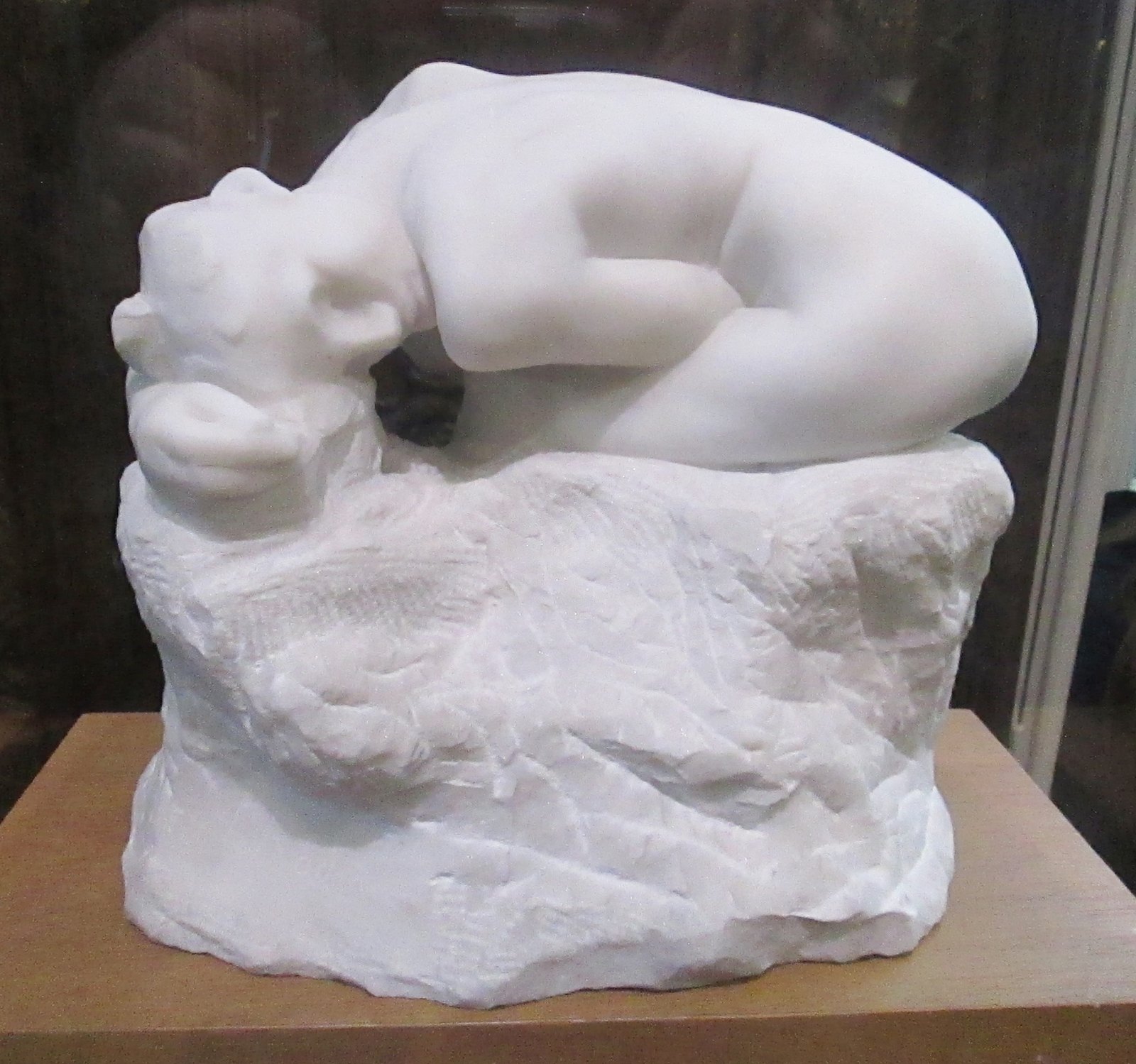
The Paris marble provides a comparison with the Philadelphia work. Photograph by Beyond My Ken, Wikimedia Commons. Image source. CC BY-SA 4.0. Resized for the web.
The Buenos Aires museum has its own marble. Its catalogue records the former title La Danaide, an indication of how readily a contracted figure on a rock could be associated with another work by Rodin. The Musée Rodin’s Danaïd is a separate design. Its museum account describes the back of the figure and the way the head and hair reach the stone. Comparing the two sculptures, follow how each back leads to the head and where the head comes to rest. The Andromeda in Philadelphia tips her face towards the light. The Danaid’s lowness against the rock and the sweep of the hair give her a different relation to the ground. The individual posture is a better guide to identifying these works than pale stone and a rough base. [1] [3] [5] [6]
Several museum records are needed to account for the different objects carrying the name Andromeda. The Musée Rodin catalogues a version without the right arm on a high column, inventory S.02323. Another record describes a model for pointing based on the marble from the Hanotaux collection. Pointing helps a carver transfer the relative positions of parts of the model to the stone. The model and the completed marble consequently tell related stories about the work, and each has its own catalogue history. A comparison can begin with the pose shared across examples and then turn to the arms, the height of the support and the handling of the surrounding material. In the Philadelphia view, the gap below the figure and the roughly rectangular block are especially easy places to begin. [1] [7] [8] [9]
Plasters for different jobs
The Musée Rodin keeps a second armless plaster, S.02324, at 26.8 centimetres high. It is nearly five centimetres shorter than S.02323, which the museum associates with a high column. S.02323 also carries notes referring to a square base and a large column. The measurements include the support, so the difference in overall height leaves the size of the body open. The notes show that the height and shape of the support were questions the workshop could consider independently of the figure. Raising a figure on a column changes how soon a viewer can see the surface beneath the head and how prominently the upper contour stands against the space beyond. [7] [10]
Two other plasters both descend from the Hanotaux marble. S.02283 contains metal nails and is catalogued as a pointing model for transferring measurements to stone. S.03155 is identified as a foundry model. Its catalogue records a release agent on the surface. The labels distinguish two functions for similar forms preserved in plaster. One made the figure available to a carver, while the other made it available to a foundry. These records establish a relationship to the same marble without assigning either plaster to the production of a particular carving or bronze. [8] [9] [11]
Rodin artworks directory
Discussion
Look again at the images and ideas explored in Andromeda. These editorial prompts invite your observations.
Reader Insights
After reading “The space beneath the body”, what detail would you look for in the object or image?
What extra evidence would help you distinguish the artist’s choices from the effects of material, viewpoint or later display?
Join the Conversation
Share a detail, comparison or question about Andromeda below.
References
- Philadelphia Museum of Art. Andromeda, modelled 1885 and carved 1886. View source.
- Ovid. Metamorphoses, book IV. Translated by A. S. Kline. View source.
- Museo Nacional de Bellas Artes. Rodin en la colección del Museo Nacional de Bellas Artes. View source.
- Musée Rodin. The Gates of Hell. View source.
- Museo Nacional de Bellas Artes. Andromède, inventory 7764. View source.
- Musée Rodin. Danaïd. View source.
- Musée Rodin. Andromède, S.02323. View source.
- Musée Rodin. Andromède, pointing model after the Hanotaux marble. View source.
- Musée Rodin. Marble carving. View source.
- Musée Rodin. Andromède without the right arm, S.02324. View source.
- Musée Rodin. Andromède, foundry model after the Hanotaux marble, S.03155. View source.

 Auguste Rodin.jpg)





