


 by Tom Gurney
Tom Gurney BSc (Hons) is an art history expert with over 20 years experience
Published on June 19, 2020 / Updated on November 18, 2026
Email: tomgurney1@gmail.com / Phone: +44 7429 011000
Bust of Victor Hugo
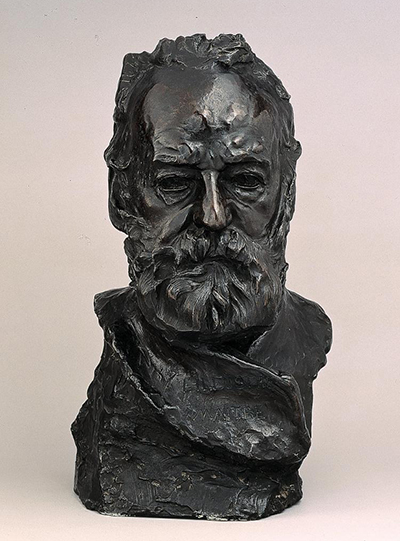
Victor Hugo’s forehead emerges from a rough border of hair in Auguste Rodin’s bust. The eyes sit deep beneath the brows, and a diagonal fold cuts across the clothing below the beard. Rodin began the portrait in 1883, when the writer allowed him to visit and observe him at home. The bronze shown at the Salon the following year preserved much of the irregular modelling that makes the face so arresting. The portrait would also supply a starting point for later works commemorating Hugo. In the bust, the small distance between facial detail and rough clothing gives the eye several ways to read the bearing of the head. [1] [2] [3]
The face and the sweep of the garment
Look first at the space across the forehead. The brows stand out near its lower edge and cast small shadows over the eyes. Bulges and depressions in the middle of the forehead catch enough light for that area to look active even while the head is still. The hair narrows the visible skin at the sides and breaks the outline at the top. In a frontal photograph, the detail around the eyes can seem much darker than the broader planes above. That is one reason the portrait can appear to look from beneath its brow even when the direction of the gaze is hard to establish. [2] [3]
The bridge of the nose makes a narrow line between the eyes, and the moustache interrupts it lower down. The beard then spreads outward in separate locks. Some turn into the light abruptly, while others recede towards the edge of the neck. Look at where the two sides of the beard reach the clothing. A dark passage under the chin briefly separates the head from the garment. The high fold below cuts across that shadow and leads the viewer towards one shoulder. The surface of the beard gives us more to follow than the silhouette alone, and the garment gathers its movement lower down. [2] [3]
The clothing makes a broad diagonal across the front. Its raised edge gives the head an asymmetrical frame, even in a photograph taken nearly square to the face. A lower view would give that fold more prominence and bring it closer to the beard. From higher up, the face can appear to sit farther over the truncated shoulders. The bust leaves much of the shoulders compressed into the narrow mass beneath the neck. A stand or stone base can alter that effect by adding a second shape to the bottom of the object. Check where the sculpted bronze actually ends before comparing the height or silhouette of two examples in photographs. [2] [3] [4]
Working without a fixed pose
The journalist Edmond Bazire introduced Rodin to Hugo early in 1883. According to the Musée Rodin, the sculptor had spoken to him about the lingering accusation that he had moulded The Age of Bronze directly from a living model. Bazire suggested portraying prominent people, and Hugo agreed to receive him. Both the Musée Rodin and the Musée cantonal des Beaux-Arts in Lausanne recount the limits of that arrangement. Hugo went about his usual activities and had little patience for formal sittings. Rodin made quick sketches from observation and kept his clay and equipment on the veranda. [1] [2]
Rodin recalled moving between the room where Hugo spent time with his friends and the veranda where he modelled. Sometimes the impression faded by the time he reached the clay, and he went back to look again. The drawings and the model were different ways of keeping a record of these visits. On paper he could catch an angle of a head quickly. In clay he had to decide how that angle would join the neck and how far a form needed to project for the light to disclose it. The Musée Rodin reports that photographs of the model also gave him material to work over with pencil after the sittings ended. [1] [2]
The surviving accounts put the act of looking at the centre of the portrait. They also help distinguish what was possible in Hugo’s home from what happened to the sculpture later. The clay stayed there for a time, and the Musée Rodin describes the translation of the unfinished portrait into bronze for Hugo’s birthday banquet in 1884. The Salon display followed that year. A historical photograph of the bronze in the Maison de Victor Hugo collection records another way in which the likeness circulated. The portrait remained recognisable through a change of medium and through the choices of a photographer about lighting and position. The Maison de Victor Hugo records that its print passed through the hands of the engraver Méaulle, who probably used it in connection with reproductions. A small printed image could thus bring the face into a setting far removed from either Hugo’s home or the Salon. [1] [5]
Watch Rodin’s sculpture up close
Five films explore Rodin’s sculpture, from his use of classical models and the figures on his monumental doorway to the work of his studio.
Auguste Rodin – Challenging Beauty
Six sculptures show how Rodin adapted classical models.
Watch on YouTubeFrom portrait to commemoration
The French national collections database describes a Musée Rodin bronze bearing the inscription À l’illustre maître across the clothing. The same entry lists a related plaster without the inscription and other variants, including a bronze with a lyre and heads in bronze and marble. The inscription belongs to the recorded example. Even a closely related likeness may have a different support or a different treatment around the head. The Metropolitan Museum’s bronze, for example, has a marble base. A reproduction of the face is enough to compare parts of the modelling. An inscription, a complete outline and a collection record are more useful when the question is which object was photographed. [3] [4]
Hugo died in 1885, and Rodin received the commission for a public monument in 1889. The Musée Rodin describes the subsequent development of a seated project and a standing project for the Panthéon. The Maison de Victor Hugo also documents the later Heroic Bust, whose plaster was exhibited on a column in 1902. Those works extended the portrait into settings with deliberate relationships of scale and distance. Return to the earlier bust and consider how close it brings the brow, beard and clothing together. They tell us much about how Rodin studied Hugo before the larger compositions gave the writer an entire place to occupy. [1] [3] [6] [7]
How the portrait changed shape
The Musée Rodin’s S.00036 is a sand cast made by François Rudier in 1883. The bronze is 48.5 centimetres high and weighs 14.3 kilograms. The dedication to Hugo is on the front, while the museum records the signature and date on the side of the modelled mound. In a frontal view the dedication belongs to the public face of the portrait, beneath the beard and collar. Walking around the bust shifts attention to the uneven lower edge and to Rodin’s own name. The museum bought this bronze in 1928. [8]
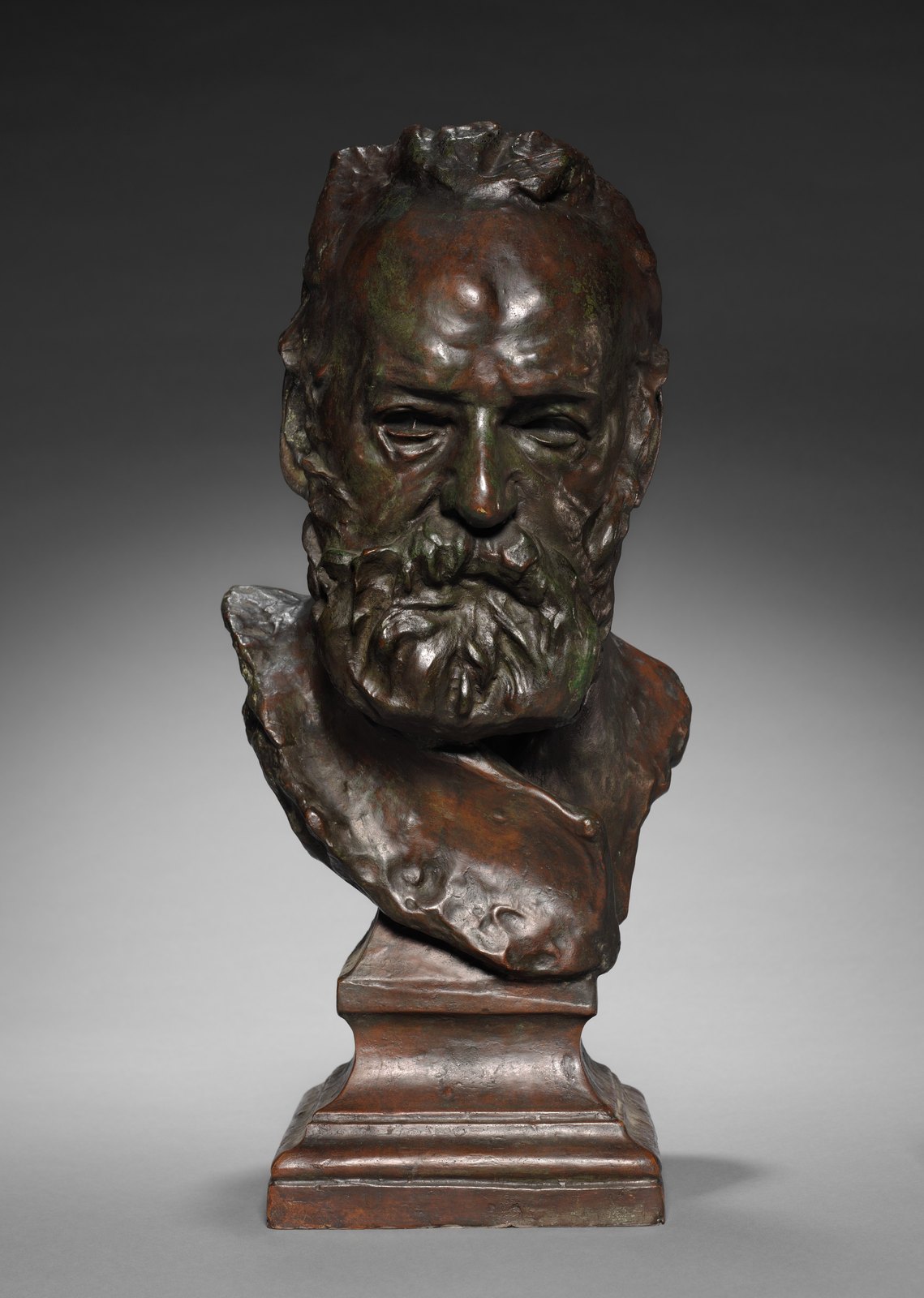
The Cleveland bust provides a comparison for the head and shoulders as a self-contained portrait. The Cleveland Museum of Art, Bequest of James Parmelee, 1940.580. Image source. CC0 / Public domain.
The national inventory links this object with alternatives that approach the portrait quite differently. It lists a plaster without the inscription and a bronze with a lyre. The lyre introduces a sign of the poet’s vocation where the dedicated bust relies on words. The same record lists a head in marble nearly half a metre high and a larger marble in which the head is set into the block. In that version the stone around the features becomes part of the portrait. The bust with a modelled base keeps Hugo’s dress and the dedication legible, while the treatments of the isolated head give the turn and scale of his features more room to dominate. [4] [8]
Rodin artworks directory
Discussion
Look again at the images and ideas explored in Bust of Victor Hugo. These editorial prompts invite your observations.
Reader Insights
After reading “The face and the sweep of the garment”, what detail would you look for in the object or image?
What extra evidence would help you distinguish the artist’s choices from the effects of material, viewpoint or later display?
Join the Conversation
Share a detail, comparison or question about Bust of Victor Hugo below.
References
- Musée Rodin. Victor Hugo. View source.
- Musée cantonal des Beaux-Arts, Lausanne. Bust of Victor Hugo, inventory 78. View source.
- Metropolitan Museum of Art. Victor Hugo, 66.85. View source.
- French Ministry of Culture. Victor Hugo, Musée Rodin S 36. Joconde. View source.
- Paris Musées. Photographie du buste de Victor Hugo par Rodin. View source.
- Maisons Victor Hugo. Victor Hugo, buste héroïque. View source.
- Musée Rodin. Model for the Monument to Victor Hugo, with Meditation and the Tragic Muse. View source.
- Musée Rodin. Buste de Victor Hugo dit À l’Illustre Maître, avec base modelée, S.00036. View source.

 Auguste Rodin.jpg)





