


 by Tom Gurney
Tom Gurney BSc (Hons) is an art history expert with over 20 years experience
Published on June 19, 2020 / Updated on November 18, 2026
Email: tomgurney1@gmail.com / Phone: +44 7429 011000
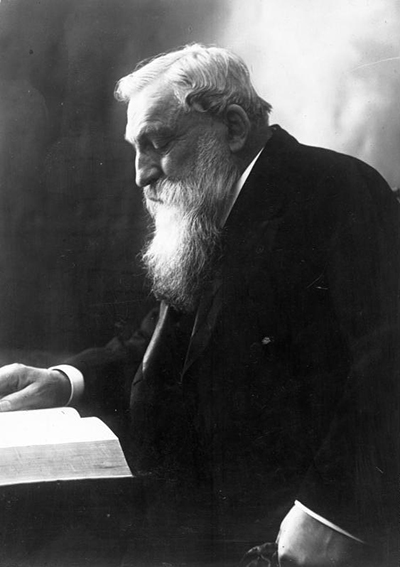
Portrait of Auguste Rodin, 1914
Auguste Rodin inclines his head over an open volume in this black-and-white photograph. Light falls on his hair, the front of his beard and the page edges near his hand. The dark coat occupies much of the right half of the picture, while the book enters at the bottom left, where the photograph cuts off part of the hand. The German Federal Archives preserves the same image under the reference Bild 183-R38535. Its accompanying caption dates the photograph to 1914, and the photographer is unrecorded. [1]
The face and the book
The face is seen from an angle close to profile. The forehead and the bridge of the nose make a clear edge on the left, and the eyelid falls into shadow beneath the raised brow. That shadow helps establish the line of sight. At the lower end of the same diagonal, the pale upper surface of the book comes into view. The distance between the face and the pages is occupied by dark background and clothing, so the relation between them depends on the angle of the head and the hand reaching towards the volume. The pages themselves turn outward towards the viewer, with the layered edges more clearly visible than anything printed on the open spread. [1]
The strongest light catches the ridges of combed hair on top of Rodin’s head. The light on his beard is distributed differently. A broad white patch catches the eye below the mouth and tapers through darker strands into the coat. The face between these two areas contains much subtler gradations, particularly across the temple and cheek. A short line of white collar beside the neck makes another division between skin, beard and jacket. The pose has little of the symmetry of a portrait made straight on. Its shifts of light make the head easy to follow as it turns down and away. [1]
Both cuffs help establish where the hands are. One makes a small bright curve near the book and the other crosses the bottom right corner. The hand on that side is cut off low in the frame, with just enough visible to convey the position of the arm. The other hand reaches into the picture from the left edge and lies beside the open pages. These two small areas of light extend the pose beyond the face. They also show how much of the figure is held in dark tones where the side of the jacket and the surface below the book meet. [1]
Identifying the photograph
The Bundesarchiv image and the reproduction here agree in the shape of the book’s page block, the arc of each cuff and the highlights across the hair and beard. They record the same exposure. The archive reference belongs to the Zentralbild collection, and its historic caption supplies the year 1914. The surviving image and caption leave the photographer, the place and the circumstances of the sitting open. The book is identifiable as a substantial open volume by the thickness of the page block. Its title and the words on the spread are beyond what can be read in the photograph. [1]
That distinction matters because several portraits of Rodin show him lowering his head, and because a single portrait could circulate through prints and reproductions. A date from a portrait with a similar subject or pose can belong to a different negative. The Bundesarchiv comparison can be made at the level of small features unlikely to recur together in another photograph, such as the corner of the raised page and the point where the nearer cuff reaches the edge of the frame. It gives the date on this page an archival basis while leaving the unknown details of the sitting open. [1]
Watch Rodin’s sculpture up close
Five films explore Rodin’s sculpture, from his use of classical models and the figures on his monumental doorway to the work of his studio.
Auguste Rodin – Challenging Beauty
Six sculptures show how Rodin adapted classical models.
Watch on YouTubeRodin and the camera
Rodin used photographs to follow the development of his sculptures. The Musée Rodin preserves examples on which he drew directly, sometimes covering large areas with ink as he reconsidered a figure or its surroundings. A photograph could hold one angle of a work still long enough for him to attend to a contour without turning the sculpture. It could also circulate beyond the studio and give people who had never seen the object an idea of its scale, position or surface. The photographic record of Rodin’s own appearance reaches audiences in a similar way. Here, the cropped frame takes the viewer close to the sitter and gives his attention to the book more prominence than details of the room. [2]
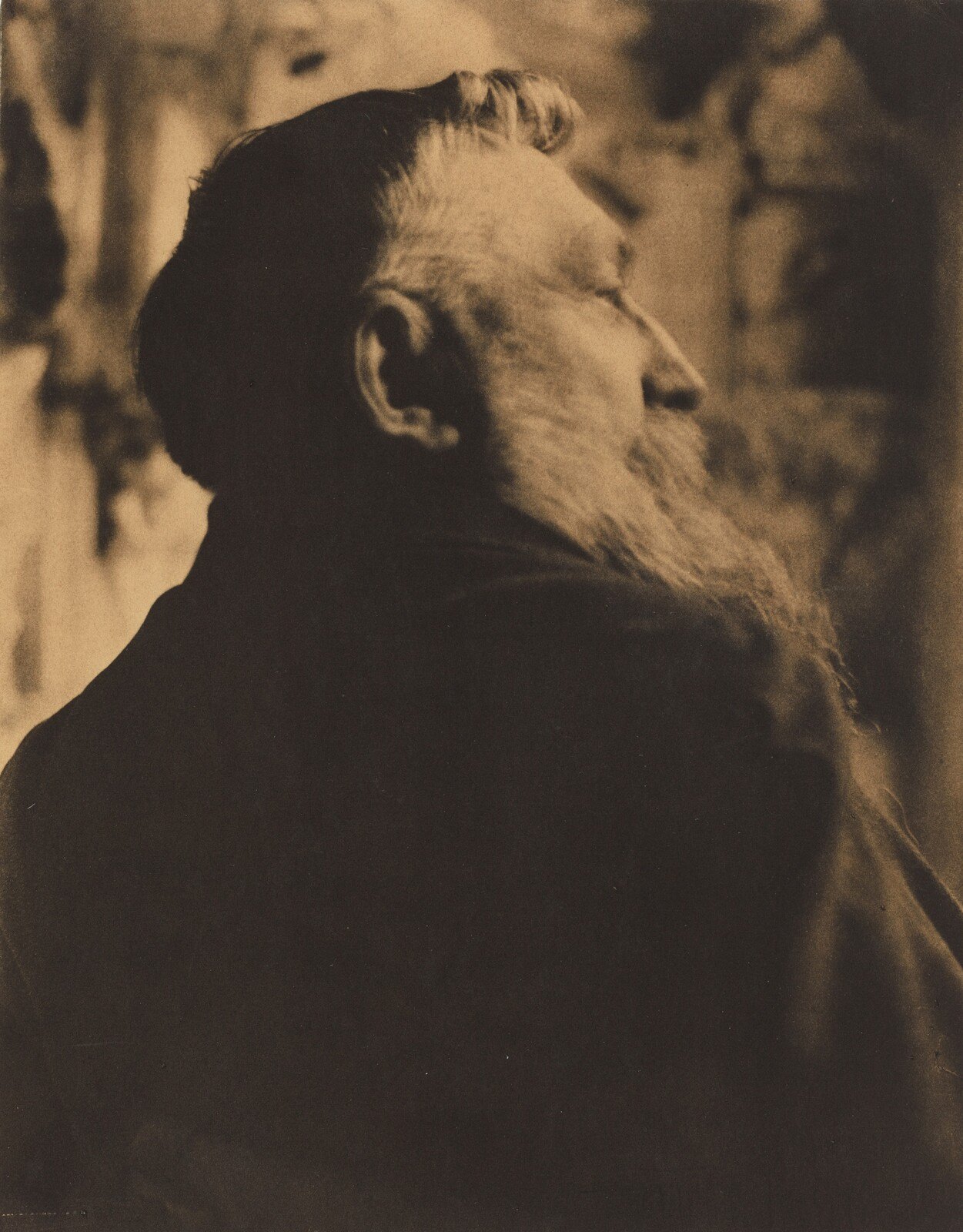
Käsebier’s earlier portrait provides a comparison for how different photographers presented the sculptor. National Gallery of Art, Washington, Patrons’ Permanent Fund, 2008.65.13. Image source. CC0 / Public domain.
Edward Steichen’s Rodin—The Thinker, dated 1902 by the Metropolitan Museum of Art, uses a different arrangement. Steichen combined two negatives to place Rodin between his monument to Victor Hugo and The Thinker. The silhouette of the sculptor’s lowered head participates in a composition shaped around his own work. In the 1914 photograph the lowered head is paired with the book, and its immediate surroundings consist chiefly of changes in background tone. The proximity of the white beard, dark lapel and open page makes the act of looking down legible within a narrow frame. The two photographs give Rodin’s concentration a visible object and use different means to direct the viewer towards it. [1] [3]
Rodin in 1914
The date places the photograph in a year when Rodin’s work took important public forms in France and Britain. Les Cathédrales de France, with an introduction by Charles Morice, appeared in 1914. The Bibliothèque nationale de France records the publication and includes it in its material on Notre-Dame de Paris. The coincidence of dates makes the book a documented part of Rodin’s activity at the time. Its title cannot be established from the leaves seen in the portrait. In the photograph, their effect comes from the way an open page catches more light than the surrounding coat and provides an end point for the downward gaze. [1] [4]
In Britain, Rodin gave eighteen sculptures to the Victoria and Albert Museum after the outbreak of the First World War. The V&A’s account follows the works from an exhibition and temporary storage to their display at the museum. John Lavery’s oil portrait of Rodin, painted the previous year, was displayed alongside the sculptures in 1914. A visitor there could see a representation of the artist in the immediate company of objects he had made. The German archive photograph presents him within a much smaller field of attention. Its close view of the open book and the inclined face gives the viewer a portrait of a sculptor occupied with looking. [1] [5] [6]
What the surviving book can show
The Toledo Museum of Art preserves a copy of Les Cathédrales de France with a rounded spine and a slipcase. Its catalogue describes the illustrations as collotypes, some with white applied through a stencil, and credits Auguste Clot with printing the reproductions. The letterpress text was printed separately. That material distinction matters in a book that brings together Rodin’s observations and his drawings. The printed line is the result of reproducing a sketch. The printed text carries a different kind of record of the buildings he had looked at. The Musée Rodin traces the notes, drawings and sketches back to visits beginning in the late 1870s. [7] [8]
Those details are available from a copy that can be studied as a book. In the portrait the open pages are visible mainly at an angle, so the identity of the volume remains open. The 1914 publication supplies a documented example of how Rodin’s scrutiny of architecture reached readers, while the photograph preserves the pose of someone looking closely at a page. [1] [7] [8]
Rodin artworks directory
Discussion
Look again at the images and ideas explored in Portrait of Auguste Rodin, 1914. These editorial prompts invite your observations.
Reader Insights
After reading “The face and the book”, what detail would you look for in the object or image?
What extra evidence would help you distinguish the artist’s choices from the effects of material, viewpoint or later display?
Join the Conversation
Share a detail, comparison or question about Portrait of Auguste Rodin, 1914 below.
References
- German Federal Archives. Auguste Rodin, Bild 183-R38535. View source.
- Musée Rodin. Rodin and photography. View source.
- Metropolitan Museum of Art. Edward Steichen, Rodin—The Thinker, 2005.100.289. View source.
- Bibliothèque nationale de France. La cathédrale Notre-Dame de Paris à la BnF. View source.
- Victoria and Albert Museum. The Rodin Gift to the V&A. View source.
- Victoria and Albert Museum. The Rodin gift of 1914, part four. View source.
- Toledo Museum of Art. Les cathédrales de France, 1984.1014. View source.
- Musée Rodin. L’Enfer selon Rodin, exhibition dossier, section on architecture. View source.

 Auguste Rodin.jpg)





