


 by Tom Gurney
Tom Gurney BSc (Hons) is an art history expert with over 20 years experience
Published on June 19, 2020 / Updated on November 18, 2026
Email: tomgurney1@gmail.com / Phone: +44 7429 011000
Two Women - One Helping the Other to Put on a Garment
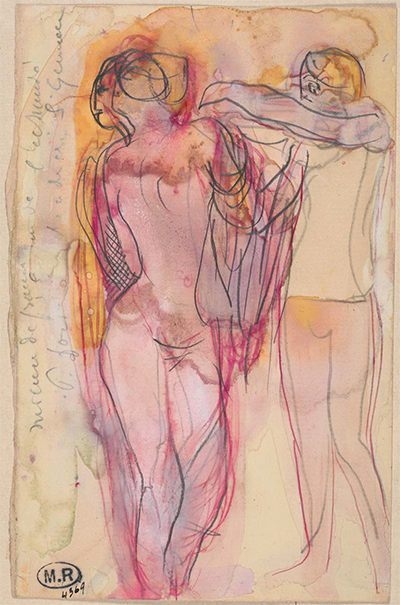
Two women stand close together in this drawing by Auguste Rodin. The woman at the right reaches across the space between them, towards the shoulders of the other. Dark loops and pink wash gather where the gesture meets the central figure. The title describes an act of dressing, and much of the drawing’s movement comes from the way Rodin follows the garment as it passes between the figures. A separate drawing in the Musée Rodin treats the same action. The image on this page corresponds to the reproduction indexed under French national catalogue reference 50440002883. [1] [2]
The reach between the figures
The figure on the left stands nearly at the centre of the narrow sheet. Her head tilts back and turns towards the left edge, away from the other woman. The hair is indicated by several looping outlines that run close together and then open out above the neck. Colour collects at the top of this shape, with yellow and orange around darker strokes. Below it, a pale opening at the neck meets a heavier area of pink. The direction of the head draws the eye towards the margin even as the marks around the shoulders bring it back towards the second figure. [1]
The figure at the right remains more upright. Her head sits above a long, pale area that gives the body relatively little definition. The reach of her arms is much more emphatic. A broad horizontal form extends from near her face to the other woman’s shoulder. Its lower edge contains several lines close together, and the lines dip where the two bodies approach. A viewer can recognise the direction of the gesture before deciding which marks belong to the arms and which describe the cloth. The drawing is clearest about the relationship between people at the place where it is least precise about individual outlines. [1]
Below that point the lines fall in a different direction. Long strokes run beside the nearer woman’s upper arm, then taper below the elbow. Some curve back towards the shoulder and others cross the pink pigment below it. Here the cloth seems caught in the middle of settling around the body. On the opposite side a much narrower pattern of lines interrupts the outline of the upper arm. These two passages give the viewer a sense of where the garment is held and where it already hangs under its own weight. [1]
Separating line and colour
The upper section is the most crowded part of the image. Yellow appears around both heads and across parts of the sheet between them. The pink is strongest along the front figure and towards the middle, where it makes a broad, uneven shape behind the dark strokes. Several dark lines pass through areas in which the wash changes abruptly in strength. Those edges can be followed independently of the drawn contour. The pigment carries the action outward into the paper beside the figures, while the closer dark strokes bring it back to an arm or a shoulder. [1]
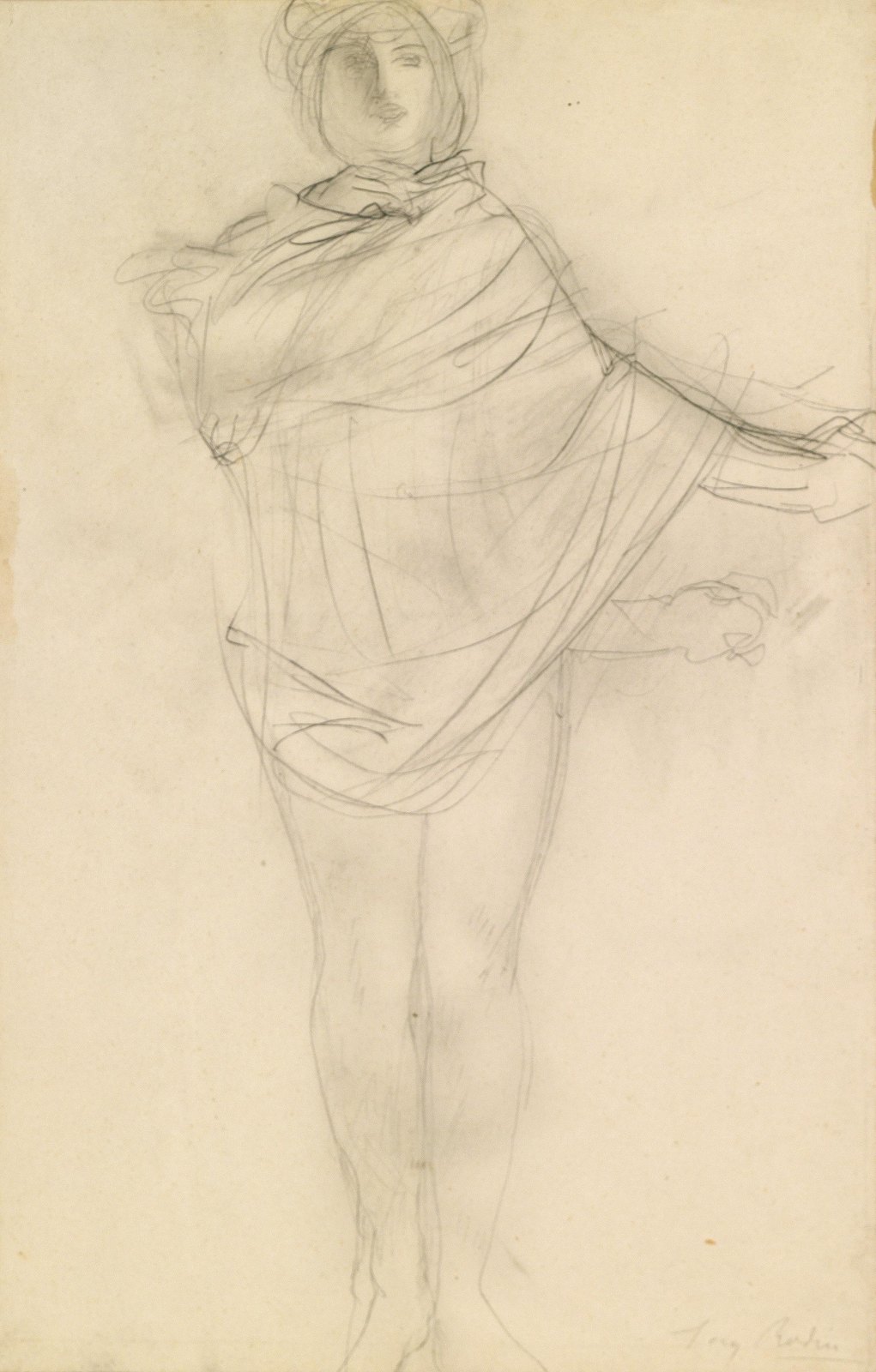
This separate graphite drawing isolates the lines Rodin used for cloth in a single figure. Auguste Rodin, via Wikimedia Commons. Image source. Public domain. Resized for the web.
The lower part of the drawing gives the eye a longer distance over which to follow the same distinction. The standing woman’s legs are described by pale red lines nearer the right edge. The line of one shin is repeated close beside itself, making a thin band through a mostly uncoloured area. The legs of the foreground figure are surrounded by more pink, and several darker strokes converge near the knees. The choice leaves the two bodies with unequal visual weight. The woman whose arms carry the action at the top becomes less prominent as the eye moves down the page. [1]
At the left edge there are also traces of writing. The words sit almost at right angles to the direction of the figures and follow a narrow margin in the wash. The lower-left corner shows an oval museum stamp. Both are visible in the legacy reproduction and in the image associated with the French catalogue reference. The writing is faint enough that a complete transcription would require a clearer view. Its location remains useful when distinguishing the sheet from drawings that use a similar motif. [1]
Watch Rodin’s sculpture up close
Five films explore Rodin’s sculpture, from his use of classical models and the figures on his monumental doorway to the work of his studio.
Auguste Rodin – Challenging Beauty
Six sculptures show how Rodin adapted classical models.
Watch on YouTubeRodin’s drawings of dressing
The Musée Rodin reproduces a detail of Femme aidant une autre femme à passer un vêtement, D.04300, in material for its study day on the roles of people in an artist’s workshop. The museum dates that related work to about 1890 and records graphite, ink and watercolour on paper. In its published detail the foreground woman’s face is turned down and the angle of the lifted arm differs from the picture on this page. The two images indicate how a similar action could yield a different division of space as Rodin changed the angle of a head or the direction of an arm. [1] [2]
The drawing reproduced here also differs from the Musée Rodin sheets D.04958 and D.04959, which the museum describes as showing a seated nude alongside a clothed standing woman. The museum links those sheets with a cut-paper version, D.05216. The pairing is comparable, but here the two bodies extend the height of the page in standing poses. Their closeness comes principally from the reach at shoulder level. That is where the hands and fabric are most difficult to separate and where the title provides the most help in following the action. [1] [3] [4] [5]
The Musée Rodin’s exhibition on drawing and cutting out describes a practice in which drawings from life could be traced, coloured and reworked. The lines in this image give a sense of the possibilities of that work on paper. Several paths remain legible around the shoulders. The curved marks below the extended arms collect in a taper, with more open paper between the strands as they descend. Above them, the colour falls over them without reducing them to a single boundary. Toward the lower edge, the contours become sparse enough for the stance of each woman to be read on its own. Starting from those lines and looking back up, the viewer can see how Rodin delays the moment when the two figures come together in the act of dressing. [1] [6]
Dressing and undressing on a single sheet
On both sides of another sheet in the Musée Rodin, clothing gives Rodin a way to vary the action of the arms. The museum describes a woman facing out and raising her arms to take off a garment on the front, and a seated woman in profile with clothing on her shoulders on the back. The two subjects can be seen only by turning the sheet. In the paired drawing reproduced here, two sets of arms are present at once. The direction of the hands matters because the cloth is being handled by someone standing behind the person who wears it. The double-sided sheet shows how much of the action Rodin could convey through one body alone and gives a comparison for the extra crossings of line produced when a second person assists. [1] [7]
Rodin artworks directory
Discussion
Look again at the images and ideas explored in Two Women - One Helping the Other to Put on a Garment. These editorial prompts invite your observations.
Reader Insights
After reading “The reach between the figures”, what detail would you look for in the object or image?
What extra evidence would help you distinguish the artist’s choices from the effects of material, viewpoint or later display?
Join the Conversation
Share a detail, comparison or question about Two Women - One Helping the Other to Put on a Garment below.
References
- The Last Museum. Reproduction indexed from French national catalogue reference 50440002883. View source.
- Musée Rodin. La part de l’autre, with a detail of D.04300. View source.
- Musée Rodin. Deux femmes, l’une assise et nue, l’autre vêtue et debout, D.04958. View source.
- Musée Rodin. Deux femmes, l’une assise et nue, l’autre vêtue et debout, D.04959. View source.
- Musée Rodin. Femme drapée auprès d’une femme nue assise, D.05216. View source.
- Musée Rodin. Dessiner, découper. View source.
- Musée Rodin. Standing woman removing a garment and seated woman with a garment over her shoulders. View source.

 Auguste Rodin.jpg)





