


 Auguste Rodin.jpg)
 by Tom Gurney
Tom Gurney BSc (Hons) is an art history expert with over 20 years experience
Published on June 19, 2020 / Updated on November 18, 2026
Email: tomgurney1@gmail.com / Phone: +44 7429 011000
The Temptation of St Anthony (La Tentation de Saint Antoine)
A nude woman arches across the back of a man who has drawn himself down into a heavy robe in Auguste Rodin’s The Temptation of Saint Anthony. Rodin sets both figures on an irregular block of marble. The woman’s body catches the light along its length, while the saint’s face is concealed from some angles by the cloth and the cross he clasps. The Musée des Beaux-Arts de Lyon dates its marble to before 1900 and records buying it from Rodin in 1903. The interaction between the figures can be followed around the block, where the depth of the carving changes what each body seems to be doing. [1] [2]
Two directions of movement
The legacy photographs show the sculpture from the end towards which the woman’s head hangs. Her body extends back from it across the top of the work. A bent arm rises near the head, and the curve through the middle of her body continues towards the far side. This creates a high, rounded outline above the stone. The face turns partly away from the light and the hair drops towards the surface below. That downward fall gives the viewer a way to see the angle of the head even where its features are difficult to distinguish. [1] [2]
Anthony’s robe takes a much longer route down to the base. It spreads across the stone below the woman as a broad sloping shape with ridges running through it. Where the highest folds overlap, they give some indication of the way his limbs are drawn in. The lower folds dissolve gradually into the rock. A short angular projection near his head has a different outline from the cloth and hair around it. The Lyon museum identifies the cross as the object he holds close to his face. The figure’s effort can be read in the way the dress gathers around that point. [1] [2]
The national collections photographs show another side of the group. From there, the woman’s body stretches across the saint more fully in profile. The edge of the hood and a gathering of cloth lie beneath her, and the slope of the robe seen in the legacy view is harder to pick out. It becomes possible to follow the direction of her body from the forward curve of the torso to the lower limbs. A viewer moving between those positions gradually sees more of her gesture and of the way the saint braces himself. The angle of the photograph therefore affects the apparent balance between the two. [1] [2]
How the marble carries the action
The exposed side of the block is broad and uneven. In the legacy view, the top surface is stippled by short marks that produce a large number of tiny shadows. Over the folds of the saint’s robe the marks have a more regular direction. They follow the slope of the material and make the form easier to read where the marble remains pale under direct light. On the woman the smoother surface lets the light travel for longer across each curve. The museum reads these degrees of finish as part of the contrast between the saint and the apparition. [1] [3]
The detail photograph is particularly clear where the robe meets the base. At some points a fold projects enough to cast a narrow shadow. Farther down, the difference between garment and ground is chiefly a change in texture. The nude appears above those transitions, with a continuous outline against the dark background. A smooth surface at the top of the block draws attention where the irregular base would otherwise carry the eye along its length. These changes in handling give an impression of different weights within a stone group that has to support itself as a single mass. [1] [2] [3]
The woman’s position also depends on where the two figures meet. From the angle of the legacy photograph, the overlap below her torso makes it difficult to determine where her weight falls. Moving around the work makes the extent of the saint’s bent shoulders more apparent. Her body can seem to float clear of his garment at one point and to bear down on it at another. The stone that joins them has enough definition to hold the bodies together, while the shift between smooth and rough surfaces gives each figure its own character. [1] [2] [3]
Watch Rodin’s sculpture up close
Five films explore Rodin’s sculpture, from his use of classical models and the figures on his monumental doorway to the work of his studio.
Auguste Rodin – Challenging Beauty
Six sculptures show how Rodin adapted classical models.
Watch on YouTubeThe saint and his vision
Saint Anthony was a hermit whose temptations were retold in accounts of his life in the desert. The Lyon museum relates Rodin’s sculpture to Gustave Flaubert’s La Tentation de saint Antoine, published in 1874. The marble gives one woman the physical presence of a vision and leaves the saint’s response to the position of his body. He draws his head and hands close to the cross beneath a hood. The position of the woman leaves more of her figure exposed. Her movement carries across the stone as his gathers towards a point close to the ground. [1] [2] [4]
The subject also helps explain why the saint can be difficult to see from the same place as the woman. He has pulled himself into a pose that hides most of his body. The curve above him stays open to the light, creating an imbalance in what the viewer can recognise first. Once the cross and hood have come into view, the uninterrupted surface of the nude takes on a different role. Her body is seen in relation to the effort required to resist it. [1] [3]
The Lyon marble
The French national collections record identifies the Lyon marble as B 661 and describes a signature on the right of the base. Its exhibition history includes Rodin’s show at the Pavillon de l’Alma in 1900 and two exhibitions in 1902. The Lyon museum acquired the work directly from him the following year, making it the first Rodin sculpture it purchased. The catalogue photographs and the legacy images agree in the profile of the woman, the folds beside the saint’s head and the form of the block. The latter two files show the same viewpoint at different resolutions. Together with the museum’s other views, they make the relation between the figures and their support easier to see. [1] [2] [5]
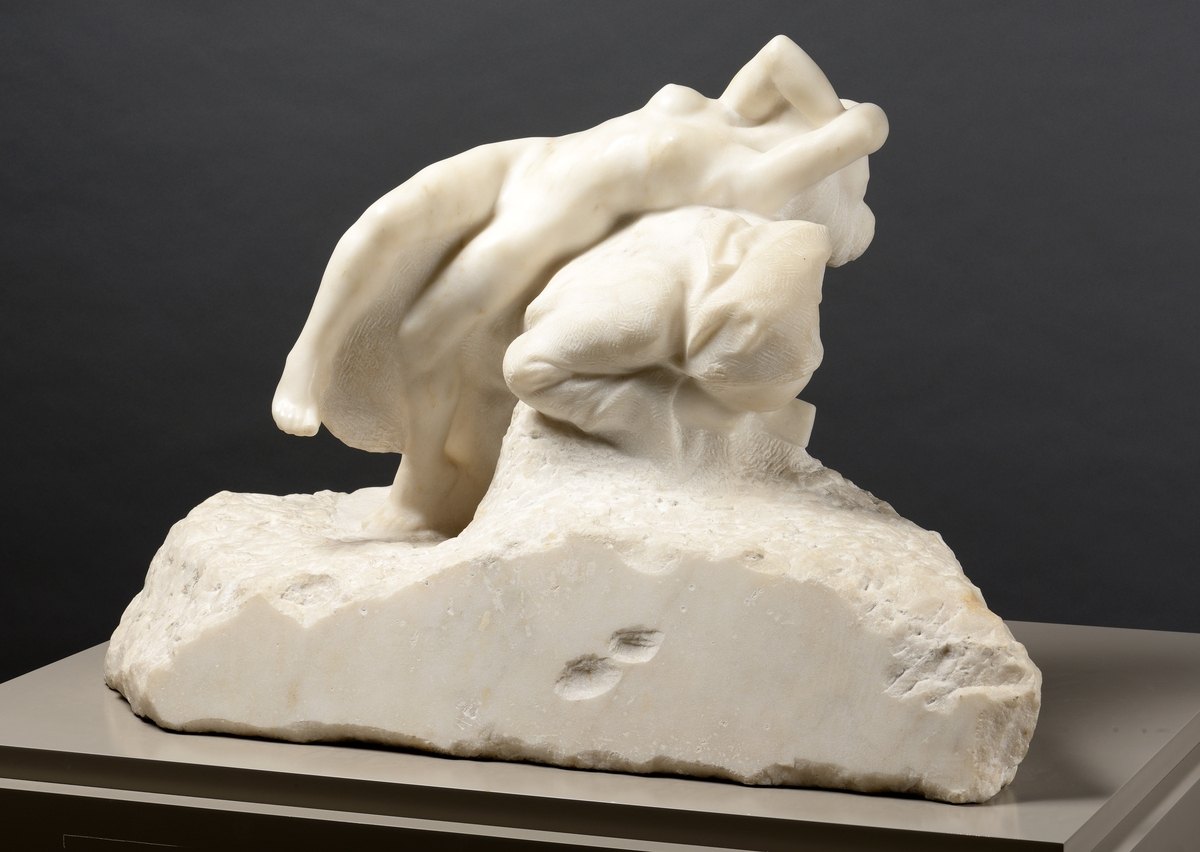
A museum photograph documents the Lyon marble, inventory B 661, as a whole. Photograph by Alain Basset, via Wikimedia Commons. Image source. CC BY-SA 3.0. Resized for the web.
From the Pavillon de l’Alma to Lyon
The French national inventory records the marble in Rodin’s 1900 exhibition at the Pavillon de l’Alma and in exhibitions in Paris and Berlin in 1902. Cécile Goldscheider, writing in the Lyon museum’s bulletin, identifies it as the first Rodin purchase the city decided on in 1903. Its passage from the sculptor’s own exhibition to a municipal collection gave the public several settings in which to encounter the same marble. The contrast of polished flesh and rough stone could first be seen in an exhibition devoted to Rodin’s work. In Lyon it could also be considered alongside sculpture by other artists working in marble. [2] [6]
Goldscheider describes the carving as work of high quality and leaves the practitioner unnamed. The museum’s records establish Rodin’s responsibility for the sculpture and trace its exhibition and purchase. The surface preserves the visible decisions about where to polish and where to leave the stone rough. Neither the catalogue itinerary nor those effects identifies the person who worked the block. [1] [2] [6]
Rodin artworks directory
Discussion
Look again at the images and ideas explored in The Temptation of St Anthony (La Tentation de Saint Antoine). These editorial prompts invite your observations.
Reader Insights
After reading “Two directions of movement”, what detail would you look for in the object or image?
What extra evidence would help you distinguish the artist’s choices from the effects of material, viewpoint or later display?
Join the Conversation
Share a detail, comparison or question about The Temptation of St Anthony (La Tentation de Saint Antoine) below.
References
- Musée des Beaux-Arts de Lyon. The Temptation of St. Anthony. View source.
- French Ministry of Culture, Joconde. La Tentation de saint Antoine, B 661. View source.
- Musée des Beaux-Arts de Lyon. Sculpture and dance education resource. View source.
- Musée des Beaux-Arts de Lyon. Sculpture guide. View source.
- Musée des Beaux-Arts de Lyon. Collection masterpieces. View source.
- Cécile Goldscheider. La sculpture de Rodin au Musée des Beaux-Arts de Lyon, museum bulletin, 1983. View source.
 in Detail Auguste Rodin.jpg)

 Auguste Rodin.jpg)





